Kamis, 01 Agustus 2019

Why the Blue Jays moved on from Aaron Sanchez’s quest for 2016 form - Sportsnet.ca

TORONTO — When it comes to the incomplete career of Aaron Sanchez, the unanswerable question is what his remarkable 2016 season will look like when all is said and done. Was that a preview of how well his undeniable stuff would play as a front-line starter if only he was fully healthy? Or, was it the exception to the rule for a hard-throwing-yet-erratic right-hander destined for the bullpen, one who has walked at least four batters per nine innings in every professional season he’s pitched save for 2016?

In trading Sanchez now — as part of a trade deadline package for Houston Astros outfielder Derek Fisher, who, by the way, will play his next two months of baseball under an unfairly intense microscope from an aggrieved fanbase — the Toronto Blue Jays front office have told you exactly what they believe the answer to that question will be.

If there was legitimate confidence within the organization that he could soon pitch again as he did in 2016, that with a tweak here and an adjustment there he’d suddenly become the guy who won an American League ERA title again, Sanchez’s Blue Jays tenure wouldn’t have ended Wednesday. The Blue Jays wouldn’t have sold so low.

But the nearly three seasons that have followed all strongly suggest that version of Sanchez isn’t coming back. And the data from his current campaign, a season in which he’s remained healthy enough to make all of his starts for the first time since Barack Obama was U.S. president, indicates matters may be getting worse.

Combine that with the fact his remaining years of club control don’t time with Toronto’s potential return to contention in 2021, and that he’s due a raise this winter on his $3.9-million salary through arbitration — making him a less attractive asset to other teams, particularly if he’s moved to the bullpen — and you end up with Sanchez continuing his quest to rediscover his prior effectiveness with another organization.

That is the cold calculus Toronto’s front office ran. And while Blue Jays fans ought to always appreciate Sanchez’s brilliant all-star season, and should never forget the dominant relief appearances he made for the club during the 2015 playoffs, plus the pair of starts the following post-season, the club’s executives are not concerned with nostalgia. They are tasked with doing what’s best for the organization, damn any outrage. And, particularly when you consider how much the trust level between Sanchez and the team eroded over two seasons lost to frustrating, recurring injuries, it’s easy to see why they made the decision they did.

Of course, the transaction wasn’t about trading Sanchez. It was about acquiring Derek Fisher. But it wasn’t not about trading Sanchez, either. He was actively shopped prior to the Fisher trade, but the only value the industry presented was similar to what Toronto received in return for veteran relievers David Phelps and Daniel Hudson — low-ceiling, fringy prospects on the cusp of their mid-20’s lacking plus tools. Not the younger, high-upside, projectable athletes the Blue Jays covet.

It was packaging Sanchez with the controllable Joe Biagini and his high spin rate curveball that made the trade possible at all. And the inclusion of Cal Stevenson — an intriguing 22-year-old with strong minor-league on-base numbers, impressive contact ability and great makeup who projects as a fourth outfielder — that sealed it. The industry spoke loud and clear in how it regarded Sanchez, whose ERA has been north of a half-dozen since late-June. Teams weren’t lining up to buy low on a distressed asset. They were valuing Sanchez based on how he’s performed over the last 30-plus months.

That Sanchez’s career has arrived at this point is demoralizing for anyone who knows him. You can never fault his passion for what he does, nor can you detract from how intensely he cares for and competes with his teammates. He was a tremendously popular presence in Toronto’s clubhouse throughout his tenure, and as he departs the franchise you won’t hear any of the character concerns that were not-so-quietly whispered about Marcus Stroman when he was traded last week.

And there’s an argument to be made that Sanchez has been the victim of preposterously bad luck and, in some cases, advice. Persistent blister and finger issues derailed his ability to grip and effectively throw a baseball after 2016, and a series of prescribed procedures and remedies failed to correct the problems. Multiple surgeries, endless grip changes, a host of mechanical adjustments, a baffling incident catching his finger in a suitcase — it all conspired to rob him of what could have been an exceptional prime.

In light of all that, and the fact Sanchez is a likeable and good-natured homegrown product who has embraced the country of Canada with open arms since Toronto drafted him in 2010, it’s understandable why many fans were dismayed to see his Blue Jays career end so unceremoniously. But MLB evaluators are not so kind.

Sanchez has been, quite literally, the worst qualified starting pitcher across MLB this season. And even as he has put up better results the last couple weeks, striking out 20 while walking only one over his last three outings, the underlying trends haven’t been encouraging.

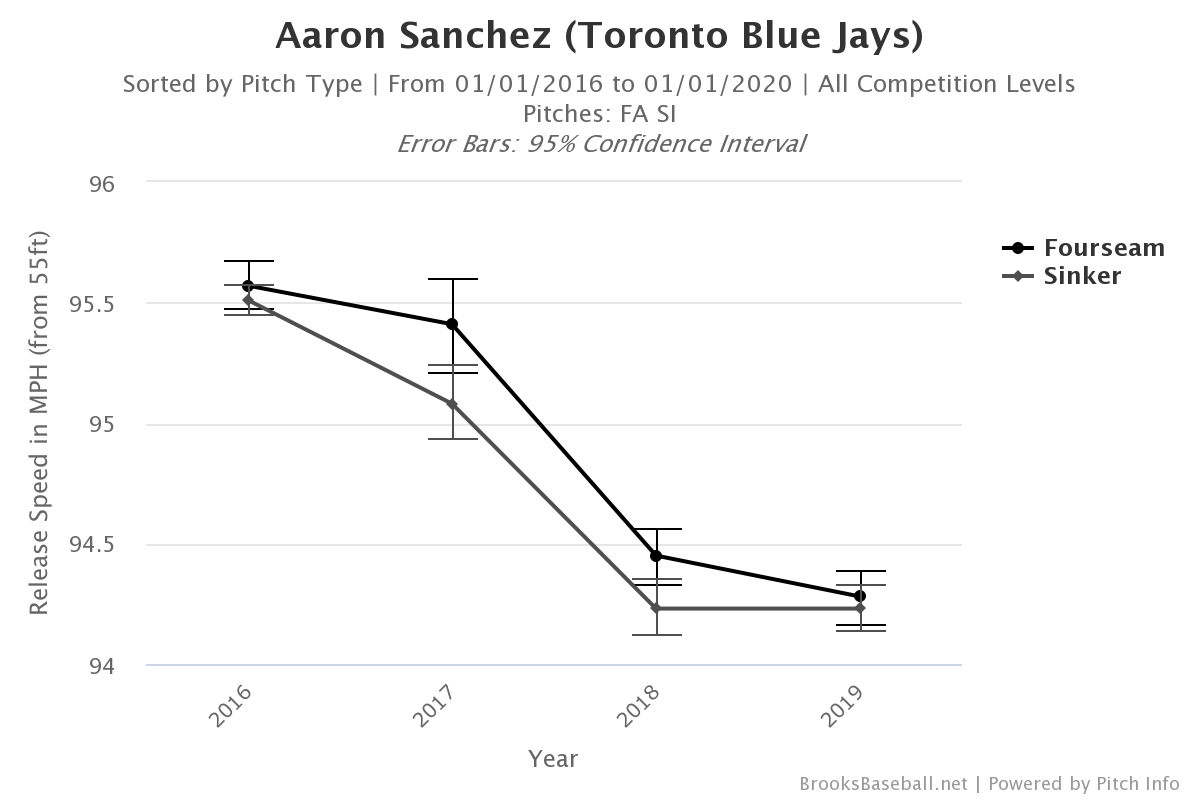
His last time out — when he allowed four runs on six hits over 5.2 innings against the Tampa Bay Rays, striking out 10 — Sanchez’s sinker averaged its lowest velocity of any start this season, while his four-seamer averaged its second-lowest. That’s not what you want to see from a pitcher whose fastball velocity has been diminishing steadily since his first full season as an MLB starter.
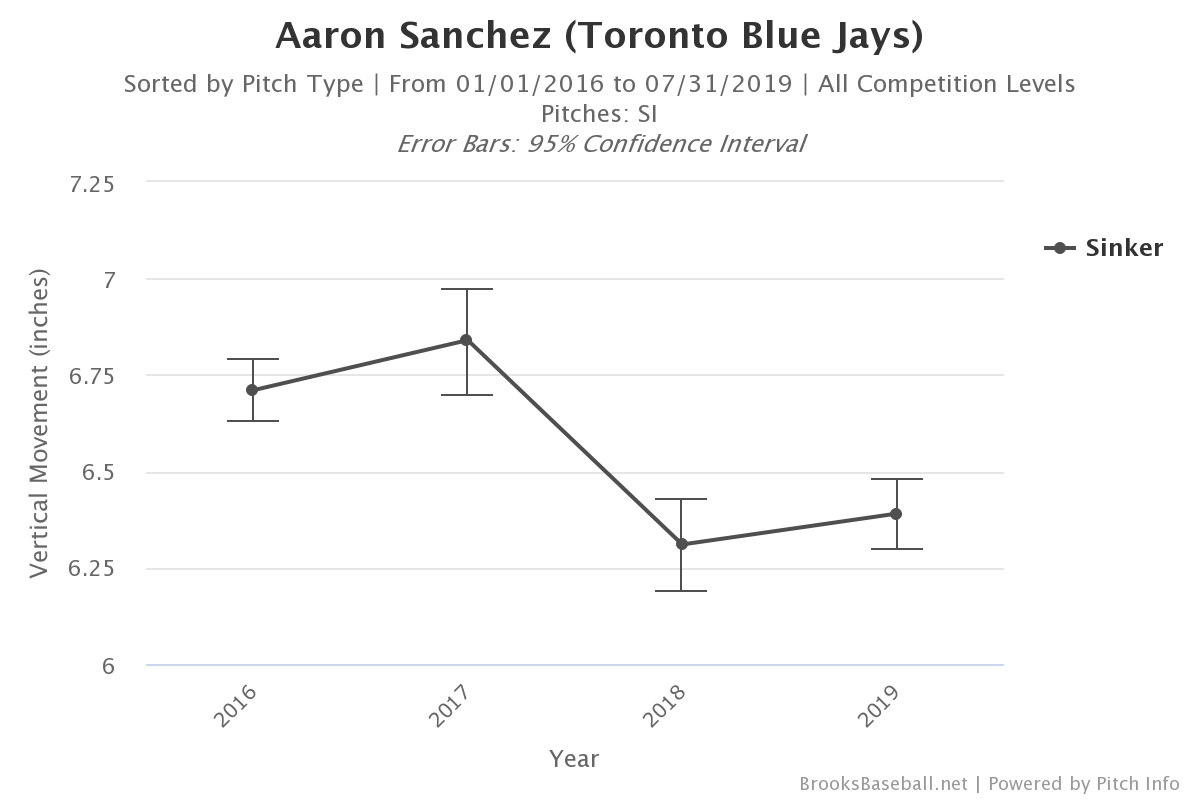
The vertical movement on his sinker was also diminished in that outing, averaging a drop more than an inch less than his season average, and more than an inch-and-a-half less than it featured in 2016. MLB clubs, practically all of them now run by analytically minded front offices, no longer scout the results. They scout the process. And Sanchez’s doesn’t suggest he’s about to turn a corner.
If anything, it affirms why he’s dead last among qualified MLB starters with a 6.07 ERA and 4.71 BB/9. Also, why Sanchez’s 39.2 per cent hard-hit rate is the highest of his career by a mile, nearly 10 points above where it sat during that remarkable 2016 campaign. And for those in the game who believe he’s better suited for a relief role, there’s the fact Sanchez’s velocity has steadily declined by the inning this season, which helps explain why his OPS against goes from .643 his first time through an order to .947 his second and .987 his third.

Of course, none of this means the Blue Jays had to give up on the possibility of Sanchez turning it around. He’s spent much of this season searching for the delivery and feel that allowed him to be so successful in the past after regularly altering his pitch grips and mechanics over the last two seasons while battling injury. It’s not impossible that with health he could suddenly find himself again.

And maybe Houston’s well-regarded R&D personnel can help. Justin Verlander’s career appeared to be on a downward plane when he arrived with the Astros and experienced an all-star resurgence in his mid-30s. Gerrit Cole’s 8.4 K/9 over his first 127 career starts has soared to 12.8 over 55 outings since joining Houston. Wade Miley — Wade Miley! — pitched to a 4.76 ERA between 2015 and 2018, but now has a 3.06 ERA in his first season with the Astros. Whatever the secret pitching sauce is, the Astros appear to have it.

You certainly won’t find anyone rooting against Sanchez thriving in Houston. His now-former teammates, Blue Jays personnel and, admittedly, those who cover the team, would all be thrilled to see the guy from 2016 re-emerge. It would be a nice result for a nice guy. There just aren’t many people betting on it, particularly those in MLB front offices. All we know is that Sanchez has the opportunity to prove them all wrong. And that the question of what 2016 was in his career will be answered someday, one way or another.


from Sports - Latest - Google News https://ift.tt/2Mvjb4B
via IFTTT
August 01, 2019 at 07:17PM

Bo Bichette's 1st career homer powers Blue Jays to sweep of lowly Royals - CBC Sports

Bo Bichette's first career homer helped lead the Toronto Blue Jays to a three-game sweep of the Kansas City Royals.

Bichette's big moment came at the start of the eighth inning against Royals starter Jakob Junis, when his drive cleared the left-center field wall in the 4-1 win on Wednesday. Freddy Galvis also hit a crucial solo shot to center in the seventh that was his 16th homer of the season.

Bichette made his major league debut here Monday.

"After the first game was over, I was able to say, `Okay, my career has started,' and then treat it like any other normal day," Bichette said. "He got me out on two sliders the first two at-bats and I made an adjustment and I hit it really hard."

WATCH | Bichette, Blue Jays sweep away Royals:

Bo Bichette hit his first-career double and home run in Toronto's 4-1 win over the Royals. 1:32

Galvis' homer, which gave the Blue Jays a 2-1 lead, surprised Junis.

"He kind of dove out over the plate to get it and scooped it up and got it in the air," Junis said. "I thought Bubba [Starling] might have a chance on the warning track or something but it just kept carrying out."

Cavan Biggio followed Bichette's homer with a double, ending Junis' outing. Reliever Kevin McCarthy surrendered a run-scoring double to Teoscar Hernandez.

Rookie Jacob Waguespack (2-1) went six innings for his second win in his fourth big-league start. He held the Royals to three hits and one run. Cam Gallagher barely cleared the left-field bullpen fence for his second homer, drilling a 2-2 pitch from Waguespack to open the third inning.

Junis (6-10) was cruising for much of the game, retiring the side on eight pitches each in the second, third and fourth innings. But the Jays got even 1-1 in the sixth as Biggio walked, stole second and scored on Justin Smoak's single.

"The first pitch [of the game] was probably the worst pitch in the seven innings that Junis threw - to Bichette was a fastball kind of high and over the middle of the plate and he hit the double down the line. But after that he was really good," Royals manager Ned Yost said.

Waguespack got exceptional defensive help early. Deep outfield catches by Lourdes Gurriel Jr. in left and Randal Grichuk in center prevented extra-base hits by Jorge Soler in the first inning and Hunter Dozier in the third. Smoak speared Ryan O'Hearn's hot shot to start a double play in the fourth and Gurriel charged in for a shoetop grab of Nicky Lopez's weak liner to end the inning.

"I didn't throw as many strikes as I wanted to but luckily the balls that were hit were at guys," Waguespack said. "The defense did a heck of a job."

Right after his last catch, however, Gurriel left the game with a sore right knee.

"Gurriel was out there making plays and sacrificed his body for me a couple of times," Waguespack said.

Rookie right-hander Justin Shafer worked a perfect ninth for his first career save.


from Sports - Latest - Google News https://ift.tt/2yxGkeF
via IFTTT
August 01, 2019 at 03:22AM

Nearby 'Super-Earth' may be habitable, NASA suggests - Fox News

NASA's Transiting Exoplanet Survey Satellite (TESS) has made several discoveries in recent days, including a planet with three suns and a sun with three planets. But the latest discovery may be the most surprising of all — an alien planet that is potentially capable of supporting life.

A group of astronomers using TESS made the discovery of the GJ 357 star in the Hydra constellation, approximately 31 light-years from Earth, NASA said in a statement. One light-year is the equivalent of 6 trillion miles.

The exoplanet in question, GJ 357 d, is on the outer limits of the star's "habitable zone," which means it likely gets the same amount of energy that Mars gets from the Sun, said the study's co-author, Diana Kossakowski. “If the planet has a dense atmosphere, which will take future studies to determine, it could trap enough heat to warm the planet and allow liquid water on its surface.”

This illustration shows one interpretation of what GJ 357 d may be like. (Credit: NASA's Goddard Space Flight Center/Chris Smith)

This illustration shows one interpretation of what GJ 357 d may be like. (Credit: NASA's Goddard Space Flight Center/Chris Smith)

NASA FINDS THREE ALIEN PLANETS, INCLUDING THE 'MISSING LINK'

“This is exciting, as this is humanity’s first nearby super-Earth that could harbor life — uncovered with help from TESS, our small, mighty mission with a huge reach,” said one of the study's co-authors, Lisa Kaltenegger, in a separate statement.

The government space agency has also posted a video to its YouTube page in conjunction with the discovery.

Assuming no atmosphere, GJ 357 d has an equilibrium temperature of -64 degrees Fahrenheit and is believed to have a mass of 6.1 times that of Earth. It also orbits GJ 357 every 55.7 days. It's unclear what GJ 357 d is comprised of and what its size is. However, if it were rocky, it would likely be between one and two times the size of Earth.

In addition to GJ 357 d, two other exoplanets were discovered, GJ 357 b and GJ 357 c. The exoplanet GJ 357 b is described as a "hot Earth," according to the study's co-author Enric Pallé.

Although GJ 357 b can't host life as we know it, due to its 490 degrees surface temperature, Pallé added astronomers are nonetheless intrigued. GJ 357 b is "the third-nearest transiting exoplanet known to date and one of the best rocky planets we have for measuring the composition of any atmosphere it may possess.”

The other exoplanet, GJ 357 c, orbits GJ 357 every 9.1 days and likely has a surface temperature approaching 260 degrees, NASA added.

Results of the findings were published in the scientific journal Astronomy & Astrophysics.

PLANET NINE MAY EXIST, BUT IT MIGHT BE HIDING BEHIND NEPTUNE

The revelation comes just days after researchers used NASA’s TESS to discover the exoplanet LTT 1445Ab, which has three red suns and a star system, known as "TESS Object of Interest 270," 73 light-years away from Earth.

TESS, which launched in April 2018, replaced the Kepler telescope, which started to malfunction towards the latter part of last year and was eventually retired in October 2018 after discovering more than 2,600 exoplanets, including 18 Earth-sized exoplanets.

In September, the $200 million TESS found its first exoplanet, and in April, it found its first Earth-sized planet.

CLICK HERE TO GET THE FOX NEWS APP

Let's block ads! (Why?)


https://www.foxnews.com/science/super-earth-habitable-nasa

2019-08-01 15:07:30Z
52780342454734

Physicists make graphene discovery that could help develop superconductors - Phys.org

Physicists make graphene discovery that could help develop superconductors
Left: This image, taken with a scanning tunneling microscope, shows a moiré pattern in "magic angle" twisted bilayer graphene. Right: Scanning tunneling charge spectroscopy, a technique invented by Professor Eva Andrei's group, reveals correlated electrons as shown by the alternating positive (blue) and negative (red) charge stripes that formed in the "magic angle" twisted bilayer graphene seen in the image at left.  Credit: Yuhang Jiang/Rutgers University-New Brunswick

When two mesh screens are overlaid, beautiful patterns appear when one screen is offset. These "moiré patterns" have long intrigued artists, scientists and mathematicians and have found applications in printing, fashion and banknotes.

Now, a Rutgers-led team has paved the way to solving one of the most enduring mysteries in physics by discovering that in the presence of a moiré in , electrons organize themselves into stripes, like soldiers in formation.

Their findings, published in the journal Nature, could help in the search for quantum materials, such as superconductors, that would work at room temperature. Such materials would dramatically reduce energy consumption by making and more efficient.

"Our findings provide an essential clue to the mystery connecting a form of graphene, called twisted bilayer graphene, to superconductors that could work at ," said senior author Eva Y. Andrei, Board of Governors professor in the Department of Physics and Astronomy in the School of Arts and Sciences at Rutgers University–New Brunswick.

Graphene—an atomically thin layer of the graphite used in pencils—is a mesh made of carbon atoms that looks like a honeycomb. It's a great conductor of electricity and much stronger than steel.

Physicists make graphene discovery that could help develop superconductors
Schematics of a moiré pattern in twisted bilayer graphene. Credit: Eva Andrei/Rutgers University-New Brunswick

The Rutgers-led team studied twisted bilayer graphene, created by superimposing two layers of graphene and slightly misaligning them. This creates a "twist angle" that results in a moiré pattern which changes rapidly when the twist angle changes.

In 2010, Andrei's team discovered that in addition to being pretty, moiré patterns formed with twisted bilayer graphene have a dramatic effect on the electronic properties of the material. This is because the moiré pattern slows down the electrons that conduct electricity in graphene and zip past each other at great speeds.

At a twist angle of about 1.1 degrees—the so-called magic angle—these electrons come to an almost dead stop. The sluggish electrons start seeing each other and interact with their neighbors to move in lock-step. As a result, the material acquires amazing properties such as superconductivity or magnetism.

Using a technique invented by Andrei's group to study twisted , the team discovered a state where the electrons organize themselves into stripes that are robust and difficult to break.

"Our team found a close resemblance between this feature and similar observations in high-temperature superconductors, providing new evidence of the deep link underlying these systems and opening the way to unraveling their enduring mystery," Andrei said.


Explore further

Experiments explore the mysteries of 'magic' angle superconductors

More information: Yuhang Jiang et al. Charge-order and broken rotational symmetry in magic angle twisted bilayer graphene, Nature (2019). DOI: 10.1038/s41586-019-1460-4
Provided by Rutgers University

Citation: Physicists make graphene discovery that could help develop superconductors (2019, August 1) retrieved 1 August 2019 from https://phys.org/news/2019-08-physicists-graphene-discovery-superconductors.html

This document is subject to copyright. Apart from any fair dealing for the purpose of private study or research, no part may be reproduced without the written permission. The content is provided for information purposes only.

Let's block ads! (Why?)


https://phys.org/news/2019-08-physicists-graphene-discovery-superconductors.html

2019-08-01 13:35:08Z
CAIiEBeqdqLjI-JfjhZJvJ6tqVYqFwgEKg8IACoHCAowpbDpAzCm_hwwj9kp

Flight by Light: Mission accomplished for LightSail 2 - Phys.org

LightSail 2 is sending home new pictures of Earth
LightSail 2 captured this image of Earth on July 7th. It’s looking at the Caribbean Sea towards Central America, with north roughly at the top. The blue-green color of the ocean around the Bahamas can be seen at the picture’s 1:00 position. A lens flare is visible in the lower right. Credit: The Planetary Society

Mission accomplished: the Planetary Society announced Wednesday that its LightSail 2 spacecraft, which was launched last month, had successfully raised its orbit using only the power of photons from the Sun.

The team behind the $7 million crowd-funded venture said they had demonstrated a proof of concept for a new form of propulsion that could one day transform by doing away with the need for expensive rockets and fuel.

"In the past four days the spacecraft has raised its apogee, or orbital high point, by about 1.7 kilometers (one mile) attributable to solar sailing," said Bruce Betts, LightSail 2 program manager.

That makes it the first spacecraft to use solar sailing for propulsion in Earth , and the second-ever solar sail spacecraft to successfully fly, following Japan's IKAROS, which launched in 2010.

"This technology enables us to take things to extraordinary destinations in the solar system, and maybe even beyond, in a way that's never been possible because you don't need fuel and you don't need all the systems to control fuel," said Bill Nye, the chief executive of the Planetary Society.

He added he would like to see the technology applied to missions searching for life on Mars, Jupiter's moon Europa, and Saturn's moon Titan, and "solar sails could enable you to lower the cost of these missions."

Another application could be in maintaining a probe at a stationary point in space, such as a telescope that looks out for asteroids in the vicinity of Earth, or a satellite that needs to be fixed in a stationary orbit above the North Pole.

The idea of solar sailing was first theorized in the 1600s by Johannes Kepler, who wrote that sails and ships "could be adapted to heavenly breezes."

LightSail 2 puts that into practice via a sail made from Mylar that unfurls to a size of 32 square meters (yards).

As packets of light energy known as photons bounce off the sail, they transfer their momentum in the opposite direction, pushing the vessel along with a thrust that is tiny but unlimited.

With no friction in the near-vacuum of space, the vessel will eventually achieve incredibly .

The parallels to ocean don't stop there: as it flies to the Sun, the sail orients itself edge-on, effectively turning off its thrust. When flying away from the Sun, the sail turns broadside to the photons, getting a slight push.

LightSail 2, which is controlled autonomously via software, does not have the precision to maintain a circular orbit.

Therefore as its apogee rises, its perigee, or orbital low point, decreases, exposing it to atmospheric drag that will overcome the thrust from . LightSail 2 will continue to orbit for about a year before falling back into Earth's atmosphere.


Explore further

LightSail 2 spacecraft successfully demonstrates flight by light

© 2019 AFP

Citation: Flight by Light: Mission accomplished for LightSail 2 (2019, August 1) retrieved 1 August 2019 from https://phys.org/news/2019-08-flight-mission-lightsail.html

This document is subject to copyright. Apart from any fair dealing for the purpose of private study or research, no part may be reproduced without the written permission. The content is provided for information purposes only.

Let's block ads! (Why?)


https://phys.org/news/2019-08-flight-mission-lightsail.html

2019-08-01 10:28:55Z
CAIiEKqDV3jPJXqpoHzJznIaXIcqFwgEKg8IACoHCAowpbDpAzCm_hwwj9kp

LightSail 2 spacecraft successfully demonstrates flight by light - Phys.Org

LightSail 2 spacecraft successfully demonstrates flight by light
Credit: The Planetary Society

Years of computer simulations. Countless ground tests. They've all led up to now. The Planetary Society's crowdfunded LightSail 2 spacecraft is successfully raising its orbit solely on the power of sunlight.

Since unfurling the spacecraft's silver solar sail last week, mission managers have been optimizing the way the spacecraft orients itself during . After a few tweaks, LightSail 2 began raising its orbit around the Earth. In the past 4 days, the spacecraft has raised its orbital high point, or apogee, by about 2 kilometers. The perigee, or low point of its orbit, has dropped by a similar amount, which is consistent with pre-flight expectations for the effects of atmospheric drag on the spacecraft. The mission team has confirmed the apogee increase can only be attributed to solar , meaning LightSail 2 has successfully completed its primary goal of demonstrating flight by light for CubeSats.

"We're thrilled to announce mission success for LightSail 2," said LightSail program manager and Planetary Society chief scientist Bruce Betts. "Our criteria was to demonstrate controlled solar sailing in a CubeSat by changing the spacecraft's orbit using only the light pressure of the Sun, something that's never been done before. I'm enormously proud of this team. It's been a long road and we did it."

LightSail 2 spacecraft successfully demonstrates flight by light
Credit: The Planetary Society / Data provided by NXTRAC

The milestone makes LightSail 2 the first spacecraft to use solar sailing for propulsion in Earth orbit, the first small spacecraft to demonstrate solar sailing, and just the second-ever solar sail spacecraft to successfully fly, following Japan's IKAROS, which launched in 2010. LightSail 2 is also the first crowdfunded spacecraft to successfully demonstrate a new form of propulsion.

"For The Planetary Society, this moment has been decades in the making," said Planetary Society CEO Bill Nye. "Carl Sagan talked about solar sailing when I was in his class in 1977. But the idea goes back at least to 1607, when Johannes Kepler noticed that comet tails must be created by energy from the Sun. The LightSail 2 mission is a game-changer for spaceflight and advancing ."

On Monday, LightSail 2 sent home a new full-resolution image captured by its camera during solar sail deployment. The perspective is opposite to last week's full-resolution image and shows the sail more fully deployed. LightSail 2's aluminized Mylar sail shines against the blackness of space, with the Sun peeking through near a sail boom.

LightSail 2 spacecraft successfully demonstrates flight by light
Credit: The Planetary Society

The mission team will continue raising LightSail 2's orbit for roughly a month, until the perigee decreases to the point where atmospheric drag overcomes the thrust from solar sailing. During the orbit-raising period, the team will continue optimizing the performance of the solar sail.

"We've been working since sail deployment to refine the way the spacecraft tracks the Sun," said LightSail 2 project manager Dave Spencer. "The team has done a great job getting us to the point where we can declare mission success. Moving ahead, we're going to continue working to tune the sail control performance and see how much we can raise apogee over time."

One such refinement involves LightSail 2's single momentum wheel, which rotates the spacecraft broadside and then edge-on to the Sun each orbit to turn the thrust from solar sailing on and off. Momentum wheels can "saturate," hitting predefined , after which they are no longer effective at rotating the spacecraft. Most spacecraft use chemical thrusters to desaturate momentum wheels; LightSail 2 relies on electromagnetic torque rods, which orient the spacecraft by pushing against Earth's .

LightSail 2's momentum wheel currently reaches its saturation limit a couple of times per day, and desaturating the wheel temporarily takes the out of its proper orientation for solar sailing. The mission team already applied a software update that increased the time between saturation events, and is also working to automate the desaturation process. Both refinements should result in improved solar sailing performance.

LightSail 2 spacecraft successfully demonstrates flight by light
Credit: The Planetary Society

Explore further

LightSail 2 is sending home new pictures of Earth

Provided by The Planetary Society

Citation: LightSail 2 spacecraft successfully demonstrates flight by light (2019, August 1) retrieved 1 August 2019 from https://phys.org/news/2019-08-lightsail-spacecraft-successfully-flight.html

This document is subject to copyright. Apart from any fair dealing for the purpose of private study or research, no part may be reproduced without the written permission. The content is provided for information purposes only.

Let's block ads! (Why?)


https://phys.org/news/2019-08-lightsail-spacecraft-successfully-flight.html

2019-08-01 06:45:43Z
CBMiS2h0dHBzOi8vcGh5cy5vcmcvbmV3cy8yMDE5LTA4LWxpZ2h0c2FpbC1zcGFjZWNyYWZ0LXN1Y2Nlc3NmdWxseS1mbGlnaHQuaHRtbNIBSmh0dHBzOi8vcGh5cy5vcmcvbmV3cy8yMDE5LTA4LWxpZ2h0c2FpbC1zcGFjZWNyYWZ0LXN1Y2Nlc3NmdWxseS1mbGlnaHQuYW1w

Blue Jays' quest for depth leads them to sell low on Sanchez - TSN

Columnist image

KANSAS CITY — Ross Atkins’ exhaustive hunt for depth continues.

This time, however, it came at the expense of upside and an arm that has shown a sky-high ceiling in the past, even if that feels like eons ago.

Sure, Aaron Sanchez has never been able to replicate his fine 2016 season and has generally looked a broken pitcher — both physically and mechanically — for three seasons now, but the Toronto Blue Jays’ ability to continually sell low on once-valuable assets has become stunning.

That’s exactly what happened at Wednesday’s Major League Baseball trade deadline when the Jays sent the 27-year-old right-hander, serviceable reliever Joe Biagini, and High-A outfield prospect Cal Stevenson to the Houston Astros in exchange for a single asset, soon-to-be 26-year-old outfielder Derek Fisher.

The biggest need in the organization is pitching.

That is quite clear.

Atkins has continually mentioned his quest for pitching, and he reiterated that Wednesday, shortly after trading two of them.

“(In) the off-season, we will be extremely driven to acquire any potential pitching that we can,” Atkins said.

Then what’s the rush to deal Sanchez, and, to a lesser extent, Biagini, a reliever with a career-best swing-and-miss rate and controllable through 2022?

Especially for an outfielder who’s been summoned by the Astros from Triple-A in three consecutive seasons, and failed to perform, putting up a .201/.282/.367 slash line in 312 plate appearances.

Nobody is closing the book on the lefty-swinging Fisher.

There’s an intriguing blend of power, speed and on-base ability, evidenced by the .860 OPS he’s posted in the minors since being taken with the 37th overall pick in the 2014 draft.

But with another year of team control to go for Sanchez, the question is, why now?

Why not hold for the time being, see how Sanchez throws over the final two months of the season, and then either reboot him in the rotation next spring or let him reinvent himself as a high-leverage reliever?

“Of course, we considered that,” Atkins said of holding onto Sanchez and trying to find a fix. “It really comes down to how much we valued Derek Fisher and how excited we are about him.”

Atkins on Sanchez trade: Fisher's upside was too much to turn away from

The Blue Jays traded Aaron Sanchez, Joe Biagini and prospect Cal Stevenson to the Astros for Derek Fisher, a 25-year old outfielder performing well in AAA. Toronto's general manager Ross Atkins discusses the deal and the excitement with Fisher's upside.

It runs much deeper than that.

Internally, the Blue Jays weren’t convinced Sanchez and his declining stuff could ever hack it as a quality big-league starter.

They also weren’t convinced his stuff would tick up enough to be the back-end-of-the-bullpen monster many would like to envision.

Further complicating matters is the fact Sanchez and his high-profile agent, Scott Boras, were balking at any potential move to the bullpen.

That internal evaluation left the Jays in a tough position.

Asked Wednesday evening after being traded if he expects to pitch out of the bullpen, Sanchez was adamant his future still lies in the rotation.

“I haven’t talked to anybody, but my plan is to be a starter,” said Sanchez, who started his media session by thanking the Jays and their fans for all the good times since being drafted 34th overall in 2010.

Potential future earning power is the reason why the Boras camp is adamant Sanchez is still a starter, even if the numbers — whether it’s the 6.07 ERA or the struggles the second (.947 OPS against) and third time (.987 OPS against) through the order — told a much different story.

They weren’t about to allow a ’pen shift to happen without putting up a fight.

“He’s driven to be a starter,” Atkins said when asked if he’s had conversations with Boras & Co. about a role change down the road. “He wants to be a starting pitcher. And that is very important to him. He certainly has the chance to do that. It’ll be interesting to see what happens and I’ll be pulling for him along the way.”

How surprising is it that both Sanchez and Biagini have been traded?

Should we be surprised that both Aaron Sanchez and Joe Biagini have been moved with still another year remaining on both of their contracts? TSN Blue Jays reporter Scott Mitchell shares his thoughts.

He’s not lying when he says it’ll be interesting to watch, especially with the Astros’ strong track record of either fixing or getting the most out of pitchers with their analytics-driven way of doing things.

Are years of finger issues, mechanical adjustments and declining stuff too much for even the Astros to fix?

We’re about to find out.

Another factor the Jays had to consider is the raise Sanchez is in line for this winter in his final trip through the arbitration process.

Making $3.9 million this season, there was even talk the Jays could non-tender him, rather than pay $5-plus million for an erratic rotation arm.

It’s not out of the realm of possibility the Astros consider the same thing after getting an up-close look over the next three months.

But the industry consensus around baseball when it comes to Wednesday’s trade is this: Huh?

The Jays do have more pitching than they did a year ago, but there’s no doubt this sell-low decision has the potential to come back and bite them, maybe in the way the 2002 move to cut Chris Carpenter loose did.

Fisher may prove to be an interesting piece, and there are similarities to Teoscar Hernandez and Randal Grichuk, two outfielders Atkins has previously targeted in trades.

This organization clearly has types.

Phillips believes in upside of Jays' deadline moves

Steve Phillips grades the moves the Blue Jays made before the trade deadline, including sharing his thoughts on Wednesday's deal that sends Aaron Sanchez and Joe Biagini to Houston.

“He’s come up in a number of discussions,” Atkins said of Fisher. “We’ve tried to get him, had an opportunity to get him, in what we viewed was a creative way, adding him to Joe Biagini and Cal Stevenson. He couldn’t fit better with our young core right now, adding that amount of control, the handedness, the speed, the ability to play centre, the success he had in the minor leagues, everything about his track record suggests that he is a great fit for us. Obviously, with any athlete there comes some risk.”

The risk is he’s just another so-so piece with flaws.

Too much swing-and-miss, not enough impact.

But Atkins believes there are unforeseen success stories within the organization that have yet to emerge, and Fisher at least has the physical tools to potentially be one of them.

They’ll need it to happen if this rebuild is going to work.

“Oftentimes I think that the best stories in baseball happen from depth,” Atkins said. “All too often stories across baseball where players are coming into a player development system and making significant strides and becoming players like (Jacob) DeGrom or players like Corey Kluber or players like Mike Clevinger, who didn’t have quite the pedigree. We’re confident we’re going to have … an incredible story that becomes game-changing talent.”

Biagini on trade to Astros: I really enjoyed my time here... I'm excited to go to space

After being traded from the Blue Jays to the Astros, pitcher Joe Biagini speaks to the media about the deal and, in typical Biagini fashion, jokes about his time in Toronto.

At the same time the Jays were selling low on Sanchez, they managed to avoid doing the same with closer Ken Giles, whose recent elbow issues scared teams away and killed the market.

Now, the Jays will hope to get Giles healthy in hopes of trading him this winter when the majority of baseball is looking for high-leverage relief help.

All told, it was a head-scratching deadline for the Jays in a number of ways, and the best move made was, perhaps, simply calling up top prospect Bo Bichette and watching him put together a three-game hit streak to begin his career.

The pipeline and player development side Atkins is currently overseeing is impossible to argue with, but the jury is absolutely out on their ability to augment that in other ways.​


from Sports - Latest - Google News https://ift.tt/2GFcxoK
via IFTTT
August 01, 2019 at 09:40AM