NASA is targeting now April 11 for the Ingenuity Mars Helicopter to make the historic first attempt at powered, controlled flight of an aircraft on another planet.
The decision to push back the date of the launch from April 8 to April 11 was announced by NASA's Jet Propulsion Laboratory (JPL) in Pasadena, California, on Thursday.
"Come fly with us. #MarsHelicopter is preparing to do something that's never been done: controlled, powered flight on another planet. Takeoff is now slated for no earlier than April 11, with data arriving on Earth on April 12," NASA JPL tweeted.
Ingenuity flew to Mars while being attached to the belly of NASA's Perseverance rover, which made a February 18 touch down on the Red Planet.
Once deployed, Ingenuity will have 30 Martian days, or sols, (31 Earth days) to conduct its test flight campaign.
"When NASA's Sojourner rover landed on Mars in 1997, it proved that roving the Red Planet was possible and completely redefined our approach to how we explore Mars. Similarly, we want to learn about the potential Ingenuity has for the future of science research," Lori Glaze, Director of the Planetary Science Division at NASA Headquarters, had said in a statement.
"Aptly named, Ingenuity is a technology demonstration that aims to be the first powered flight on another world and, if successful, could further expand our horizons and broaden the scope of what is possible with Mars exploration." Flying in a controlled manner on Mars is far more difficult than flying on Earth.
The Red Planet has significant gravity (about one-third that of Earth's), but its atmosphere is just 1 per cent as dense as Earth's at the surface.
During Martian daytime, the planet's surface receives only about half the amount of solar energy that reaches Earth during its daytime, and nighttime temperatures can drop as low as minus 90 degrees Celsius, which can freeze and crack unprotected electrical components.
To fit within the available accommodations provided by the Perseverance rover, the Ingenuity helicopter must be small.
To fly in the Mars environment, it must be lightweight. To survive the frigid Martian nights, it must have enough energy to power internal heaters.
The system—from the performance of its rotors in rarified air to its solar panels, electrical heaters, and other components—has been tested and retested in the vacuum chambers and test labs of NASA's JPL in Southern California.
"Every step we have taken since this journey began six years ago has been uncharted territory in the history of aircraft," said Bob Balaram, Mars Helicopter Chief Engineer at JPL.
"And while getting deployed to the surface will be a big challenge, surviving that first night on Mars alone, without the rover protecting it and keeping it powered, will be an even bigger one." — IANS
Back in the 1980s, there was a public service announcement on TV that you may remember — or may have seen on YouTube.
A guy in a kitchen held up an egg and said, "This is your brain." Then he cracked the egg into a hot frying pan, and said, "This is your brain on drugs."
One year into this pandemic, your brain might be feeling a bit like that egg: Fried.
"Everything is so much harder," said Stephanie Johnson, a client relationship executive who lives in Toronto. "I don't have the motivation that I used to have. I don't have the efficiency that I used to have."
"Defeated" is how Vas Smountas, a freelance graphic designer, describes it. Also living in Toronto, she describes herself these days as "tired, defeated, foggy, unmotivated."
And research suggests those feelings are not uncommon right now, as the chronic stress of the pandemic has both affected our brains — and robbed us of normal, healthy ways to cope.
Reduced cognition due to stress
Just shy of one year into the pandemic, a national survey of Canadians suggested that more than half of all respondents — 56 per cent — said they were feeling increased stress or anxiety as a result of COVID-19. Among those aged 18-34, it was even higher, at 63 per cent.
You don't have to be lonely or depressed — you're just living through a pandemic. Or as Dr. Roger McIntyre describes it, "daily, unpredictable, malignant stress."
McIntyre, a professor of psychiatry and pharmacology at the University of Toronto's Temerty Faculty of Medicine, has recently co-authored a review on cognitive impairment in patients with COVID-19, which found prevalence of delirium and markers of inflammation.
You don't have to be lonely or depressed to be feeling lethargic or disengaged from life right now. (DGLimages/Shutterstock)
For the rest of us, living in a world changed by the disease, McIntyre says our cognitive issues come from stress.
He describes two kinds of stress: one which is short and predictable and has an end point, and another which is long in duration, unpredictable and seems interminable.
That second one sound familiar? Yup. Pandemic.
Unpredictability upon layers of unpredictability, as McIntyre put it.
'It's just a lot to take in'
Even among the most optimistic and positive people, the resulting stress is having an impact.
"Chronic stress, predictably, has this pronounced effect on our motivation, our energy, our get-up-and-go, our sense of joie de vivre," said McIntyre.
WATCH: Adrienne Arsenault examines how the brain makes sense of this bizarre time and why many people are having such vivid dreams:
The pandemic has affected every aspect of our lives, especially how we sleep. Psychologists and sleep scientists tell Adrienne Arsenault how the brain makes sense of this bizarre time and why many people are having such vivid dreams. 5:42
It also affects brain tissue.
"The brain is no different than the motherboard on your PC. It is a set of circuits and networks, all interconnected," McIntyre said.
"Work that's looked at the effect of chronic, malignant, unpredictable stress on the brain has shown loss of brain tissue. And not just randomly anywhere in the brain. Key brain areas that are responsible for what you and I need to do each day: think and feel."
"It's just a lot to take in," said Smountas. "Every day, you get up and it's the same thing. And you feel like you're in this Groundhog Day movie that just doesn't end without any learnings at the end of it. It's been trying."
Vas Smountas says the pandemic has left her feeling tired, foggy, and unmotivated. (Robin Tampas)
It's not just about mood.
"I literally don't think I go a day without saying my brain isn't functioning. Like, I can't remember. I'm not operating at 100 per cent," Johnson said.
"What happens is stress systems have been activated," McIntyre explains.
"You've got hormones, you've got inflammatory proteins, you've got a variety of neurochemicals, [and they] have created a mix which, in the longer term, jeopardizes the brain's health, creating this loss of brain tissue, resulting in a loss of brain interconnectivity."
Stress — or just boredom?
Some people have wondered if what they're feeling is just straight up boredom.
But boredom, in all its tediousness, can actually be a good thing, according to Erin Westgate, an assistant professor of psychology at the University of Florida who has studied boredom for years.
Stephanie Johnson says she is having trouble remembering things and feels like she is not functioning at 100 per cent. (Submitted by Stephanie Johnson)
It's usually a signal that something is wrong — telling a person that what they are doing right now isn't engaging or doesn't feel meaningful and that they need to do something to change that.
"But boredom wasn't designed to let us know that there's a pandemic going on," said Westgate.
"We know that boredom is caused by a lack of meaning and a lack of attention. And finding ways to challenge yourself, finding ways to reintroduce the meaning into your life, can reduce boredom," she said. "But ultimately, it's sort of like trying to push a rock up a big hill, you know. The way to solve boredom during the pandemic is to end the pandemic."
Not something you can do yourself. And in addition to having no control over when this will end, the pandemic has also taken away the systems to which we normally turn in stressful times for comfort and healing.
LISTEN | Separating stress from burnout:
Airplay6:51How to tell when stress becomes burnout
Money columnist Bruce Sellery says it's important for everyone to realize how stressful the past year has been, and how dangerous workplace stress and burnout can be. 6:51
Brains can heal
With so-called "normal" stress — that which is predictable and finite — and even the biggest stressors in life such as death or divorce or the loss of a job, people are able to rely on different ways of coping: having a job, hanging out with friends or extended family, going to a place of worship or to a community centre.
But in many cases, those have been compromised, too.
The pandemic has also gotten in the way of strategies we could normally use to relieve stress, like gathering with friends and family. But the brain does heal, too. (Ben Nelms/CBC)
The brain does heal, though.
"The brain is incredibly plastic and incredibly modifiable and incredibly able to regenerate," McIntyre said. And once the source of stress is removed, the brain circuits begin to normalize again.
"You see a correction of brain circuit function, and you also see a rejuvenation of brain tissue because our brains, our neurons, our brain cells, continue to grow."
And in the case of the pandemic, once most people are fully vaccinated, once life returns to what is commonly thought of as "normal" — with kids in school, and people at work, and restaurants full of people hanging out together without masks on — McIntyre says brain recoverability should follow in short order.
"Based on research that looks at brain function and brain anatomy before and then after intervention for people who've gone through stress-related conditions, you start to see changes fairly quickly."
The Ipsos survey cited in this article was conducted between February 8-10, 2021. A sample of 1,000 Canadians aged 18+ was interviewed online, with a margin of error of ± 3.5 percentage points, 19 times out of 20.
Back in the 1980s, there was a public service announcement on TV that you may remember — or may have seen on YouTube.
A guy in a kitchen held up an egg and said, "This is your brain." Then he cracked the egg into a hot frying pan, and said, "This is your brain on drugs."
One year into this pandemic, your brain might be feeling a bit like that egg: Fried.
"Everything is so much harder," said Stephanie Johnson, a client relationship executive who lives in Toronto. "I don't have the motivation that I used to have. I don't have the efficiency that I used to have."
"Defeated" is how Vas Smountas, a freelance graphic designer, describes it. Also living in Toronto, she describes herself these days as "tired, defeated, foggy, unmotivated."
And research suggests those feelings are not uncommon right now, as the chronic stress of the pandemic has both affected our brains — and robbed us of normal, healthy ways to cope.
Reduced cognition due to stress
Just shy of one year into the pandemic, a national survey of Canadians suggested that more than half of all respondents — 56 per cent — said they were feeling increased stress or anxiety as a result of COVID-19. Among those aged 18-34, it was even higher, at 63 per cent.
You don't have to be lonely or depressed — you're just living through a pandemic. Or as Dr. Roger McIntyre describes it, "daily, unpredictable, malignant stress."
McIntyre, a professor of psychiatry and pharmacology at the University of Toronto's Temerty Faculty of Medicine, has recently co-authored a review on cognitive impairment in patients with COVID-19, which found prevalence of delirium and markers of inflammation.
You don't have to be lonely or depressed to be feeling lethargic or disengaged from life right now. (DGLimages/Shutterstock)
For the rest of us, living in a world changed by the disease, McIntyre says our cognitive issues come from stress.
He describes two kinds of stress: one which is short and predictable and has an end point, and another which is long in duration, unpredictable and seems interminable.
That second one sound familiar? Yup. Pandemic.
Unpredictability upon layers of unpredictability, as McIntyre put it.
'It's just a lot to take in'
Even among the most optimistic and positive people, the resulting stress is having an impact.
"Chronic stress, predictably, has this pronounced effect on our motivation, our energy, our get-up-and-go, our sense of joie de vivre," said McIntyre.
WATCH: Adrienne Arsenault examines how the brain makes sense of this bizarre time and why many people are having such vivid dreams:
The pandemic has affected every aspect of our lives, especially how we sleep. Psychologists and sleep scientists tell Adrienne Arsenault how the brain makes sense of this bizarre time and why many people are having such vivid dreams. 5:42
It also affects brain tissue.
"The brain is no different than the motherboard on your PC. It is a set of circuits and networks, all interconnected," McIntyre said.
"Work that's looked at the effect of chronic, malignant, unpredictable stress on the brain has shown loss of brain tissue. And not just randomly anywhere in the brain. Key brain areas that are responsible for what you and I need to do each day: think and feel."
"It's just a lot to take in," said Smountas. "Every day, you get up and it's the same thing. And you feel like you're in this Groundhog Day movie that just doesn't end without any learnings at the end of it. It's been trying."
Vas Smountas says the pandemic has left her feeling tired, foggy, and unmotivated. (Robin Tampas)
It's not just about mood.
"I literally don't think I go a day without saying my brain isn't functioning. Like, I can't remember. I'm not operating at 100 per cent," Johnson said.
"What happens is stress systems have been activated," McIntyre explains.
"You've got hormones, you've got inflammatory proteins, you've got a variety of neurochemicals, [and they] have created a mix which, in the longer term, jeopardizes the brain's health, creating this loss of brain tissue, resulting in a loss of brain interconnectivity."
Stress — or just boredom?
Some people have wondered if what they're feeling is just straight up boredom.
But boredom, in all its tediousness, can actually be a good thing, according to Erin Westgate, an assistant professor of psychology at the University of Florida who has studied boredom for years.
Stephanie Johnson says she is having trouble remembering things and feels like she is not functioning at 100 per cent. (Submitted by Stephanie Johnson)
It's usually a signal that something is wrong — telling a person that what they are doing right now isn't engaging or doesn't feel meaningful and that they need to do something to change that.
"But boredom wasn't designed to let us know that there's a pandemic going on," said Westgate.
"We know that boredom is caused by a lack of meaning and a lack of attention. And finding ways to challenge yourself, finding ways to reintroduce the meaning into your life, can reduce boredom," she said. "But ultimately, it's sort of like trying to push a rock up a big hill, you know. The way to solve boredom during the pandemic is to end the pandemic."
Not something you can do yourself. And in addition to having no control over when this will end, the pandemic has also taken away the systems to which we normally turn in stressful times for comfort and healing.
LISTEN | Separating stress from burnout:
Airplay6:51How to tell when stress becomes burnout
Money columnist Bruce Sellery says it's important for everyone to realize how stressful the past year has been, and how dangerous workplace stress and burnout can be. 6:51
Brains can heal
With so-called "normal" stress — that which is predictable and finite — and even the biggest stressors in life such as death or divorce or the loss of a job, people are able to rely on different ways of coping: having a job, hanging out with friends or extended family, going to a place of worship or to a community centre.
But in many cases, those have been compromised, too.
The pandemic has also gotten in the way of strategies we could normally use to relieve stress, like gathering with friends and family. But the brain does heal, too. (Ben Nelms/CBC)
The brain does heal, though.
"The brain is incredibly plastic and incredibly modifiable and incredibly able to regenerate," McIntyre said. And once the source of stress is removed, the brain circuits begin to normalize again.
"You see a correction of brain circuit function, and you also see a rejuvenation of brain tissue because our brains, our neurons, our brain cells, continue to grow."
And in the case of the pandemic, once most people are fully vaccinated, once life returns to what is commonly thought of as "normal" — with kids in school, and people at work, and restaurants full of people hanging out together without masks on — McIntyre says brain recoverability should follow in short order.
"Based on research that looks at brain function and brain anatomy before and then after intervention for people who've gone through stress-related conditions, you start to see changes fairly quickly."
The Ipsos survey cited in this article was conducted between February 8-10, 2021. A sample of 1,000 Canadians aged 18+ was interviewed online, with a margin of error of ± 3.5 percentage points, 19 times out of 20.
Uranus is emitting X-rays, and scientists want to take a closer look.
That's the mysterious conclusion of a new study, which analyzed two visuals of the planet and discovered X-ray activity for the first time.
Astronomers looked at snapshots of the planet taken by NASA's Chandra Observatory in 2002 and 2017, noticing a clear detection of X-rays in the first observation and a possible flare in the second.
The most likely cause for most of those X-rays is the sun; it is already known that both Jupiter and Saturn scatter X-ray light given off by the sun, and the research suggests Uranus does the same.
But not all of the activity can be explained, and NASA has called for scientists to look in more detail.
"While the authors of the new Uranus study initially expected that most of the X-rays detected would also be from scattering, there are tantalizing hints that at least one other source of X-rays is present," according to a NASA release. "If further observations confirm this, it could have intriguing implications for understanding Uranus."
"One possibility is that the rings of Uranus are producing X-rays themselves, which is the case for Saturn's rings."
X-rays have been detected in most of the planets in our solar system, but not in the so-called ice giants, Uranus and Neptune, authors wrote.
But studying X-ray emissions can provide valuable insights into a planet's characteristics, they explained, adding that their findings can give clues about the "atmospheric, surface and planetary ring composition."
The research was published Wednesday in the Journal of Geophysical Research.
NASA said that Uranus is a particularly intriguing target for X-ray analysis due to the "unusual orientations" of its spin axis and its magnetic field.
A wealth of data on the planet captured in 1986 by NASA's Voyager 2 spacecraft -- the only craft to fly by the planet -- is still revealing tantalizing clues about its make-up.
The name Kalahari is derived from the Tswana word Kgala, meaning 'great thirst'. And today the climate at Ga-Mohana, a rock-shelter site in the Kalahari Desert, South Africa, is semi-arid, with little, very seasonal rainfall. However, ancient proof of abundant water on the landscape is evident from the abundant tufa formations (a variety of limestone formed when carbonate minerals precipitate out of water) and fossil lake sediments.
Used as a place of spiritual activities today by some of the local community, archaeological research in the rock-shelter has revealed a long history as a place of spiritual significance. An international team of scientists excavated the site, discovering evidence on the earliest human presence in the interior of southern Africa.
The researchers excavated 22 white calcite crystals and fragments of ostrich eggshell from deposits dated to 105,000 years ago when the environment was much wetter than today. Dating directly the sediments, the researchers were delighted to discover that the assemblage of human-collected crystals and ostrich eggshell fragments at Ga-Mohana were significantly older than that reported in interior environments elsewhere.
Ostrich eggshells are still used today as water storage containers. Buried in the cool sand or deposited in the shadow of a rock-shelter they can preserve drinking water for months. The fragments found at Ga-Mohana may be the remains of early containers. More intriguing are the crystals found in the same sediments.
"Our analysis indicates that the crystals were not introduced into the deposits via natural processes, but were deliberately collected objects likely linked to spiritual beliefs and ritual," lead author of the study Dr Jayne Wilkins explains.
"The crystals point towards spiritual or cultural use of the shelter 105,000 years ago," said Dr Sechaba Maape from the University of the Witwatersrand. "This is remarkable considering that site continues to be used to practice ritual activities today."
We Homo sapiens first emerged in Africa about 300,000 years ago. Archaeological evidence for early humans has been largely discovered at coastal sites in South Africa, supporting the idea that our origins were linked to coastal environments. But Ga-Mohana, and other datable archaeological sites, shows that the interior of southern Africa also played a role in human innovation.
Even if the exact use and significance of the crystals deposited in the rock-shelter remains unknown, objects like seashells, fossils and minerals across the planet and from several time periods have previously been linked to humans' spiritual belief and ritual. For example, some cultures explained semitransparent crystals, like rock crystals, as a form of petrified water. Maybe the calcite crystals had a similar connection to water.
Calcite crystals.
getty
Ga-Mohana is still today a site for ritual practices dedicated to Nnoga ya metsi, the Great Water Snake, a spirit of great power associated with water. Respecting the spiritual significance of the site, the researchers limited their stay, leaving no visible traces following each excavation season and involving the local community in the research.
The Junior Astronauts program designs activities for youth in grades six to nine in science and technology, fitness and nutrition, and communications and teamwork to interest them in a future in science, technology, engineering and math.
Saint-Jacques told his audience to take care of themselves, especially when it comes to physical and mental health. He said they might feel young and like they will be healthy forever but they still need to take care of what they eat, much they sleep, and to exercise at least a little bit.
“Your body really is the most important tool you have to accomplish whatever dream you have,” he said.
Saint-Jacques said it’s never too early to practice taking responsibility and becoming a person worthy of confidence.
“As a child, a lot of people make decisions for us and that’s OK but eventually, slowly you need to become responsible for yourself and it’s always good to practice holding your promises to practice taking responsibility for things and becoming someone others can trust I think is really important for whatever you want to do in life,” he said.
Saint-Jacques said it’s important to have fun because you need to have a balance.
“We all want to be someone useful and we all want to be the most beloved person but you have to have fun because you’re no good when you’re sad and the only way to have fun and be successful in your career is to do something you love,” he said.
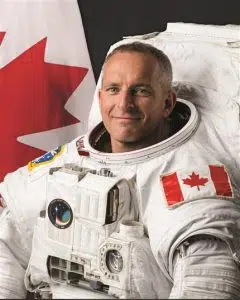
Canadian astronaut David Saint-Jacques (Photo: Courtesy of the Canadian Space Agency)
Saint-Jacques said it was harder to adjust back to Earth than it was to adjust to space. He said he lost his sense of balance, his body forgot to pump blood more to his head than his feet, and like he had the flu or was moving in slow motion which astronauts tend to call “Space Brain.”
One question asked was how he took care of his mental health.
He said when he was having a hard day, he would go to the window and look at Earth to remember why he’s doing it. He said because of the pandemic, it’s like every person is an astronaut in their home dealing with many similar problems on a different scale.
“There’s graffiti on the space station left by a very old astronaut from a very long time ago it says the most important thing is what you’re doing right now,” he said.
Saint-Jacques said one way to do well is to resolve to talk more to avoid explosions but leave others alone if they need space. He suggested getting organized, don’t stay in pyjamas all day, and make a schedule otherwise, you won’t achieve what you want.
“Sometimes we have a dream that seems too big, too crazy, too ambitious, and we’re afraid that we’re not going to make it. The error is to decide not to try in case we fail. That would be a big mistake,” said Saint-Jacques.
“Your dream is not a destination, it’s just a direction. It’s like the North Star. You’ll never get to the North Star ever, but you can still use it as a guide.”
Some of the questions asked were:
How long did it take to re-adjust to the gravity on Earth (One week before he could walk without holding someone’s hand, a month before he could ride a bike and two months to feel normal)
What was the hardest training he took (Learning to speak Russian in order to learn to fly the Russian rockets, plus the three years away from his family and the balance between work, family and friends)
What were some of the first noticeable changes his body experienced in a zero-gravity environment (The feeling of his organs floating up, like jumping off a high diving board, and nausea, congestion and disorientation)
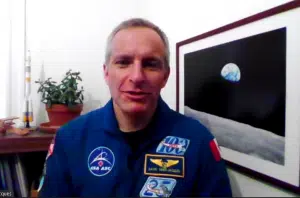
Canadian astronaut David Saint-Jacques (Photo: Screengrab)
How can you tell when you pass through the atmosphere (the rocket stops shaking)
What it was like when he first arrived at the space station (The feeling that it had moved from being a machine to a home with his friends)
How often were you able to communicate with people on Earth and how often is it with family (Making a call depends on the satellite connection. He called his wife at least every day and every weekend had a video conversation with his family)
Was there anything he had to improvise for on the ISS (Some repairs needed to be done because there was no procedure so every day there was improvisation because you can’t plan everything)
If space has a sun, why is it so dark (In space even during the day you see the sun while on Earth the sky is blue because sunlight goes through the atmosphere, then diffuses depending on the colours but the blue light doesn’t go straight through although red does. Space is black because it has no reason to be any other colour)
Is it possible to one day live on Mars (There’s a lot of issues about living in space so first, we have to get Mars, then we have to deal with the radiation, and then figure out how to land people on Mars ready to work, or to keep them alive since Mars has nothing we need so that will need to require life support systems)
Back in the 1980s, there was a public service announcement on TV that you may remember — or may have seen on YouTube.
A guy in a kitchen held up an egg and said, "This is your brain." Then he cracked the egg into a hot frying pan, and said, "This is your brain on drugs."
One year into this pandemic, your brain might be feeling a bit like that egg: Fried.
"Everything is so much harder," said Stephanie Johnson, a client relationship executive at Sun Life who lives in Toronto. "I don't have the motivation that I used to have. I don't have the efficiency that I used to have."
"Defeated" is how Vas Smountas, a freelance graphic designer, describes it. Also living in Toronto, she describes herself these days as "tired, defeated, foggy, unmotivated."
And research suggests those feelings are not uncommon right now, as the chronic stress of the pandemic has both affected our brains — and robbed us of normal, healthy ways to cope.
Reduced cognition due to stress
Just shy of one year into the pandemic, a national survey of Canadians suggested that more than half of all respondents — 56 per cent — said they were feeling increased stress or anxiety as a result of COVID-19. Among those aged 18-34, it was even higher, at 63 per cent.
You don't have to be lonely or depressed — you're just living through a pandemic. Or as Dr. Roger McIntyre describes it, "daily, unpredictable, malignant stress."
McIntyre, a professor of psychiatry and pharmacology at the University of Toronto's Temerty Faculty of Medicine, has recently co-authored a review on cognitive impairment in patients with COVID-19, which found prevalence of delirium and markers of inflammation.
You don't have to be lonely or depressed to be feeling lethargic or disengaged from life right now. (DGLimages/Shutterstock)
For the rest of us, living in a world changed by the disease, McIntyre says our cognitive issues come from stress.
He describes two kinds of stress: one which is short and predictable and has an end point, and another which is long in duration, unpredictable and seems interminable.
That second one sound familiar? Yup. Pandemic.
Unpredictability upon layers of unpredictability, as McIntyre put it.
'It's just a lot to take in'
Even among the most optimistic and positive people, the resulting stress is having an impact.
"Chronic stress, predictably, has this pronounced effect on our motivation, our energy, our get-up-and-go, our sense of joie de vivre," said McIntyre.
It also affects brain tissue.
"The brain is no different than the motherboard on your PC. It is a set of circuits and networks, all interconnected," McIntyre said.
"Work that's looked at the effect of chronic, malignant, unpredictable stress on the brain has shown loss of brain tissue. And not just randomly anywhere in the brain. Key brain areas that are responsible for what you and I need to do each day: think and feel."
"It's just a lot to take in," said Smountas. "Every day, you get up and it's the same thing. And you feel like you're in this Groundhog Day movie that just doesn't end without any learnings at the end of it. It's been trying."
Vas Smountas says the pandemic has left her feeling tired, foggy, and unmotivated. (Robin Tampas)
It's not just about mood.
"I literally don't think I go a day without saying my brain isn't functioning. Like, I can't remember. I'm not operating at 100 per cent," Johnson said.
"What happens is stress systems have been activated," McIntyre explains.
"You've got hormones, you've got inflammatory proteins, you've got a variety of neurochemicals, [and they] have created a mix which, in the longer term, jeopardizes the brain's health, creating this loss of brain tissue, resulting in a loss of brain interconnectivity."
Stress — or just boredom?
Some people have wondered if what they're feeling is just straight up boredom.
But boredom, in all its tediousness, can actually be a good thing, according to Erin Westgate, an assistant professor of psychology at the University of Florida who has studied boredom for years.
Stephanie Johnson says she is having trouble remembering things and feels like she is not functioning at 100 per cent. (Submitted by Stephanie Johnson)
It's usually a signal that something is wrong — telling a person that what they are doing right now isn't engaging or doesn't feel meaningful and that they need to do something to change that.
"But boredom wasn't designed to let us know that there's a pandemic going on," said Westgate.
"We know that boredom is caused by a lack of meaning and a lack of attention. And finding ways to challenge yourself, finding ways to reintroduce the meaning into your life, can reduce boredom," she said. "But ultimately, it's sort of like trying to push a rock up a big hill, you know. The way to solve boredom during the pandemic is to end the pandemic."
Not something you can do yourself. And in addition to having no control over when this will end, the pandemic has also taken away the systems to which we normally turn in stressful times for comfort and healing.
LISTEN | Separating stress from burnout:
Airplay6:51How to tell when stress becomes burnout
Money columnist Bruce Sellery says it's important for everyone to realize how stressful the past year has been, and how dangerous workplace stress and burnout can be. 6:51
Brains can heal
With so-called "normal" stress — that which is predictable and finite — and even the biggest stressors in life such as death or divorce or the loss of a job, people are able to rely on different ways of coping: having a job, hanging out with friends or extended family, going to a place of worship or to a community centre.
But in many cases, those have been compromised, too.
The pandemic has also gotten in the way of strategies we could normally use to relieve stress, like gathering with friends and family. But the brain does heal, too. (Ben Nelms/CBC)
The brain does heal, though.
"The brain is incredibly plastic and incredibly modifiable and incredibly able to regenerate," McIntyre said. And once the source of stress is removed, the brain circuits begin to normalize again.
"You see a correction of brain circuit function, and you also see a rejuvenation of brain tissue because our brains, our neurons, our brain cells, continue to grow."
And in the case of the pandemic, once most people are fully vaccinated, once life returns to what is commonly thought of as "normal" — with kids in school, and people at work, and restaurants full of people hanging out together without masks on — McIntyre says brain recoverability should follow in short order.
"Based on research that looks at brain function and brain anatomy before and then after intervention for people who've gone through stress-related conditions, you start to see changes fairly quickly."
The Ipsos survey cited in this article was conducted between February 8-10, 2021. A sample of 1,000 Canadians aged 18+ was interviewed online, with a margin of error of ± 3.5 percentage points, 19 times out of 20.