Minggu, 25 September 2022
The Weekly: NASA monitoring Ian's track ahead of planned Artemis I launch in October - WKMG News 6 ClickOrlando
https://news.google.com/__i/rss/rd/articles/CBMiK2h0dHBzOi8vd3d3LnlvdXR1YmUuY29tL3dhdGNoP3Y9bGl6RGh6czl1aknSAQA?oc=5
2022-09-25 13:32:59Z
1576143795

Why is a NASA Spacecraft Crashing Into an Asteroid? - Voice of America - VOA News
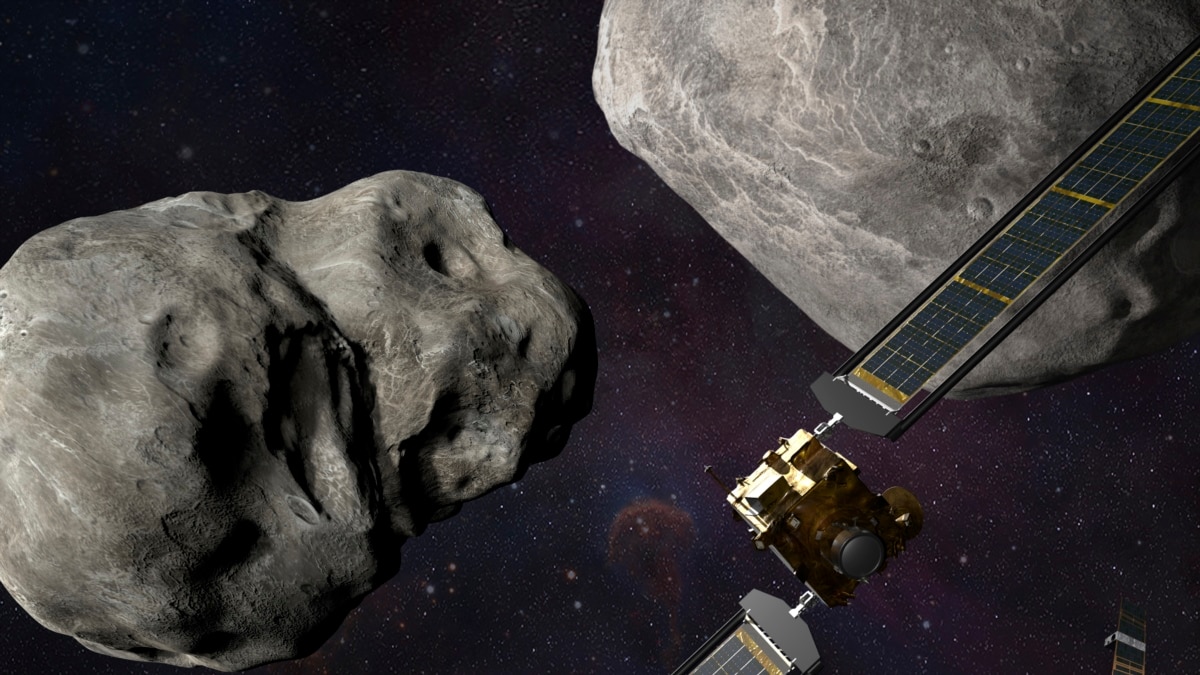
In the first-of-its kind, save-the-world experiment, NASA is about to clobber a small, harmless asteroid millions of miles away.
A spacecraft named Dart will zero in on the asteroid Monday, intent on slamming it head-on at 14,000 mph (22,500 kph). The impact should be just enough to nudge the asteroid into a slightly tighter orbit around its companion space rock — demonstrating that if a killer asteroid ever heads our way, we'd stand a fighting chance of diverting it.
"This is stuff of science-fiction books and really corny episodes of "StarTrek" from when I was a kid, and now it's real," NASA program scientist Tom Statler said Thursday.
Cameras and telescopes will watch the crash, but it will take days or even weeks to find out if it actually changed the orbit.
The $325 million planetary defense test began with Dart's launch last fall.
Asteroid target
The asteroid with the bull's-eye on it is Dimorphos, about 7 million miles (9.6 million kilometers) from Earth. It is actually the puny sidekick of a 2,500-foot (780-meter) asteroid named Didymos, Greek for twin. Discovered in 1996, Didymos is spinning so fast that scientists believe it flung off material that eventually formed a moonlet. Dimorphos — roughly 525 feet (160 meters) across — orbits its parent body at a distance of less than a mile (1.2 kilometers).
"This really is about asteroid deflection, not disruption," said Nancy Chabot, a planetary scientist and mission team leader at Johns Hopkins University's Applied Physics Laboratory, which is managing the effort. "This isn't going to blow up the asteroid. It isn't going to put it into lots of pieces." Rather, the impact will dig out a crater tens of yards (meters) in size and hurl some 2 million pounds (1 million kilograms) of rocks and dirt into space.
NASA insists there's a zero chance either asteroid will threaten Earth — now or in the future. That's why the pair was picked.
Dart, the impactor
The Johns Hopkins lab took a minimalist approach in developing Dart — short for Double Asteroid Redirection Test — given that it's essentially a battering ram and faces sure destruction. It has a single instrument: a camera used for navigating, targeting and chronicling the final action. Believed to be essentially a rubble pile, Dimorphos will emerge as a point of light an hour before impact, looming larger and larger in the camera images beamed back to Earth. Managers are confident Dart won't smash into the larger Didymos by mistake. The spacecraft's navigation is designed to distinguish between the two asteroids and, in the final 50 minutes, target the smaller one.
The size of a small vending machine at 1,260 pounds (570 kilograms), the spacecraft will slam into roughly 11 billion pounds (5 billion kilograms) of asteroid. "Sometimes we describe it as running a golf cart into a Great Pyramid," said Chabot.
Unless Dart misses — NASA puts the odds of that happening at less than 10% — it will be the end of the road for Dart. If it goes screaming past both space rocks, it will encounter them again in a couple years for Take 2.
Saving earth
Little Dimorphos completes a lap around big Didymos every 11 hours and 55 minutes. The impact by Dart should shave about 10 minutes off that. Although the strike itself should be immediately apparent, it could take a few weeks or more to verify the moonlet's tweaked orbit. Cameras on Dart and a mini tagalong satellite will capture the collision up close. Telescopes on all seven continents, along with the Hubble and Webb space telescopes and NASA's asteroid-hunting Lucy spacecraft, may see a bright flash as Dart smacks Dimorphos and sends streams of rock and dirt cascading into space. The observatories will track the pair of asteroids as they circle the sun, to see if Dart altered Dimorphos' orbit. In 2024, a European spacecraft named Hera will retrace Dart's journey to measure the impact results.
Although the intended nudge should change the moonlet's position only slightly, that will add up to a major shift over time, according to Chabot. "So if you were going to do this for planetary defense, you would do it five, 10, 15, 20 years in advance in order for this technique to work," she said. Even if Dart misses, the experiment still will provide valuable insight, said NASA program executive Andrea Riley. "This is why we test. We want to do it now rather than when there's an actual need," she said.
Asteroid missions galore
Planet Earth is on an asteroid-chasing roll. NASA has close to a pound (450 grams) of rubble collected from asteroid Bennu headed to Earth. The stash should arrive next September. Japan was the first to retrieve asteroid samples, accomplishing the feat twice. China hopes to follow suit with a mission launching in 2025. NASA's Lucy spacecraft, meanwhile, is headed to asteroids near Jupiter, after launching last year. Another spacecraft, Near-Earth Asteroid Scout, is loaded into NASA's new moon rocket awaiting liftoff; it will use a solar sail to fly past a space rock that's less than 60 feet (18 meters) next year. In the next few years, NASA also plans to launch a census-taking telescope to identify hard-to-find asteroids that could pose risks. One asteroid mission is grounded while an independent review board weighs its future. NASA's Psyche spacecraft should have launched this year to a metal-rich asteroid between Mars and Jupiter, but the team couldn't test the flight software in time.
Hollywood's take
Hollywood has churned out dozens of killer-space-rock movies over the decades, including 1998′s "Armageddon" which brought Bruce Willis to Cape Canaveral for filming, and last year's "Don't Look Up" with Leonardo DiCaprio leading an all-star cast. NASA's planetary defense officer, Lindley Johnson, figures he's seen them all since 1979′s "Meteor," his personal favorite "since Sean Connery played me." While some of the sci-fi films are more accurate than others, he noted, entertainment always wins out. The good news is that the coast seems clear for the next century, with no known threats. Otherwise, "it would be like the movies, right?" said NASA's science mission chief Thomas Zurbuchen. What's worrisome, though, are the unknown threats. Fewer than half of the 460-foot (140-meter) objects have been confirmed, with millions of smaller but still-dangerous objects zooming around. "These threats are real, and what makes this time special, is we can do something about it," Zurbuchen said. Not by blowing up an asteroid as Willis' character did — that would be a last, last-minute resort — or by begging government leaders to take action as DiCaprio's character did in vain. If time allows, the best tactic could be to nudge the menacing asteroid out of our way, like Dart.
https://news.google.com/__i/rss/rd/articles/CBMiWmh0dHBzOi8vd3d3LnZvYW5ld3MuY29tL2Evd2h5LWlzLWEtbmFzYS1zcGFjZWNyYWZ0LWNyYXNoaW5nLWludG8tYW4tYXN0ZXJvaWQtLzY3NjAwODcuaHRtbNIBAA?oc=5
2022-09-25 07:01:36Z
1576687942
Sabtu, 24 September 2022
NWT man among finalists in international astronomy photographer contest - KamloopsBCNow
[unable to retrieve full-text content]
NWT man among finalists in international astronomy photographer contest KamloopsBCNowView Full coverage on Google Newshttps://news.google.com/__i/rss/rd/articles/CBMifmh0dHBzOi8vd3d3LmthbWxvb3BzYmNub3cuY29tL25ld3MvbmV3cy9OYXRpb25hbF9OZXdzL05XVF9tYW5fYW1vbmdfZmluYWxpc3RzX2luX2ludGVybmF0aW9uYWxfYXN0cm9ub215X3Bob3RvZ3JhcGhlcl9jb250ZXN0L9IBAA?oc=5
2022-09-24 18:13:36Z
CBMifmh0dHBzOi8vd3d3LmthbWxvb3BzYmNub3cuY29tL25ld3MvbmV3cy9OYXRpb25hbF9OZXdzL05XVF9tYW5fYW1vbmdfZmluYWxpc3RzX2luX2ludGVybmF0aW9uYWxfYXN0cm9ub215X3Bob3RvZ3JhcGhlcl9jb250ZXN0L9IBAA
NASA delays moon rocket launch again - CTV News
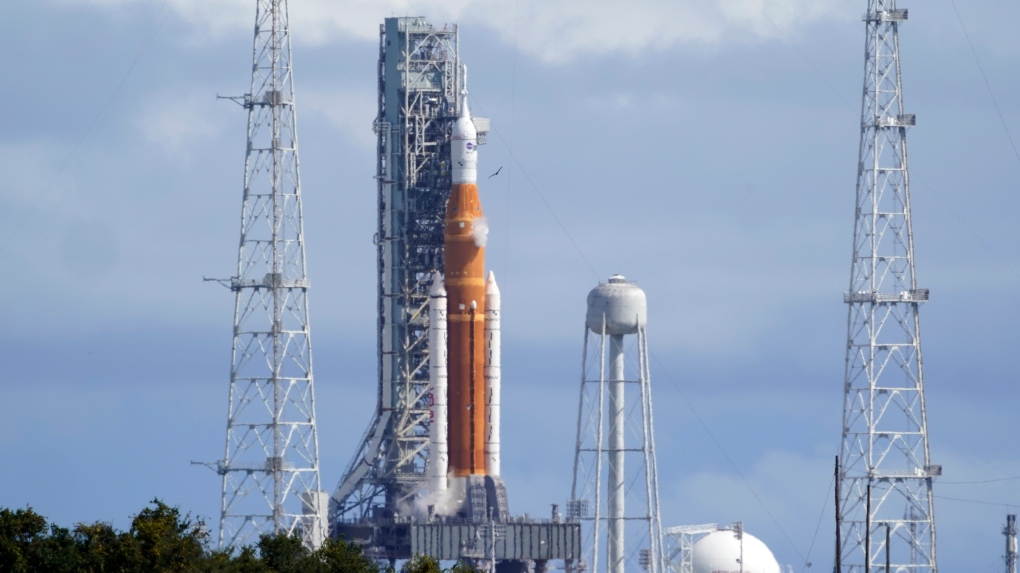
NASA is skipping next week's launch attempt of its new moon rocket because of a tropical storm that's expected to become a major hurricane.
It's the third delay in the past month for the lunar-orbiting test flight featuring mannequins but no astronauts, a follow-up to NASA's Apollo moon-landing program of a half-century ago. Hydrogen fuel leaks and other technical issues caused the previous scrubs.
Currently churning in the Caribbean, Tropical Storm Ian is expected to become a hurricane by Monday and slam into Florida's Gulf coast by Thursday. The entire state, however, is in the cone showing the probable path of the storm's center -- including NASA's Kennedy Space Center.
Given the forecast uncertainties, NASA decided Saturday to forgo Tuesday's planned launch attempt and instead prepare the 322-foot (98-metre) rocket for a possible return to its hangar. Managers will decide Sunday whether to haul it off the launch pad.
If the rocket remains at the pad, NASA could try for an Oct. 2 launch attempt, the last opportunity before a two-week blackout period. But a rollback late Sunday or early Monday likely would mean a lengthy delay for the test flight, possibly pushing it into November.
The Space Launch System rocket is the most powerful ever built by NASA. Assuming its first test flight goes well, astronauts would climb aboard for the next mission in 2024, leading to a two-person moon landing in 2025.
------
The Associated Press Health and Science Department receives support from the Howard Hughes Medical Institute's Department of Science Education. The AP is solely responsible for all content.
https://news.google.com/__i/rss/rd/articles/CBMiY2h0dHBzOi8vd3d3LmN0dm5ld3MuY2Evc2NpLXRlY2gvbmFzYS1kZWxheXMtbW9vbi1yb2NrZXQtbGF1bmNoLWR1ZS10by1wb3RlbnRpYWwtaHVycmljYW5lLTEuNjA4Mjg0ONIBAA?oc=5
2022-09-24 14:56:33Z
1576143795
NASA is slamming a spacecraft into an asteroid on Monday to test planetary defence - CBC.ca
On Monday, in what seems like a scene out of a science fiction movie, NASA will slam a spacecraft into a distant asteroid to see whether it can nudge its orbit — all in an effort to test a way to protect Earth from any potential future threats.
The good news is that there's no need to panic: The asteroid, which is part of a binary — or two-bodied — system, is not a threat to our planet, and there are no known ones that are headed our way for at least the next 100 years. However, space agencies like the U.S. National Aeronautics and Space Administration want to be prepared should there ever be a threat.
NASA's Double Asteroid Redirection Test (DART) is testing a way in which a spacecraft may be able to nudge an asteroid on a collision course with Earth out of its orbit.
At 7:14 p.m. ET on Monday, the refrigerator-sized spacecraft will plunge itself into Dimorphos — a moonlet that orbits its larger companion, Didymos — at roughly 6.6 km/s.
The goal isn't to knock Dimorphos out of orbit but rather to change its 12-hour orbit around Didymos by 10 minutes. This means that scientists will know within roughly 12 hours whether they were successful.
So why target a binary asteroid system rather than a single asteroid to see whether you can change its orbit around the sun?

"A binary system was perfect for this test," said Mallory DeCoster, a senior scientist at Johns Hopkins University's Applied Physics Laboratory in Maryland and part of the DART Impact Modeling Working Group.
For one, the size of Dimorphos — about 164 metres across — is perfect to illustrate whether this would be an effective way of deflecting asteroids that pose a threat to Earth. Didymos is 780 metres across.
"But then the other piece is, if we were to impact a single asteroid, in order to characterize if we changed its orbit, we would have to wait until it completed its orbit around the sun, which could take many, many years."
The other advantage is that the binary system is relatively close to us, astronomically speaking, at just 11 million kilometres away.
Shooting gallery
NASA's Center for Near-Earth Object Studies says that more than 90 per cent of near-Earth objects (NEOs) bigger than one kilometre have already been discovered. But that doesn't mean we're out of the woods when it comes to Potentially Hazardous Asteroids (PHAs).
In 2013, the Chelyabinsk asteroid — which was roughly 20 metres in diameter— exploded over parts of Russia, injuring about 1,000 people and serving as a reminder of how even a small asteroid can be dangerous.

Basically, Earth flies through a shooting gallery in space. There are small chunks of debris that burn up in our atmosphere as meteors; bigger ones, like Chelyabinsk; and then even bigger ones that can be catastrophic — all left over from the formation of our solar system.
That's why space agencies like NASA and the European Space Agency have been trying to develop ways to deflect or nudge a PHA so that its orbit changes and poses no threat to Earth.
Mike Daly, a professor at York University's Lassonde School of Engineering in Toronto and a co-investigator on DART, said one of the most popular concepts is deflecting asteroids before they become a real threat. But that means we need to have advance warning that one is headed our way.
"So the simplest method is the one that DART is doing, which is essentially to take a spacecraft at high speed and crash it into the asteroid and use that transfer of the energy from the spacecraft to the asteroid to move it along," he said.

However, the science behind asteroid deflection in this manner is about more than just the combination of the spacecraft's size and incredibly high speed, called a hypervelocity impact.
"In a hypervelocity impact, you induce this pressure wave into the target that causes a lot of new physics to happen," Johns Hopkins University's DeCoster said.
"So what will happen, or what we think will happen, is that the size of the spacecraft might actually not matter that much. It might actually be: How does the asteroid respond to this pressure wave that is induced due to the hypervelocity impact? And we think that it will likely spew out a lot of material in the form of ejecta. And this ejecta might actually have a major component for changing the orbit. So much ejecta might get spewed out that that piece might matter more than the incoming energy from the spacecraft in changing its orbit."
The DART team hopes that an onboard camera, called DRACO, will show the close approach and then suddenly go black, which would be indicative of an impact.

But there's a straggler tagging along behind DART, by about three minutes: the Italian Space Agency's Light Italian Cubesat for Imaging of Asteroids, or LICIACube. Its job is to photograph the impact, study the plume of ejecta and help determine the morphology of the asteroid, as they can be made of iron, rock or just rocky clumps held together by gravity.
As this is the first test of a form of planetary defence, scientists are eagerly anticipating not only the impact of the event itself but what they will learn from it and, most importantly, what this may mean for the future of protecting Earth in the future. Telescopes from around the world will be observing the event and collecting followup data.
"We're really the first generation that can protect ourselves from these potentially catastrophic impacts," York University's Daly said. "And, you know, fortunately the really catastrophic ones don't happen very often, but they could happen, and never before have we been able to change our fate. So I think it's really up to us, given the potentially large consequences of not paying attention and our ability to do it."
The event will be broadcast on NASA TV, which is available online and through its app.
https://news.google.com/__i/rss/rd/articles/CBMiRGh0dHBzOi8vd3d3LmNiYy5jYS9uZXdzL3NjaWVuY2UvbmFzYS1kYXJ0LWFzdGVyb2lkLW1pc3Npb24tMS42NTkwNDIx0gEgaHR0cHM6Ly93d3cuY2JjLmNhL2FtcC8xLjY1OTA0MjE?oc=5
2022-09-24 08:00:00Z
1576687942
Jumat, 23 September 2022
Approaching storm may delay launch try for NASA moon rocket - Winnipeg Free Press
CAPE CANAVERAL, Fla. (AP) — An approaching storm threatens to delay NASA’s next launch attempt for its new moon rocket, already grounded for weeks by fuel leaks.
A tropical depression in the southern Caribbean is moving toward Florida and could become a major hurricane.
Managers said Friday that the rocket is ready to blast off Tuesday on its first test flight without astronauts, after overcoming more hydrogen leaks during a fueling test earlier this week.

NASA said it will keep monitoring the forecast and decide no later than Saturday whether to not only delay the launch, but haul the rocket off the pad and back to the hangar. Officials said it’s unclear when the next launch attempt would be — whether October or even November — if the rocket must seek shelter indoors.
It takes three days of preparations to get the rocket back into Kennedy Space Center’s mammoth Vehicle Assembly Building, four miles away.
“I don’t think we’re cutting it close,” said NASA’s Tom Whitmeyer, deputy associate administrator for exploration systems. “We’re just taking it a step at a time.”
This would be the third launch attempt for the Space Launch System rocket, the most powerful ever built by NASA. Fuel leaks and other technical problems scrapped the first two tries.
The 322-foot (98-meter) rocket can withstand gusts of 85 mph (137 kph) at the pad, but only 46 mph (74 kph) once it’s on the move.
___
The Associated Press Health and Science Department receives support from the Howard Hughes Medical Institute’s Department of Science Education. The AP is solely responsible for all content.
https://news.google.com/__i/rss/rd/articles/CBMihAFodHRwczovL3d3dy53aW5uaXBlZ2ZyZWVwcmVzcy5jb20vYXJ0cy1hbmQtbGlmZS9saWZlL3NjaS10ZWNoLzIwMjIvMDkvMjMvYXBwcm9hY2hpbmctc3Rvcm0tbWF5LWRlbGF5LWxhdW5jaC10cnktZm9yLW5hc2EtbW9vbi1yb2NrZXTSAQA?oc=5
2022-09-23 18:09:55Z
1576143795
Undersea volcano eruption in Tonga was a "once-in-a-lifetime event" that could warm Earth's surface, scientists say - CBS News
When an undersea volcano erupted in Tonga in January, its watery blast was huge and unusual — and scientists are still trying to understand its impacts.
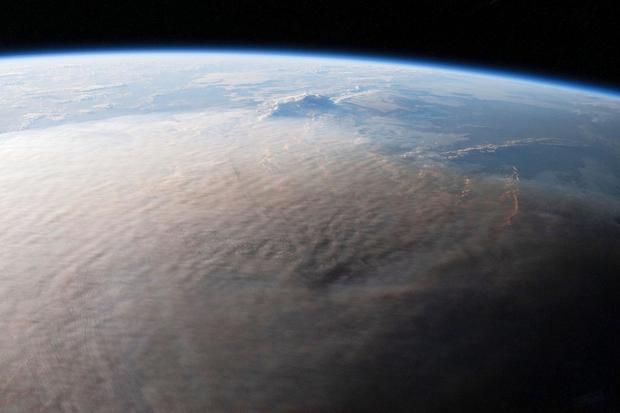
The volcano, known as Hunga Tonga-Hunga Ha'apai, shot millions of tons of water vapor high up into the atmosphere, according to a study published Thursday in the journal Science.
The researchers estimate the eruption, which dwarfed the power of the Hiroshima atomic bomb, raised the amount of water in the stratosphere - the second layer of the atmosphere, above the range where humans live and breathe - by around 5%.
Now, scientists are trying to figure out how all that water could affect the atmosphere, and whether it might warm Earth's surface over the next few years.
"This was a once-in-a-lifetime event," said lead author Holger Voemel, a scientist at the National Center for Atmospheric Research in Colorado.
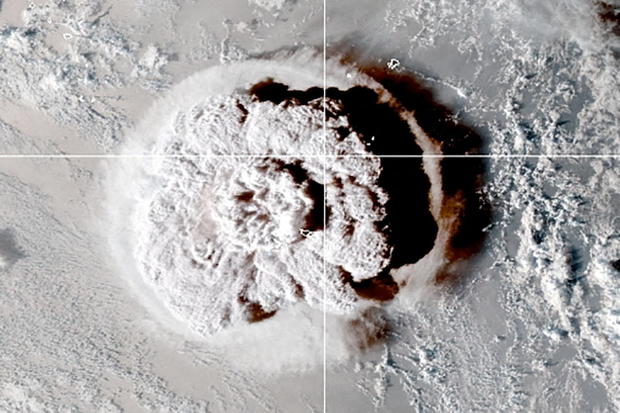
Big eruptions usually cool the planet. Most volcanoes send up large amounts of sulfur, which blocks the sun's rays, explained Matthew Toohey, a climate researcher at the University of Saskatchewan who was not involved in the study.
The Tongan blast was much soggier: The eruption started under the ocean, so it shot up a plume with much more water than usual. And since water vapor acts as a heat-trapping greenhouse gas, the eruption will probably raise temperatures instead of lowering them, Toohey said.
It's unclear just how much warming could be in store.
Karen Rosenlof, a climate scientist at the National Oceanic and Atmospheric Administration who was not involved with the study, said she expects the effects to be minimal and temporary.
"This amount of increase might warm the surface a small amount for a short amount of time," Rosenlof said in an email.
In August, scientists said it broke "all records" for the injection of water vapor since satellites began recording such data -- enough water vapor to fill 58,000 Olympic-sized swimming pools.
The water vapor will stick around the upper atmosphere for a few years before making its way into the lower atmosphere, Toohey said. In the meantime, the extra water might also speed up ozone loss in the atmosphere, Rosenlof added.
But it's hard for scientists to say for sure, because they've never seen an eruption like this one.
The stratosphere stretches from around 7.5 miles to 31 miles above Earth and is usually very dry, Voemel explained.
Voemel's team estimated the volcano's plume using a network of instruments suspended from weather balloons. Usually, these tools can't even measure water levels in the stratosphere because the amounts are so low, Voemel said.
Another research group monitored the blast using an instrument on a NASA satellite. In their study, published earlier this summer, they estimated the eruption to be even bigger, adding around 150 million metric tons of water vapor to the stratosphere - three times as much as Voemel's study found.
In that study, scientists also concluded that the unprecedented plume could temporarily affect Earth's global average temperature.
Voemel acknowledged that the satellite imaging might have observed parts of the plume that the balloon instruments couldn't catch, making its estimate higher.
Either way, he said, the Tongan blast was unlike anything seen in recent history, and studying its aftermath may hold new insights into our atmosphere.
https://news.google.com/__i/rss/rd/articles/CBMiW2h0dHBzOi8vd3d3LmNic25ld3MuY29tL25ld3MvdG9uZ2Etdm9sY2Fuby1jb3VsZC13YXJtLWVhcnRoLW9uY2UtaW4tYS1saWZldGltZS1ldmVudC1zdHVkeS_SAQA?oc=5
2022-09-23 11:02:00Z
1571707069
Langganan:
Postingan (Atom)