Senin, 03 Oktober 2022

NASA's DART mission crashed a spacecraft into an asteroid and got photos to prove it - BradfordToday

This article by David Barnhart, University of Southern California originally appeared on the Conversation and is published here with permission.

In a world first, NASA has crashed a spacecraft into an asteroid in an attempt to push the rocky traveler off its trajectory. The Double Asteroid Redirection Test – or DART – is meant to test one potential approach that could prevent an asteroid from colliding with Earth. David Barnhart is a professor of astronautics at the University of Southern California and director of the Space Engineering Research Center there. He watched NASA’s live stream of the successful mission and explains what is known so far.

1. What do the images show?

The first images, taken by a camera aboard DART, show the double asteroid system of Didymos – about 2,500 feet (780 meters) in diameter – being orbited by the smaller asteroid Dimorphos that is about 525 feet (160 meters) long.

As the targeting algorithm on DART locked onto Dimorphos, the craft adjusted its flight and began heading towards the smaller of the two asteroids. The image taken at 11 seconds before impact and 42 miles (68 kilometers) from Dimorphos shows the asteroid centered in the camera’s field of view. This meant that the targeting algorithm was fairly accurate and the craft would collide right at the center of Dimorphos.

The second-to-last image, taken two seconds before impact shows the rocky surface of Dimorphos, including small shadows. These shadows are interesting because they suggest that the camera aboard the DART spacecraft was seeing Dimorphos directly on but the Sun was at an angle relative to the camera. They imply the DART spacecraft was centered on its trajectory to impact Dimorphos at the moment, but it’s also possible the asteroid was slowly rotating relative to the camera.

The final photo, taken one second before impact, only shows the top slice of an image but this is incredibly exciting. The fact that NASA received only a part of the image implies that the shutter took the picture but DART, traveling at around 14,000 miles per hour (22,500 kilometers per hour) was unable to transmit the complete image before impact.

2. What was supposed to happen?

The point of the DART mission was to test whether it is possible to deflect an asteroid with a kinetic impact – by crashing something into it. NASA used the analogy of a golf cart hitting the side of an Egyptian pyramid to convey the relative difference in size between tiny DART and Dimorphos, the smaller of the two asteroids. Prior to the test, Dimorphos orbited Didymos in roughly 16 hours. NASA expects the impact to shorten Dimorphos’ orbit by about 1%, or roughly 10 minutes. Though small, if done far enough away from Earth, a nudge like this could potentially deflect a future asteroid headed towards Earth just enough to prevent an impact.

3. What do we know already?

The last bits of data that came from the DART spacecraft right before impact show that it was on course. The fact that the images stopped transmitting after the target point was reached can only mean that the impact was a success.

While there is likely a lot of information to be learned from the images taken by DART, the world will have to wait to learn whether the deflection was also a success. Fifteen days before the impact, DART released a small satellite with a camera that was designed to document the entire impact. The small satellite’s sensors should have taken images and collected information, but given that it doesn’t have a large antenna onboard, the images will be transmitted slowly back to Earth, one by one, over the coming weeks.

4. What does the test mean for planetary defense?

I believe this test was a great proof-of-concept for many technologies that the U.S. government has invested in over the years. And importantly, it proves that it is possible to send a craft to intercept with a minuscule target millions of miles away from Earth. From that standpoint DART has been a great success.

Over the course of the next months and years, researchers will learn just how much deflection the impact caused – and most importantly, whether this type of kinetic impact can actually move a celestial object ever so slightly at a great enough distance to prevent a future asteroid from threatening Earth.The Conversation

David Barnhart, Professor of Astronautics, University of Southern California

This article is republished from The Conversation under a Creative Commons license. Read the original article.

Adblock test (Why?)


https://news.google.com/__i/rss/rd/articles/CBMigwFodHRwczovL3d3dy5icmFkZm9yZHRvZGF5LmNhL2xvY2FsLW5ld3MvbmFzYXMtZGFydC1taXNzaW9uLWNyYXNoZWQtYS1zcGFjZWNyYWZ0LWludG8tYW4tYXN0ZXJvaWQtYW5kLWdvdC1waG90b3MtdG8tcHJvdmUtaXQtNTg5MzA1NtIBAA?oc=5

2022-10-03 13:25:00Z
1576687942

GIA Scientists Unlock Secrets Within Earth Using Diamonds - INSTORE MAG

(PRESS RELEASE) No one has ever visited the depths of our planet. However, a team of researchers from GIA and other institutions were able to gain incredible insight into the deep mantle – 660 km below the surface – by examining a diamond that in fact did ride a volcanic eruption to the surface.

Led by Dr. Tingting Gu, a GIA post-doctoral research fellow at the time of the research and now at Purdue University, the researchers, including GIA’s vice president of research and development Dr. Wuyi Wang, examined an exceptionally rare type IaB diamond from the Karowe mine in Botswana. The 1.5 ct, D-color diamond’s inclusions, examined using advanced, non-destructive methods including FTIR, Raman spectroscopy and X-ray diffraction, revealed that water can be found at least across the earth transition zone (410 – 670 km deep) and into the lower mantle (more than 670 Km deep).

When the diamond was submitted to GIA for evaluation – GIA sees millions of diamonds every year – researchers were intrigued by its unusual inclusions. These turned out to be very rare hydrous (water-bearing) minerals, suggesting the presence of water far deeper in the earth than previously believed.

Speaking about the research, Dr. Wang said, “Mineral inclusions in diamonds are the only materials from the earth’s interior that we can analyze directly. The study of these minerals offers unique opportunities to understand the chemistry of the Earth’s interior. GIA has been actively contributing to this fundamental research.”

The Richard T. Liddicoat Postdoctoral Research Fellowship program, created in 2014 in honor of GIA’s former president, who was widely considered the “Father of Modern Gemology,” gives researchers who study mineralogy, geology, physics, materials science and other fields related to gemology access to GIA’s gemological data, equipment and the rare, unusual and large gems that come into the laboratories.

The paper was published in late September in the scientific journal Nature Geoscience – you can see an abstract here. Popular Science magazine published an article about the paper on September 27.

Advertisement

In addition to Gu and Wang, a large team from GIA contributed to the research, including research scientists and technicians, photomicrographers, executives and GIA board members.

Adblock test (Why?)


https://news.google.com/__i/rss/rd/articles/CBMiUWh0dHBzOi8vaW5zdG9yZW1hZy5jb20vZ2lhLXNjaWVudGlzdHMtdW5sb2NrLXNlY3JldHMtd2l0aGluLWVhcnRoLXVzaW5nLWRpYW1vbmRzL9IBVWh0dHBzOi8vaW5zdG9yZW1hZy5jb20vZ2lhLXNjaWVudGlzdHMtdW5sb2NrLXNlY3JldHMtd2l0aGluLWVhcnRoLXVzaW5nLWRpYW1vbmRzL2FtcC8?oc=5

2022-10-03 04:41:49Z
1576614069

Minggu, 02 Oktober 2022

This Week @NASA: World’s First Planetary Defense Test and Jupiter’s Icy Moon Europa - SciTechDaily

This Week at NASA DART Artemis I Juno Europa

The world’s first-ever planetary defense test is a big hit …

A major hurricane spotted from space …

And moving NASA’s mega Moon rocket back inside ahead of that storm … a few of the stories to tell you about – This Week at NASA!

Successful Impact for First-Ever Planetary Defense Test

On September 26, NASA’s Double Asteroid Redirection Test, or DART spacecraft successfully impacted Dimorphos – the asteroid the spacecraft had been on a collision course with for about 10 months.

“Waiting … (applause) … and we have impact!”

DART’s intentional crash into Dimorphos, a moonlet of a larger asteroid called Didymos, was an attempt to alter the course of an asteroid in space as part of the world’s first planetary defense technology demonstration. The DART team will observe Dimorphos with ground-based telescopes to confirm that the technique, known as kinetic impact, did indeed alter the moonlet’s orbit around Didymos. The cosmic collision was actually captured by NASA’s Hubble and Webb space telescopes, marking the first time that Webb and Hubble observed the same celestial target at the same time. Neither of these asteroids is a threat to Earth, but this technique could prove to be a reliable way to alter the course of an asteroid that is on a collision course with Earth in the future.

Hurricane Ian From International Space Station

Hurricane Ian is pictured approaching the west coast of Florida as a category 4 storm. The International Space Station was orbiting 259 miles above the Gulf of Mexico at the time of this photograph. Credit: NASA

Hurricane Ian Seen from the Space Station

On September 26, external cameras aboard the International Space Station captured views of Hurricane Ian just south of Cuba as the storm moved toward the north-northwest. As expected, Ian intensified as it approached Florida. Space station cameras caught the storm again on September 28 as it was making landfall in southwest Florida as a Category 4 storm with winds upward of 155 mph and a potentially catastrophic storm surge.

Artemis I WDR Rollout

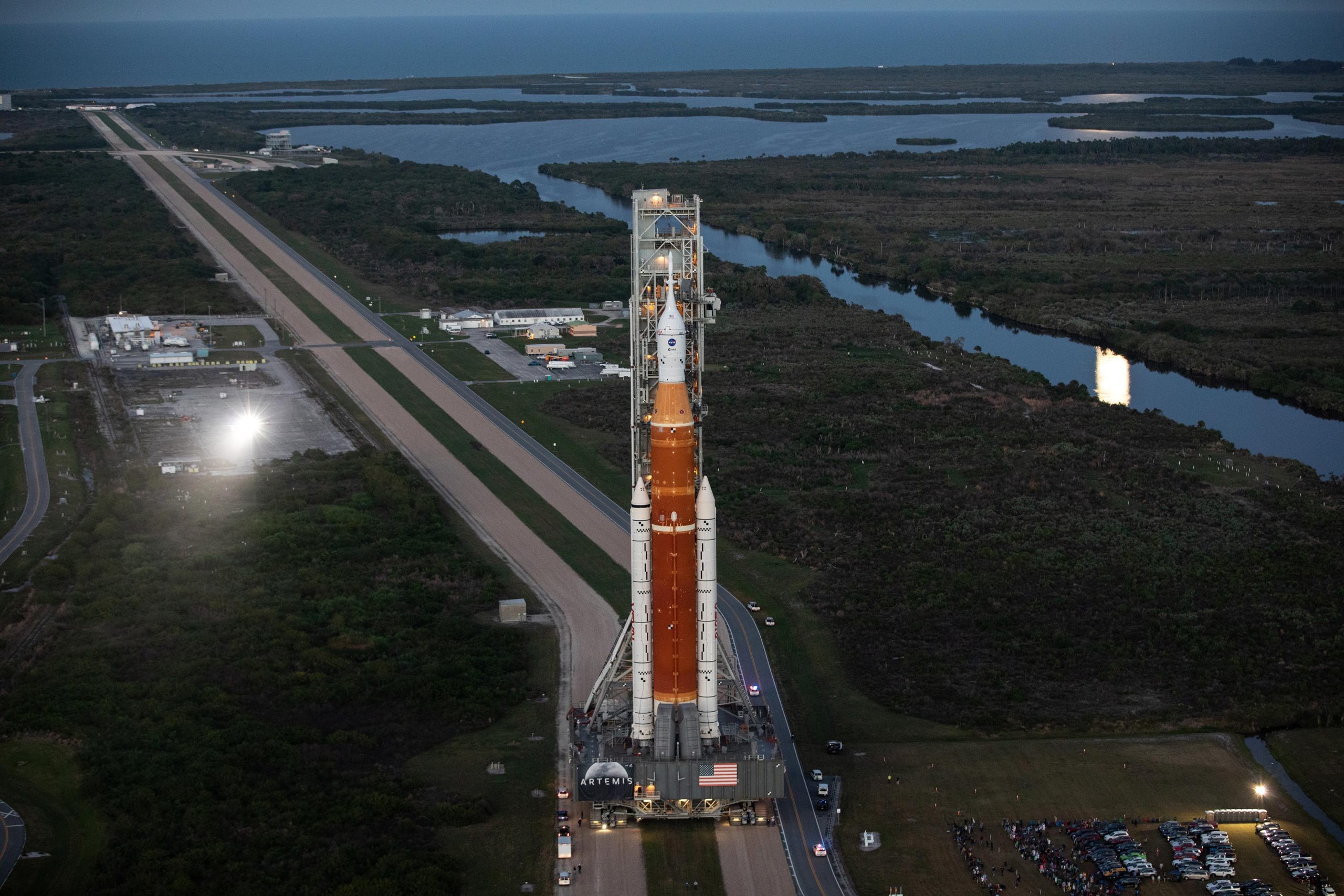
NASA’s Space Launch System (SLS) rocket with the Orion spacecraft aboard atop a mobile launcher as it rolls out to Launch Complex 39B. Credit: NASA/Kim Shiflett

Artemis I Rocket Rolled Back Inside Ahead of Hurricane Ian

On the night of September 26, the team at NASA’s Kennedy Space Center began moving the Artemis I Moon rocket from launch pad 39B back to the Vehicle Assembly Building, or VAB. The Space Launch System rocket and Orion spacecraft were secured inside the VAB the next morning. Managers decided on the “roll back” due to weather predictions related to Hurricane Ian. In addition to protecting the integrated rocket and spacecraft, they also wanted to give employees time to address the needs of their families ahead of the storm.

Jupiter Moon Europa Juno 2022 Crop

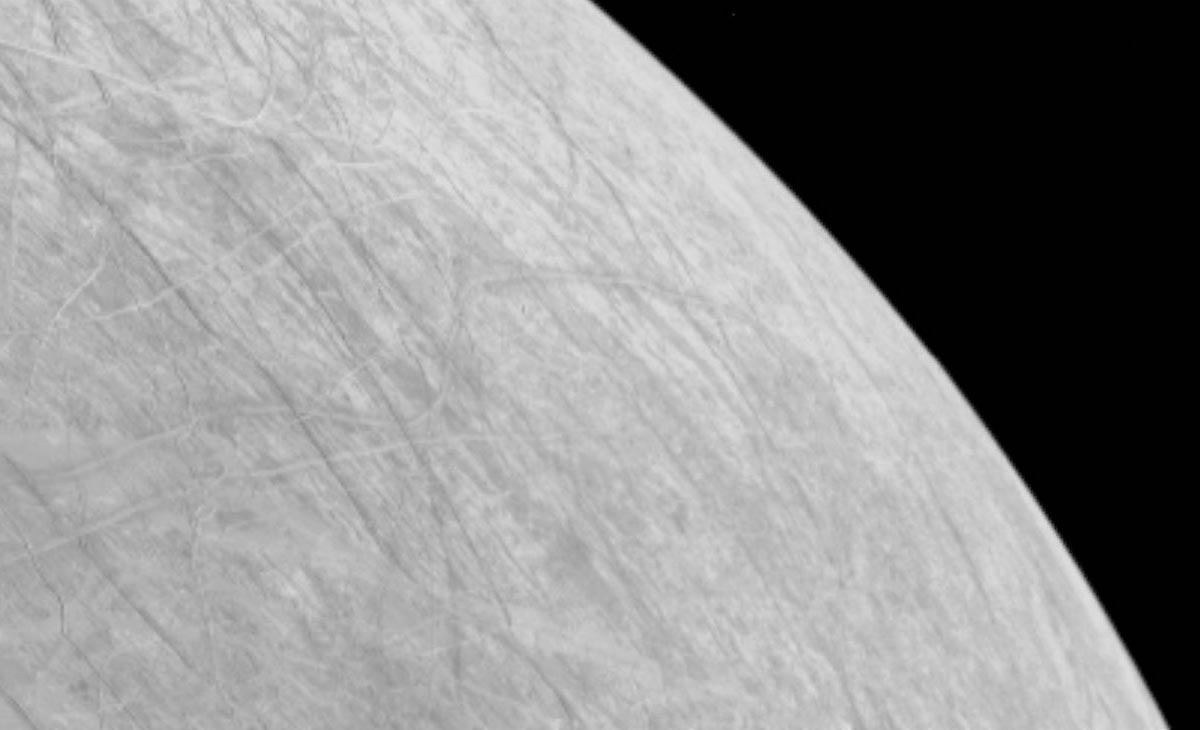
The complex, ice-covered surface of Jupiter’s moon Europa was captured by NASA’s Juno spacecraft during a flyby on Sept. 29, 2022. At closest approach, the spacecraft came within a distance of about 219 miles (352 kilometers). Credit: NASA/JPL-Caltech/SWRI/MSSS

Juno’s Close Flyby of Jupiter’s Icy Moon Europa

The spacecraft for NASA’s Juno mission at Jupiter made a close flyby of the planet’s ice-covered moon, Europa on September 29. This image from the pass, some 220 miles above Europa’s surface, is the first to come of some of the highest-resolution images ever taken of portions of the moon. Valuable data are also expected from the flyby that, once processed, could benefit and inform future missions, like the agency’s Europa Clipper mission, which is targeted to launch in 2024 to study the icy moon. More information is available at: nasa.gov/juno.


As NASA prepares to send humans back to the Moon and beyond to Mars, inflatable habitats are concepts being considered for Lunar Surface Habitats and Mars Transit Habitats. Burst pressure tests are necessary to meet human safety certification, and engineers use them to determine the ability of the habitat to withstand internal pressure and the maximum internal pressure required to cause failure of the habitat’s woven, structural shell. The test, conducted in collaboration with Sierra Space and ILC Dover, took place at NASA’s Johnson Space Center as part of the NextSTEP-2 Habitat Systems contract managed by NASA’s Marshall Space Flight Center. Credit: NASA’s Marshall Space Flight Center

Inflatable Habitat Burst Pressure Test

Believe it or not, these inflatable habitats are being blown up to help make them safe for humans. Habitats like these could be used to house astronauts on future long-term surface exploration missions to the Moon and, eventually Mars. But before then, NASA and commercial partners are conducting burst pressure tests to determine the maximum internal pressure these habitats can safely withstand before they fail.

That’s what’s up this week @NASA …

Adblock test (Why?)


https://news.google.com/__i/rss/rd/articles/CBMiaWh0dHBzOi8vc2NpdGVjaGRhaWx5LmNvbS90aGlzLXdlZWstbmFzYS13b3JsZHMtZmlyc3QtcGxhbmV0YXJ5LWRlZmVuc2UtdGVzdC1hbmQtanVwaXRlcnMtaWN5LW1vb24tZXVyb3BhL9IBbWh0dHBzOi8vc2NpdGVjaGRhaWx5LmNvbS90aGlzLXdlZWstbmFzYS13b3JsZHMtZmlyc3QtcGxhbmV0YXJ5LWRlZmVuc2UtdGVzdC1hbmQtanVwaXRlcnMtaWN5LW1vb24tZXVyb3BhL2FtcC8?oc=5

2022-10-02 17:33:40Z
1576687942

DART mission: How NASA hit the bullseye - CBS News

Little asteroids strike the Earth's atmosphere every single day. It's the big ones we worry about, as depicted in such Hollywood extravaganzas as "Armageddon" and "Don't Look Up."

"I've never been able to sit still watching any of the asteroid movies and not just want to get up and walk away," said MIT professor Richard Binzel. In addition to writing the book on asteroids, he also invented the Torino scale, a 10-point danger scale for asteroids.

"All the objects we know of today reside at zero or one, which simply means they're so small that they don't matter, or that we know for sure there's no impact possibility," Binzel said.

torino-scale.jpg
CBS News

Correspondent David Pogue asked, "It sounds like asteroids wiping out humanity should not be at the top of our list of worries?"

"Asteroids wiping our humanity does not keep me awake at night, unless I'm at the telescope studying them!" Binzel laughed.

But there have been dangerous asteroid strikes. In 2013, a 60-foot rock from space injured 1,500 people, and damaged thousands of buildings, in Russia.

NASA thinks it's time to prepare for the next one.

But probably not the way an asteroid was dealt with in "Deep Impact" – by blowing it up.

Deep Impact (9/10) Movie CLIP - The Ultimate Sacrifice (1998) HD by Movieclips on YouTube

"That's probably not the best way of doing it," said NASA's Elena Adams. "Because if you blow up an asteroid, you create a large number of chunks. And those chunks will still be going the same direction. The easiest thing to do is to actually just change its direction slightly, and then it will miss Earth entirely."

Adams is the lead engineer on the DART mission, a joint venture of NASA and the Johns Hopkins Applied Physics Laboratory. It took off last November on a mission to change an asteroid's path by crashing into it.

DART stands for Double Asteroid Redirection Test because its target is, in fact, a double asteroid that orbits the sun. The main asteroid, called Didymos, is about half-a-mile across. It has a moonlet of its own, and that's our target.

dart-nasa-1920.jpg
An illustration of NASA's Double Asteroid Redirection Test (DART) spacecraft prior to impact against Dimorphos, a 525-foot-wide moonlet in the Didymos binary asteroid system. NASA/Johns Hopkins APL/Steve Gribben

The goal is to bump the moonlet's orbit slightly closer to Didymos. "Just a little nudge, a tap," said Adams. "It's basically like throwing a tennis ball at a 747. If it goes fast enough, you're gonna move it. It's a first test of, can we actually do it?"

As a bonus, the 1,200-pound spacecraft is a veritable science fair of technology tests that could be useful in future missions: super lightweight solar panels that unroll; a new ion thruster; and a separate little camera satellite that DART carried in its pocket, the Italian Space Agency's LICIACube, so we can all enjoy pictures of the crash.

There's even a new self-driving computer, SMART Nav, which takes over when DART is too far away to control from the Earth

"This is the crown jewel of the spacecraft," Adams said. "So, we're going to see how well it works."

DART is the first major project of a NASA department called the Planetary Defense Coordination Office.

NASA's Lori Glaze leads the division that oversees planetary defense.

"The ones that really are the civilization-ending-size asteroids, we know; we've already found 99% of those," Glaze said. "The smaller ones that could have regional damage, there are some out there that we don't know about. So, we're actually right now already building the next telescope, a space telescope called the Near-Earth Object Surveyor (NEO Surveyor), to search the sky 24 hours a day."

This past Monday, 10 months after liftoff, DART approached its target: Seven million miles from Earth, traveling four miles a second, toward an asteroid moonlet that nobody's ever seen.

And to make matters even tougher? Adams said, "We also don't know what it's made out of, we don't know its shape. How do you hit something where you don't even know its shape?"

At 19 minutes to impact, you could see the moonlet Dimorphos for the first time.

092622-dart-midrange.jpg
Dimorphos, just prior to impact.    NASA/Johns Hopkins APL

NASA's DART hit the bullseye.

dart-liciacube-nasa-isa.jpg
The Italian Space Agency's LICIACube took this image of the DART spacecraft impacting the tiny moonlet Dimorphos, circling Didymos, September 26, 2022. ASI/NASA

In a few weeks, NASA will calculate how much that little moon moved. But we already know what happened to Elena Adams' $325 million baby. "It's like a Ferrari, right? It's just a beautiful piece of equipment, and then the whole point of it is to go smash into a rock!" she laughed.

"That's sad!" said Pogue.

"But also kinda glorious!"

     
For more info:

       
Story produced by Julie Kracov. Editor: Mike Levine. 

Adblock test (Why?)


https://news.google.com/__i/rss/rd/articles/CBMiZWh0dHBzOi8vd3d3LmNic25ld3MuY29tL25ld3MvZGFydC1taXNzaW9uLWRvdWJsZS1hc3Rlcm9pZC1yZWRpcmVjdGlvbi10ZXN0LWhvdy1uYXNhLWhpdC10aGUtYnVsbHNleWUv0gEA?oc=5

2022-10-02 14:17:44Z
1576687942

NASA Says Hurricane Didn't Hurt Artemis I Hardware, Sets New Launch Window - CNET

NASA's Artemis I moon mission launch, stalled by Hurricane Ian, has a new target for takeoff. The launch window for step one of NASA's bold plan to return humans to the lunar surface now opens Nov. 12 and closes Nov. 27, the space agency said Friday. 

The news comes after the pending storm caused NASA to scrub the latest Artemis I Iaunch, which had been scheduled for Sunday, Oct. 2. As Hurricane Ian threatened to travel north across Cuba and into Florida, bringing rain and extreme winds to the launch pad's vicinity, NASA on Monday rolled its monster Space Launch System rocket, and the Orion spacecraft it'll propel, back indoors to the Vehicle Assembly Building at Florida's Kennedy Space Center. 

The hurricane made landfall in Florida on Wednesday, bringing with it a catastrophic storm surge, winds and flooding that left dozens of people dead, caused widespread power outages and ripped buildings from their foundations. Hurricane Ian is "likely to rank among the worst in the nation's history," US President Joe Biden said on Friday, adding that it will take "months, years, to rebuild."

Initial inspections Friday to assess potential impacts of the devastating storm to Artemis I flight hardware showed no damage, NASA said. "Facilities are in good shape with only minor water intrusion identified in a few locations," the agency said in a statement. 

Next up, teams will complete post-storm recovery operations, which will include further inspections and retests of the flight termination system before a more specific launch date can be set. The new November launch window, NASA said, will also give Kennedy employees time to address what their families and homes need post-storm. 

Artemis I is set to send instruments to lunar orbit to gather vital information for Artemis II, a crewed mission targeted for 2024 that will carry astronauts around the moon and hopefully pave the way for Artemis III in 2025. Astronauts on that high-stakes mission will, if all goes according to plan, put boots on the lunar ground, collect samples and study the water ice that's been confirmed at the moon's South Pole. 

The hurricane-related Artemis I rollback follows two other launch delays, the first due to an engine problem and the second because of a hydrogen leak.

Hurricane Ian has been downgraded to a post-tropical cyclone but is still bringing heavy rains and gusty winds to the Mid-Atlantic region and the New England coast.

Adblock test (Why?)


https://news.google.com/__i/rss/rd/articles/CBMicGh0dHBzOi8vd3d3LmNuZXQuY29tL3NjaWVuY2Uvc3BhY2UvbmFzYS1zYXlzLWh1cnJpY2FuZS1pYW4tZGlkbnQtaHVydC1hcnRlbWlzLWktaGFyZHdhcmUtc2V0cy1uZXctbGF1bmNoLXdpbmRvdy_SAQA?oc=5

2022-10-01 22:41:00Z
CAIiEEBASfkmdOEQtfMhv7hbqDAqFQgEKgwIACoFCAow4GowoAgw6_XJBw

Sabtu, 01 Oktober 2022

Dramatic images show spacecraft collision with an asteroid - ABC17News.com

By Ashley Strickland, CNN

The DART mission made history this week when it successfully slammed into an asteroid — and we got to see it happen live, from millions of miles away.

As the spacecraft for NASA’s Double Asteroid Redirection Test neared its target Monday, images streamed back to Earth at the rate of one per second of the asteroid Dimorphos, which orbits a larger space rock called Didymos.

Each image proved better than the last, and in the seconds before DART’s impact with Dimorphos, the surface of the small moon filled the entire frame.

Dimorphos, which had never been seen before, turned out to be egg-shaped and covered in boulders. The rocky asteroid has surprised scientists, who are eager to study the images captured by DART before it crashed in a blaze of glory.

Researchers estimate it will take about two months to determine whether DART was successful in changing Dimorphos’ motion in space in humanity’s first test of asteroid deflection technology.

The spacecraft may have shared an incredible first look at an asteroid, but it’s not the only perspective of that asteroid system we’ve been fortunate enough to see.

The wonder

All eyes were on Didymos and Dimorphos to get a glimpse of the DART impact and aftermath, and the early images did not disappoint.

The Hubble Space Telescope and James Webb Space Telescope both observed the collision and spied plumes of material releasing from the surface of Dimorphos.

Ground-based observatories also shared how bright the asteroid system became after being dinged by DART.

But the most dramatic images were the first ones shared by LICIACube, the mini Italian satellite that followed DART and watched the entire event from a safe distance. The best part? We’re going to see so much more over the next two months.

Trailblazers

The Nobel committee will soon announce the recipients of its annual prizes next week.

It’s difficult to predict who will win these prestigious awards because the nominators, short list and the selection process are kept from public view.

In 2021, none of the Nobel laureates for sciences were women, which some critics suggested was more evidence of systemic bias in scientific fields.

But there are plenty of women who are worthy candidates, such as Dr. Mary-Claire King, who discovered cancer-causing genes, and Dr. Marilyn Hughes Gaston, whose work blazed a trail in treating sickle cell disease.

Meet more of the female scientists on CNN’s list and learn about the revolutionary discoveries they’ve made in vaccine research, astronomy and chemistry.

Ocean secrets

Popping fireworks, sizzling bacon and extended booms of thunder are just some of the sounds associated with Earth’s massive glaciers as they fracture and shrink.

Scientists are tuning in to the surprisingly noisy nature of glaciers to learn how quickly ice is melting amid the climate crisis — and to uncover mysteries of the deep.

Glacial ice can be very fizzy, hissing as it releases pressurized air and bubbles that have been frozen for hundreds or even thousands of years.

Where glaciers meet the ocean can be a dangerous place for humans. Monitoring the acoustics of these dense bodies of ice from afar is changing how researchers understand them and what we know about how their sounds impact the animals living in these disappearing habitats.

Discoveries

More than 100 years after the SS Mesaba sank, scientists have found its wreckage at the bottom of the Irish Sea.

On April 14, 1912, the British merchant steamship had sent a message to the RMS Titanic, but the iceberg warning never reached the massive ocean liner’s main control center on that fateful night.

A German submarine torpedoed the Mesaba just six years later, resulting in the death of 20 people. But the exact location of the vessel has been unknown until now.

Researchers used sonar surveying to find the Mesaba — along with a multitude of other shipwrecks strewn across 7,500 square miles (19,425 kilometers).

Across the universe

Galaxies far, far away seem to be putting on a scintillating show for the James Webb Space Telescope.

Webb spotted the “bones” of a stunning spiral galaxy located 29 million light-years from Earth, a feat even more surprising when compared with Hubble’s view of the same galaxy.

Meanwhile, astronomers analyzed Webb’s very first image and determined that it contains some of the oldest stars and galaxies in the universe — including one that looks a lot like a celestial firework.

The Sparkler galaxy is surrounded by glittering yellow and red dots, some of which turned out to be clusters of ancient stars.

Explorations

Linger a little longer over these stories:

— The Hubble Space Telescope may get a boost into a higher orbit to extend its life, depending on the findings under a new exploratory agreement between NASA and SpaceX.

— Dogs are endearing for many reasons, and now there’s scientific evidence shedding more light on one of their impressive scent-detecting skills.

— The NASA Juno spacecraft flew by Jupiter’s moon Europa and captured a stunning new look at the ice-covered ocean world.

The-CNN-Wire
™ & © 2022 Cable News Network, Inc., a Warner Bros. Discovery Company. All rights reserved.

Like what you’ve read? Oh, but there’s more. Sign up here to receive in your inbox the next edition of Wonder Theory, brought to you by CNN Space and Science writers Ashley Strickland and Katie Hunt. They find wonder in planets beyond our solar system and discoveries from the ancient world.

Adblock test (Why?)


https://news.google.com/__i/rss/rd/articles/CBMiYWh0dHBzOi8vYWJjMTduZXdzLmNvbS9uZXdzLzIwMjIvMTAvMDEvZHJhbWF0aWMtaW1hZ2VzLXNob3ctc3BhY2VjcmFmdC1jb2xsaXNpb24td2l0aC1hbi1hc3Rlcm9pZC_SAQA?oc=5

2022-10-01 15:56:36Z
1576687942

Dramatic images show spacecraft collision with an asteroid - jacksonprogress-argus

[unable to retrieve full-text content]

  1. Dramatic images show spacecraft collision with an asteroid  jacksonprogress-argus
  2. SpaceX To Fix Hubble // NASA Smashes Asteroid // Exciting Enceladus Discoveries  Fraser Cain
  3. Opinion | NASA's DART mission is cause for celebration and action  The Washington Post
  4. See NASA's DART Asteroid Crash Through the Lens of Webb, Hubble Telescopes  CNET
  5. View Full coverage on Google News

https://news.google.com/__i/rss/rd/articles/CBMilwFodHRwczovL3d3dy5qYWNrc29ucHJvZ3Jlc3MtYXJndXMuY29tL25ld3MvZHJhbWF0aWMtaW1hZ2VzLXNob3ctc3BhY2VjcmFmdC1jb2xsaXNpb24td2l0aC1hbi1hc3Rlcm9pZC9hcnRpY2xlXzdiNDAwNWE1LWRjYWUtNWVmMC1iMDU1LTdkODJiMDAxN2U0My5odG1s0gEA?oc=5

2022-10-01 15:31:26Z
1576687942