Sabtu, 04 Maret 2023

Rare insect found outside a Walmart dates back to the Jurassic - Scripps News

A quick trip to Walmart led to rare a discovery after a university scientist found a historic insect dating back to the Jurassic period.

Michael Skvarla, director of Penn State University's Insect Identification Lab, found the large insect outside a Walmart in Fayetteville, Arkansas in 2012 when he was a doctoral student at the University of Arkansas.

"I remember it vividly because I was walking into Walmart to get milk, and I saw this huge insect on the side of the building," he said in a press release from Penn State. "I thought it looked interesting, so I put it in my hand and did the rest of my shopping with it between my fingers. I got home, mounted it and promptly forgot about it for almost a decade."

Skvarla initially misidentified the specimen but learned its true identity in 2020 while teaching an online course based on his personal insect collection. Skvarla used his own specimen samples to teach the class, which was held via Zoom due to the pandemic.

Though he originally thought it to be an antlion, Skvarla noticed that the insect's characteristics didn't quite match up during the course. Students then got to work comparing features and discovered that it is actually a giant lacewing dating back to the Jurassic period.

Penn State University

The finding has since been confirmed via DNA testing, and the insect is now in the collections of the Frost Entomological Museum at Penn State, where scientists and students will use it for further research.

Skvarla says the discovery likely reveals a larger story about biodiversity and a changing environment. He said the giant lacewing's disappearance from North America largely remains a mystery; scientists hypothesize everything from the increase in artificial light to the introduction of non-native predators as potential causes. 

After researchers analyzed collection records of giant lacewings and placed them onto a map to see their distribution, they realized that the Fayetteville specimen was the first spotted in eastern North America in more than 50 years.

How the insect ended up on the side of a well-lit Walmart is another mystery, but Skvarla says it suggests the bug was attracted to light and may have flown at least a few hundred meters from where it originated.

"It could have been 100 years since it was even in this area, and it's been years since it's been spotted anywhere near it," he said in the release. "The next closest place that they've been found was 1,200 miles away, so very unlikely it would have traveled that far."

Researchers suspect the insect represents a rare, surviving population of North American giant lacewings that have evaded detection and extinction for millions of years — a finding that highlights an everyday situation can lead to a historic discovery.
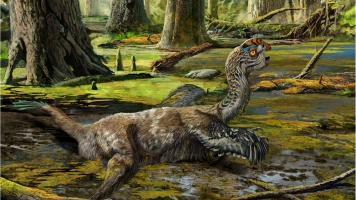
An artist's rendering of Tongtianlong limosus

New dinosaur fossil has a lot in common with its bird relatives

The fossil was recently discovered in China.

LEARN MORE

Adblock test (Why?)


https://news.google.com/rss/articles/CBMiW2h0dHBzOi8vc2NyaXBwc25ld3MuY29tL3N0b3JpZXMvcmFyZS1pbnNlY3QtZm91bmQtb3V0c2lkZS1hLXdhbG1hcnQtZGF0ZXMtYmFjay10by1qdXJhc3NpYy_SAV9odHRwczovL3NjcmlwcHNuZXdzLmNvbS9hbXAvc3Rvcmllcy9yYXJlLWluc2VjdC1mb3VuZC1vdXRzaWRlLWEtd2FsbWFydC1kYXRlcy1iYWNrLXRvLWp1cmFzc2ljLw?oc=5

2023-03-03 22:24:00Z
CBMiW2h0dHBzOi8vc2NyaXBwc25ld3MuY29tL3N0b3JpZXMvcmFyZS1pbnNlY3QtZm91bmQtb3V0c2lkZS1hLXdhbG1hcnQtZGF0ZXMtYmFjay10by1qdXJhc3NpYy_SAV9odHRwczovL3NjcmlwcHNuZXdzLmNvbS9hbXAvc3Rvcmllcy9yYXJlLWluc2VjdC1mb3VuZC1vdXRzaWRlLWEtd2FsbWFydC1kYXRlcy1iYWNrLXRvLWp1cmFzc2ljLw

Feast your eyes on this image of remnant from earliest recorded supernova - Ars Technica

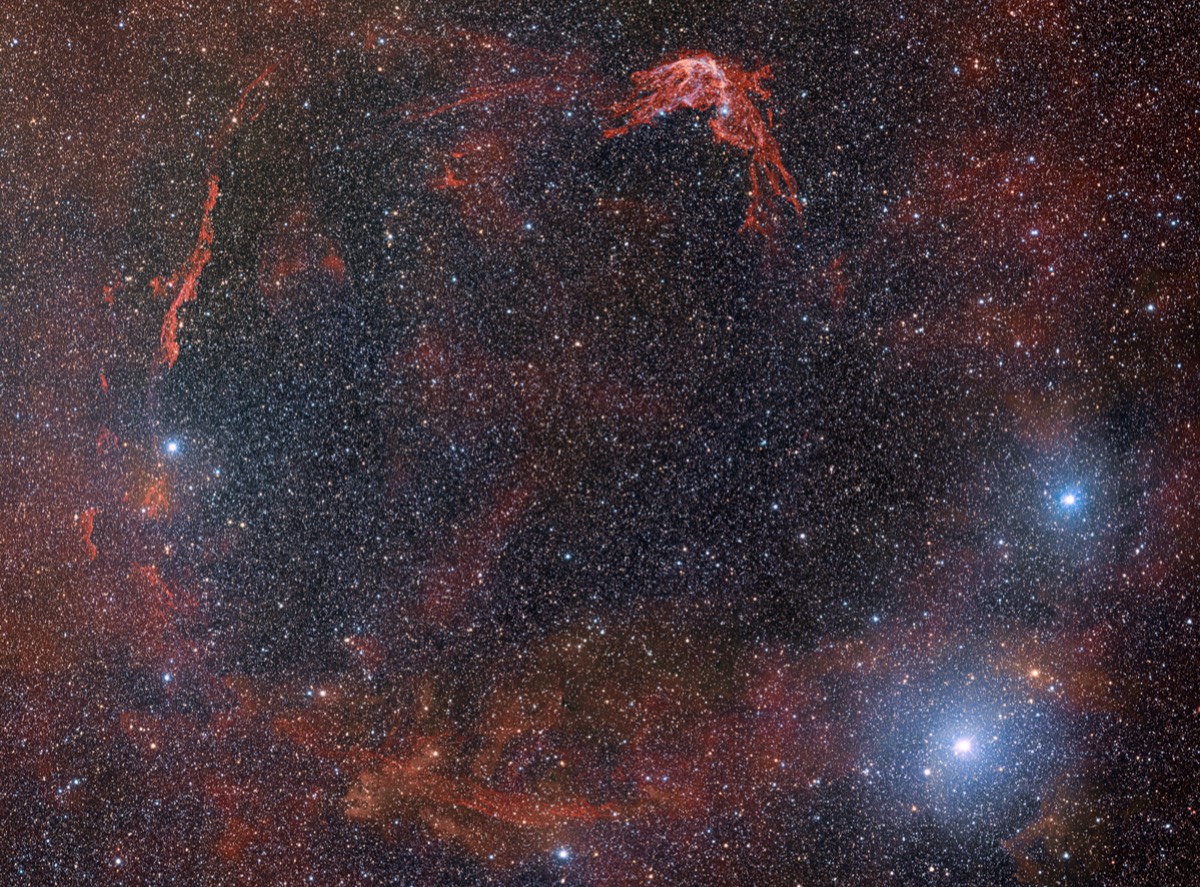
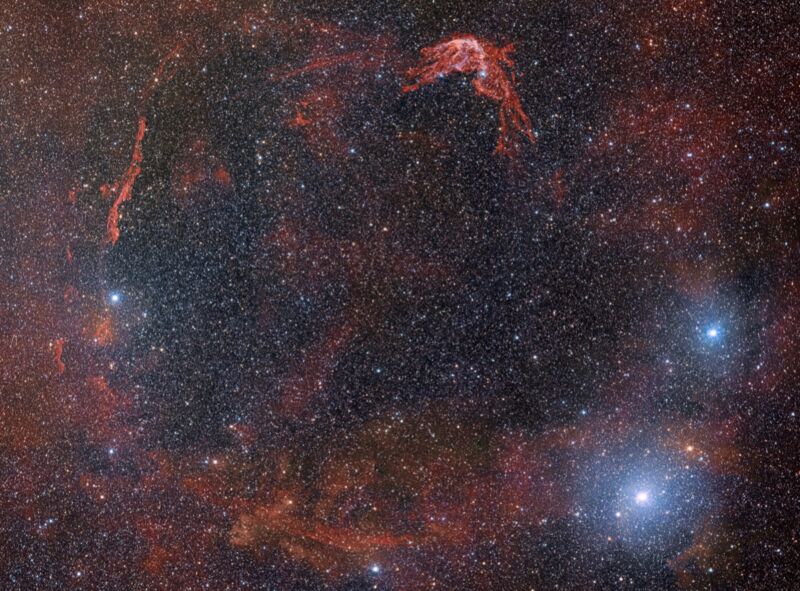
The tattered shell of the first recorded supernova (Sn185) was captured by the Dark Energy Camera. This image covers an impressive 45 arcminutes in the sky—a rare view of the entirety of this supernova remnant.
Enlarge / The tattered shell of the first recorded supernova (Sn185) was captured by the Dark Energy Camera. This image covers an impressive 45 arcminutes in the sky—a rare view of the entirety of this supernova remnant.
CTIO/NOIRLab/DOE/NSF

In early December 185 CE, Chinese astronomers recorded a bright "guest star" in the night sky that shone for eight months in the direction of Alpha Centauri before fading away—most likely the earliest recorded supernova in the historical record. The image above gives us a rare glimpse of the entire tattered remnant of that long-ago explosion, as captured by the Dark Energy Camera (DECam), mounted on the four-meter telescope at the Cerro Tololo Inter-American Observatory in the Andes in Chile. DECam has been operating since 2012, and while it was originally designed to be part of the ongoing Dark Energy Survey, it's also available for other astronomers to use in their research. This new wide-view perspective of the remains of SN 185 should help astronomers learn even more about stellar evolution.

As we've written previously, there are two types of known supernovas, depending on the mass of the original star. An iron-core collapse supernova occurs with massive stars (greater than 10 solar masses), which collapse so violently that it causes a huge, catastrophic explosion. The temperatures and pressures become so high that the carbon in the star's core fuses. This halts the core's collapse, at least temporarily, and this process continues, over and over, with progressively heavier atomic nuclei. When the fuel finally runs out entirely, the (by then) iron core collapses into a black hole or a neutron star.

Then there is a Type Ia supernova. Smaller stars (up to about eight solar masses) gradually cool to become dense cores of ash known as white dwarfs. If a white dwarf that has run out of nuclear fuel is part of a binary system, it can siphon off matter from its partner, adding to its mass until its core reaches high enough temperatures for carbon fusion to occur. These are the brightest supernovae, and they also shine with a remarkably consistent peak luminosity, making them invaluable "standard candles" for astronomers to determine cosmic distances.

There are precious few details about SN185 provided in the Book of Later Han, other than it was the "size of a bamboo mat," and "displayed various colors, both pleasing and otherwise." Astronomers suspected there might be a link between SN 185 and the remnant structure dubbed RCW 86, but for a long time, they assumed the event that formed RCW 86 had been a core-collapse supernova, which would require some 10,000 years for the remnant structure to achieve its present form.

In 2006, new X-ray data gathered by the European Space Agency's XMM-Newton Observatory and NASA's Chandra X-Ray Observatory demonstrated that RCW 86 is much younger than previously thought: about 2,000 years old. The authors were able to calculate how quickly the shockwave within RCW 86 was expanding. They found that there are denser spots where the shockwave is expanding more slowly, misleading astronomers into thinking the remnant was older than it is. But there are other regions where the shockwave is still inside the bubble—and still expanding rapidly—that provide a more accurate estimate of RCW 86's age.

The new age estimate significantly strengthened the case that RCW 86 is the remnant of SN 185. In that case, SN 185 was probably a Type Ia supernova, a conclusion based in part on the discovery that there is a large amount of iron present in the remnant. A white dwarf star devouring its partner in a binary system produced high-velocity winds, pushing gas and dust outward and creating a cavity before the white dwarf exploded. That enabled all that debris to expand outward very rapidly to create the impressive tattered structure that exists today.

Adblock test (Why?)


https://news.google.com/rss/articles/CBMicmh0dHBzOi8vYXJzdGVjaG5pY2EuY29tL3NjaWVuY2UvMjAyMy8wMy9mZWFzdC15b3VyLWV5ZXMtb24tdGhpcy1pbWFnZS1vZi1yZW1uYW50LWZyb20tZWFybGllc3QtcmVjb3JkZWQtc3VwZXJub3ZhL9IBdmh0dHBzOi8vYXJzdGVjaG5pY2EuY29tL3NjaWVuY2UvMjAyMy8wMy9mZWFzdC15b3VyLWV5ZXMtb24tdGhpcy1pbWFnZS1vZi1yZW1uYW50LWZyb20tZWFybGllc3QtcmVjb3JkZWQtc3VwZXJub3ZhL2FtcC8?oc=5

2023-03-03 22:57:24Z
1812983614

Jumat, 03 Maret 2023

SpaceX crew docks at International Space Station - Al Jazeera English

The autonomously flying spacecraft, carrying four crew members, docked successfully on Friday morning.

A SpaceX Crew Dragon capsule has arrived safely at the International Space Station (ISS), carrying two US astronauts, a Russian cosmonaut and a United Arab Emirates astronaut to begin a six-month science mission.

The autonomously flying spacecraft dubbed Endeavour docked at the space station shortly after 06:40 GMT on Friday, nearly 25 hours after launching from NASA’s Kennedy Space Center in Cape Canaveral, Florida.

The coupling was confirmed as the ISS and capsule flew in tandem at 28,164 km/h (17,500 miles per hour) some 240km (250 miles) above Earth across the coast of East Africa, according to a live NASA webcast of the rendezvous.

The four-member team was assigned to conduct more than 200 experiments and technology demonstrations on board the space station, ranging from research on human cell growth in space to controlling combustible materials in microgravity.

Some of the research will help pave the way for future long-duration human expeditions to the Moon and beyond under NASA’s Artemis programme, its successor to Apollo, the US space agency said.

The ISS crew is also responsible for performing maintenance and repairs on board the station, and to prepare for the arrival and departure of other astronauts and cargo payloads.

Designated Crew 6, the mission marks the sixth long-duration ISS team that SpaceX has flown for NASA since the private rocket venture founded by billionaire Elon Musk began sending American astronauts to orbit in May 2020. Musk is CEO of electric carmaker Tesla and social media platform Twitter.

The latest crew was led by Stephen Bowen, 59, a former US Navy submarine officer who has logged more than 40 days in orbit as a veteran of three Space Shuttle flights and seven spacewalks.

SpaceX
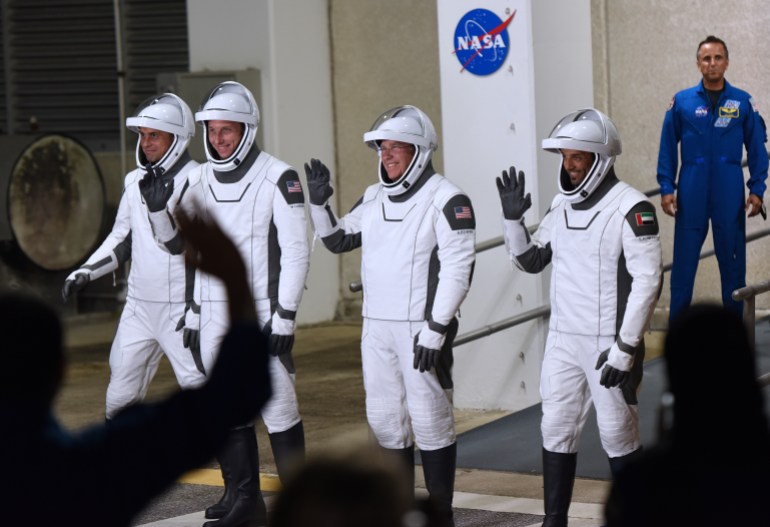
Crew-6 members (L-R) Russian cosmonaut Andrey Fedyaev, NASA astronauts Warren Hoburg and Stephen Bowen, and astronaut Sultan al-Neyadi of the United Arab Emirates wave before riding to pad 39A at the Kennedy Space Center for the launch of the SpaceX Falcon 9 Crew-6 mission [Paul Hennessy/Anadolu Agency]

Fellow NASA astronaut Warren “Woody” Hoburg, 37, an electrical engineer, computer science expert and commercial aviator designated, was making his first spaceflight.

The Crew 6 mission was also notable for its inclusion of UAE astronaut Sultan al-Neyadi, 41, the second person from his country to fly to space and the first to launch from US soil as part of a long-duration space station team.

Rounding out the four-man Crew 6 was Russian cosmonaut Andrey Fedyaev, 42, who, like al-Neyadi is an engineer and spaceflight rookie designated as a mission specialist for the team.

Fedyaev is the second cosmonaut to fly on board an American spacecraft under a renewed ride-sharing deal signed in July by NASA and the Russian space agency Roscosmos, despite heightened tensions between Washington and Moscow over Russia’s invasion of Ukraine.

On arrival, the crew prepared to conduct a series of standard leak checks and to pressurise the passageway between the capsule and the ISS before they could open the hatch to the interior of the space station.

The Crew 6 team will be welcomed on board the space station by seven current ISS occupants – three NASA crew members, including commander Nicole Aunapu Mann, the first Indigenous American woman to fly to space, along with three Russians and a Japanese astronaut.

Those seven are expected to end their mission and depart the space station this month. Four will return in the SpaceX Dragon they rode to orbit in October, and three others will ride home in a Russian Soyuz spacecraft flown empty to the ISS last week to replace one that sprang a coolant leak while docked to the station in December.

Adblock test (Why?)


https://news.google.com/rss/articles/CBMiWmh0dHBzOi8vd3d3LmFsamF6ZWVyYS5jb20vbmV3cy8yMDIzLzMvMy9zcGFjZXgtY3Jldy1kb2Nrcy13aXRoLWludGVybmF0aW9uYWwtc3BhY2Utc3RhdGlvbtIBXmh0dHBzOi8vd3d3LmFsamF6ZWVyYS5jb20vYW1wL25ld3MvMjAyMy8zLzMvc3BhY2V4LWNyZXctZG9ja3Mtd2l0aC1pbnRlcm5hdGlvbmFsLXNwYWNlLXN0YXRpb24?oc=5

2023-03-03 09:01:25Z
1784332837

Kamis, 02 Maret 2023

SpaceX launches US, Russia, UAE astronauts to space station - Al Jazeera English

Elon Musk’s rocket company has sent the four astronauts to the International Space Station.

Elon Musk’s rocket company SpaceX has launched four astronauts to the International Space Station for NASA, including the first person from the Arab world to go for an extended monthslong stay.

The Falcon rocket bolted from the Kennedy Space Center in Cape Canaveral, Florida shortly after midnight on Thursday, illuminating the night sky as it headed up the East Coast.

The trip to the International Space Station (ISS), a laboratory orbiting some 420km (250 miles) above Earth, was expected to take nearly 25 hours, with rendezvous planned for about 06:15 GMT on Friday.

Nearly 80 spectators from the United Arab Emirates watched from the launch site as astronaut Sultan al-Neyadi – only the second Emirati to fly to space – blasted off on his six-month mission.

Half a world away in Dubai and elsewhere across the UAE, schools and offices planned to broadcast the launch live.

Also riding the Dragon capsule that is due at the space station on Friday: NASA’s Stephen Bowen, a retired Navy submariner who logged three space shuttle flights, and Warren “Woody” Hoburg, a former research scientist at Massachusetts Institute of Technology and space newbie, and Andrey Fedyaev, a space rookie who has retired from the Russian Air Force.

The first attempt to launch them was called off on Monday at the last minute because of a clogged filter in the engine ignition system.

They will replace a US-Russian-Japanese crew that has been up there since October. The other station residents are two Russians and an American whose six-month stay was doubled, until September, after their Soyuz capsule sprang a leak. A replacement Soyuz arrived last weekend.

Al-Neyadi, a communications engineer, served as a backup for the first Emirati astronaut, Hazza al-Mansoori, who rode a Russian rocket to the space station in 2019 for a weeklong visit. The UAE paid for al-Neyadi’s seat on the SpaceX flight.

The UAE’s minister for public education and advanced technology, Sarah al-Amiri, said the long mission “provides us a new venue for science and scientific discovery for the country”.

“We don’t want to just go to space and then not have much to do there or not have impact,” said the director general of the UAE’s space centre in Dubai, Salem al-Marri.

The UAE already has a spacecraft orbiting Mars, and a mini rover is hitching a ride to the Moon on a Japanese lander. Two new UAE astronauts are training with NASA’s latest astronaut picks in Houston.

SpaceX
The astronauts will spend six months at the International Space Station [Paul Hennessy/Anadolu]

Saudi Prince Sultan bin Salman was the first Arab in space, launching on board the shuttle Discovery in 1985. He was followed two years later by Syrian astronaut Muhammed Faris, launched by Russia. Both were in space for about a week.

Al-Neyadi will be joined this spring by two Saudi astronauts going to the space station on a short private SpaceX flight paid for by their government.

“It’s going to be really exciting, really interesting” to have three Arabs in space at once, he said last week. “Our region is also thirsty to learn more.”

He is taking up lots of dates to share with his crewmates, especially during Ramadan, the Muslim holy month which begins this month. As for observing Ramadan in orbit, he said fasting is not compulsory since it could make him weak and jeopardise his mission.

Bowen, the crew’s leader, said the four have jelled well as a team despite differences between their countries. Even with the tension over the war in Ukraine, the US and Russia have continued to work together on the space station and trade seats on rides there.

“It’s just tremendous to have the opportunity to fly with these guys,” Bowen said.

Adblock test (Why?)


https://news.google.com/rss/articles/CBMiYWh0dHBzOi8vd3d3LmFsamF6ZWVyYS5jb20vbmV3cy8yMDIzLzMvMi9zcGFjZXgtbGF1bmNoZXMtdXMtcnVzc2lhLXVhZS1hc3Ryb25hdXRzLXRvLXNwYWNlLXN0YXRpb27SAWVodHRwczovL3d3dy5hbGphemVlcmEuY29tL2FtcC9uZXdzLzIwMjMvMy8yL3NwYWNleC1sYXVuY2hlcy11cy1ydXNzaWEtdWFlLWFzdHJvbmF1dHMtdG8tc3BhY2Utc3RhdGlvbg?oc=5

2023-03-02 08:16:03Z
1784332837

Rabu, 01 Maret 2023

Huge Jurassic-era bug found outside Arkansas Walmart in ‘super-rare’ discovery - Global News

Scientists are unravelling a mystery that may have never seen the light of day if not for a fateful encounter over 10 years ago outside a Walmart in Arkansas.

That’s when Michael Skvarla, director of Penn State’s Insect Identification Lab, came across an astonishingly large flying insect while shopping for groceries.

“I remember it vividly, because I was walking into Walmart to get milk and I saw this huge insect on the side of the building,” said Skvarla, who was working on his PhD at the University of Arkansas at the time.

Read more: Missing father of 3 found inside shark’s stomach, IDed by tattoo

“I thought it looked interesting, so I put it in my hand and did the rest of my shopping with it between my fingers. I got home, mounted it, and promptly forgot about it for almost a decade.”

At the time, Skvarla didn’t know that the insect he so casually held in his fingers was a living artifact. What he thought was an antlion, a bug that resembles a dragonfly, was actually a giant lacewing.

Giant lacewings were abundant during the time of the dinosaurs, but they mysteriously died out in eastern North America over half a century ago. The last giant lacewing recorded in the area was found in the 1950s but this is the first of the species to be found in Arkansas.

Read more: ChatGPT wouldn’t exist without Canadian AI pioneers. Why one fears for the future

“This discovery suggests there may be relic populations of this large, Jurassic-Era insect yet to be discovered,” reads a press release from Penn State about the discovery.

No one knows why the giant lacewing disappeared from the area, but scientists have hypothesized that light pollution, invasive species or even forest fire suppression could be to blame.

Misidentified by Skvarla, the historic rediscovery of the giant lacewing could have gone completely unnoticed.

Flashing forward to 2020, Skvarla, now a professor, was teaching a fourth-year entomology course at Penn State on Zoom after the world went into lockdown amid the COVID-19 pandemic. Since he was teaching from home, Skvarla used his own personal insect collection as samples to show students.

Skvarla showed the class the giant bug he had collected at Walmart all those years ago, presenting it as an antlion. But as Skvarla was explaining the insect’s features to his students, he noticed something was wrong. The characteristics he was describing didn’t match the label.

“We were watching what Dr. Skvarla saw under his microscope and he’s talking about the features and then just kinda stops,” said Codey Mathis, a PhD candidate in entomology at Penn State. “We all realized together that the insect was not what it was labelled and was in fact a super-rare giant lacewing.

Read more: ‘Cocaine Bear’ — The wild true story of a drugged-up bear that inspired the film

“I still remember the feeling. It was so gratifying to know that the excitement doesn’t dim, the wonder isn’t lost. Here we were making a true discovery in the middle of an online lab course.”

Skvarla and his colleagues performed molecular DNA analyses on the giant lacewing specimen to confirm its true identity. He has since published a paper about the discovery in the Proceedings of the Entomological Society of Washington.

The giant lacewing has been transferred to the Frost Entomological Museum at Penn State, where scientists and students will be able to access it for further study.

Read more: Ford vehicles of the future could repossess themselves and drive away

“Entomology can function as a leading indicator for ecology,” Skvarla said. “The fact that this insect was spotted in a region that it hasn’t been seen in over half a century tells us something more broadly about the environment.”

Another one of Skvarla’s students marvelled at the find.

“It was one of those experiences you don’t expect to have in a prerequisite lab course,” said Louis Nastasi. “Here we were, just looking at specimens to identify them and all of a sudden, out of nowhere, this incredible new record pops up.”

&copy 2023 Global News, a division of Corus Entertainment Inc.

Adblock test (Why?)


https://news.google.com/rss/articles/CBMiVGh0dHBzOi8vZ2xvYmFsbmV3cy5jYS9uZXdzLzk1MTk5NjEvZ2lhbnQtYnVnLWxhY2V3aW5nLWp1cmFzc2ljLWVyYS1hcmthbnNhcy13YWxtYXJ0L9IBAA?oc=5

2023-03-01 19:15:22Z
1808429234

First ever Canadian lunar rover will hunt for frozen water on the moon - University of Alberta

EDMONTON - The first ever Canadian rover to set wheels on the moon is under construction for a mission set to launch as early as 2026. The rover will explore the south polar region of the moon in a search for frozen water in the lunar soil. 

The Canadian Space Agency has awarded a contract to Canadensys Aerospace Corporation to build the rover, with the project involving NASA, industry partners and academic researchers, including the University of Alberta’s Chris Herd, a professor of Earth and Atmospheric Sciences. The lunar rover will weigh about 30 kilograms and will take along six scientific payloads designed to gather data, five of which are Canadian.

Herd is helping develop a tool called the Lunar Hydrogen Autonomous Neutron Spectrometer (LHANS), which is being developed by Ontario-based Bubble Technology Industries. The LHANS tool is designed to detect water ice on the moon by identifying the presence of hydrogen in the lunar soil. By looking for the signature of radiation from space as it interacts with material beneath the moon's surface, the LHANS tool can confirm the presence of hydrogen.

Craig Hardgrove, an associate professor in the School of Earth and Space Exploration at Arizona State University, will interpret the hydrogen component of the data, while Herd will focus on any other elements or minerals present.

Herd notes that the mission will focus on the permanently shadowed southern regions of the moon, as these areas act as "cold traps" for any frozen water present. "Any kind of water vapor that's around will migrate and get trapped into these cold spots," he explains.

If frozen water is found on the moon, it would be a step forward for space exploration. "Water is one of the most important resources we could look for, because the less we have to bring with us from Earth, the more we can use there and the less expensive it is overall to go to the moon and eventually set up a long-term presence," says Herd.

While the tool and the rover are still under development, Herd will become a part of the mission when it begins. He’s no stranger to rover missions, having also been involved in a Mars rover mission over the past two years.

He is thrilled that the lunar rover mission is being led by Canadians with mostly Canadian instruments, with NASA contributing to the project. "Our American partners are super excited as well, because it's a different way of doing things for them, and we've been great partners in space exploration for a long time," he says.

The full story can be seen here. To arrange an interview with Chris Herd, please contact:

Ross Neitz | U of A media strategist | ross.neitz@ualberta.ca | 780-297-8354

Adblock test (Why?)


https://news.google.com/rss/articles/CBMiqwFodHRwczovL3d3dy51YWxiZXJ0YS5jYS9uZXdzL25ld3MtcmVsZWFzZXMtYW5kLXN0YXRlbWVudHMvbmV3cy1yZWxlYXNlcy8yMDIzLzAzLW1hcmNoL2ZpcnN0LWV2ZXItY2FuYWRpYW4tbHVuYXItcm92ZXItd2lsbC1odW50LWZvci1mcm96ZW4td2F0ZXItb24tdGhlLW1vb25uZXdzLXN0b3J5Lmh0bWzSAQA?oc=5

2023-03-01 18:02:30Z
CBMiqwFodHRwczovL3d3dy51YWxiZXJ0YS5jYS9uZXdzL25ld3MtcmVsZWFzZXMtYW5kLXN0YXRlbWVudHMvbmV3cy1yZWxlYXNlcy8yMDIzLzAzLW1hcmNoL2ZpcnN0LWV2ZXItY2FuYWRpYW4tbHVuYXItcm92ZXItd2lsbC1odW50LWZvci1mcm96ZW4td2F0ZXItb24tdGhlLW1vb25uZXdzLXN0b3J5Lmh0bWzSAQA

NASA and SpaceX Move Forward With Crew-6 Launch to International Space Station - SciTechDaily

NASA SpaceX Crew-6 Falcon 9 Sunset

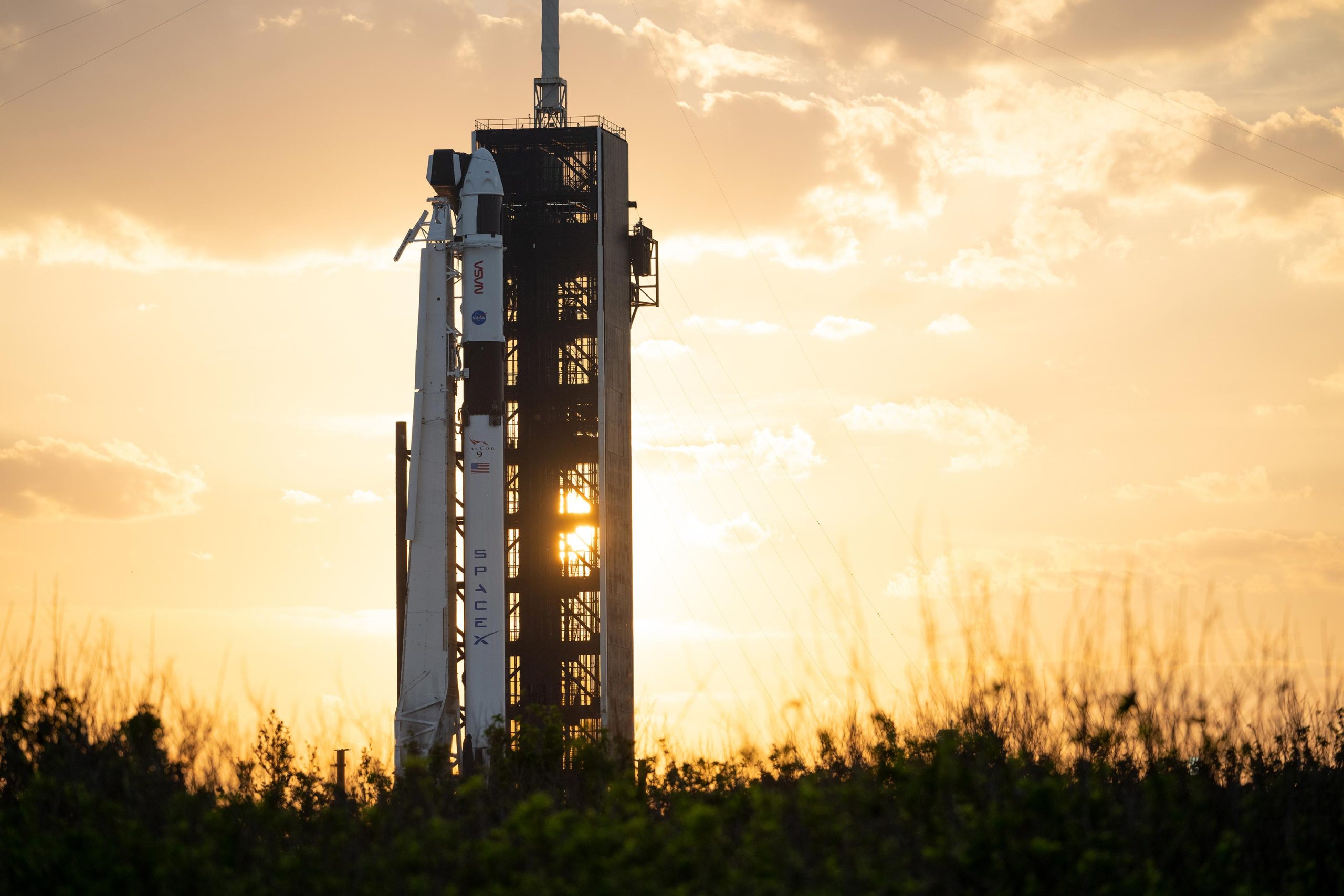
A SpaceX Falcon 9 rocket with the company’s Dragon spacecraft on top is seen at sunset on Saturday, February 25, 2023, at NASA’s Kennedy Space Center in Florida. The rocket sits ready on the launch pad at Launch Complex 39A as preparations continue for the Crew-6 mission. NASA’s SpaceX Crew-6 mission is the sixth crew rotation mission of the SpaceX Crew Dragon spacecraft and Falcon 9 rocket to the International Space Station as part of the agency’s Commercial Crew Program. NASA astronauts Stephen Bowen and Warren “Woody” Hoburg, UAE (United Arab Emirates) astronaut Sultan Alneyadi, and Roscosmos cosmonaut Andrey Fedyaev are scheduled to launch at 12:34 a.m. EST on Thursday, March 2, from Launch Complex 39A at the Kennedy Space Center. Credit: NASA/Joel Kowsky

NASA’s SpaceX Crew-6 mission is ‘Go’ for launch to the International Space Station (ISS) following the completion of a launch readiness review, weather briefing, and mission management meeting today (February 28). Launch on a SpaceX Falcon 9 rocket and Dragon spacecraft from Launch Complex 39A from NASA’s Kennedy Space Center in Florida is now targeted at 12:34 a.m. EST on Thursday, March 2.

Mission teams stood down from a February 27 launch attempt to review an unusual data signature related to confirming a proper bleed in of pad supplied fluid known as triethylaluminum triethylboron (TEA-TEB). TEA-TEB is an ignition fluid used to start the Falcon 9’s nine first stage kerosene/liquid oxygen Merlin engines. The bleed-in process ensures there is an adequate supply of this fluid at each engine to mix with liquid oxygen to start the engines. During prelaunch, the TEA-TEB fluid – which originates in a ground supply tank – flows to the rocket’s interface and back to a catch tank to remove gas from the ground plumbing. During engine start, the fluid then flows to the engines for ignition. Flow into the catch tank is one of several parameters used to determine that the fluid has been properly bled into the system.

After a thorough review of the data and ground system, NASA and SpaceX determined there was a reduced flow back to the ground TEA-TEB catch tank due to a clogged ground filter. This clogged filter fully-explained the signature observed on the launch attempt. SpaceX teams replaced the filter, purged the TEA-TEB line with nitrogen, and verified the lines are clean and ready for launch.

NASA SpaceX Crew-6 Live Launch Coverage

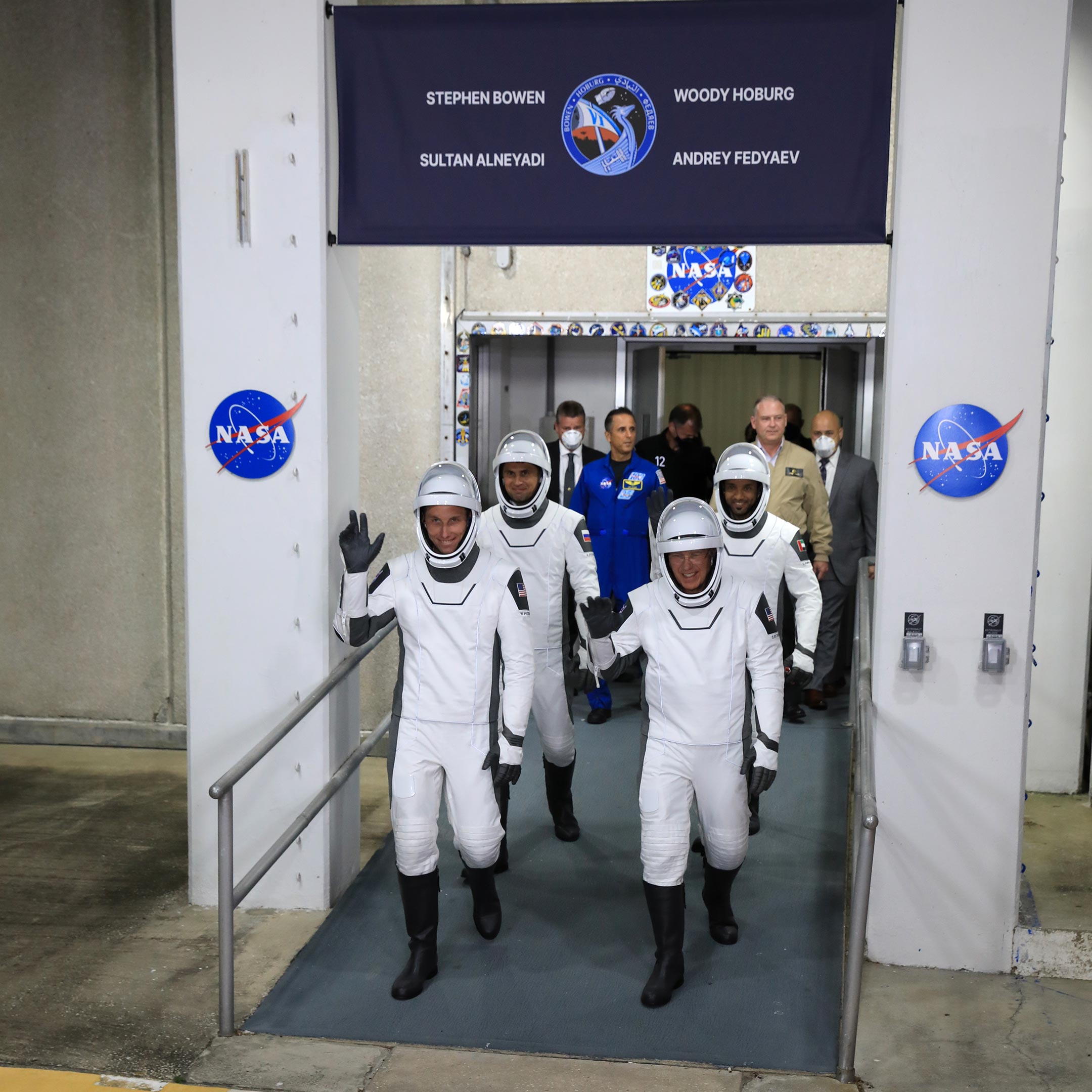
NASA’s SpaceX Crew-6 astronauts walk out of the Neil Armstrong Operations and Checkout Building at the agency’s Kennedy Space Center in Florida on February 26, 2023. In front, from left are NASA astronaut Warren “Woody” Hoburg, pilot; and NASA astronaut Stephen Bowen, spacecraft commander. Behind them, from left are Andrei Fedyaev, Roscosmos cosmonaut and mission specialist; and Sultan Alneyadi, UAE (United Arab Emirates) astronaut and mission specialist. Credit: NASA/Kim Shiflett

Weather officials with Cape Canaveral Space Force Station’s 45th Weather Squadron continue to predict a 95% chance of favorable weather conditions for Crew-6 launch, with the flight through precipitation rule serving as the primary weather concern. Conditions along the Dragon ascent corridor are within acceptable limits, but will remain a watch item for Thursday’s attempt.

NASA astronauts Stephen Bowen, mission commander, and Warren Hoburg, pilot, along with UAE (United Arab Emirates) astronaut Sultan Alneyadi and Roscosmos cosmonaut Andrey Fedyaev, who join as mission specialists, will travel to the space station for a science expedition mission. The international crew will fly aboard the Dragon spacecraft named Endeavour, which previously flew NASA’s SpaceX Demo-2, NASA’s SpaceX Crew-2, and Axiom Mission 1 astronauts.

After an approximate 24.5-hour transit, the crew will dock to the space-facing port of the microgravity laboratory’s Harmony module at about 1:17 a.m. on Friday, March 3. Hatch opening is targeted for approximately 3:27 a.m., followed by the welcome ceremony at about 3:40 a.m. Arrival coverage on NASA TV and the agency’s website begins on Thursday, March 2, at 11:30 p.m.

Starting at 9 p.m. Wednesday, March 1, tune in to a Crew-6 live launch broadcast on NASA TV or the agency’s website and follow along through countdown and other key mission milestones.

Adblock test (Why?)


https://news.google.com/rss/articles/CBMiaGh0dHBzOi8vc2NpdGVjaGRhaWx5LmNvbS9uYXNhLWFuZC1zcGFjZXgtbW92ZS1mb3J3YXJkLXdpdGgtY3Jldy02LWxhdW5jaC10by1pbnRlcm5hdGlvbmFsLXNwYWNlLXN0YXRpb24v0gEA?oc=5

2023-03-01 07:41:13Z
1784332837