Jumat, 02 Juni 2023

Webb Takes Portrait of Star-Studded Barred Galaxy - Gizmodo

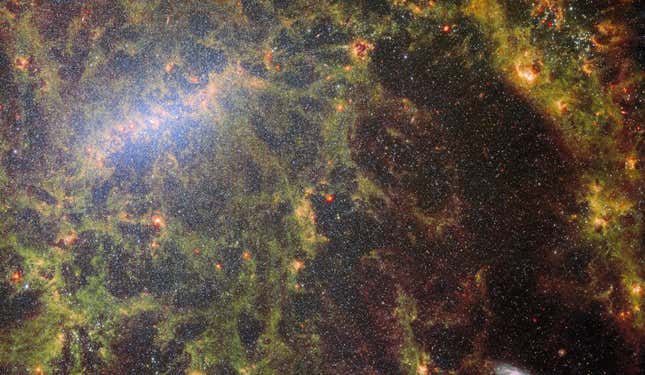
NGC 5068, as seen by Webb's MIRI and NIRCam instruments.
NGC 5068, as seen by Webb’s MIRI and NIRCam instruments.
Image: ESA/Webb, NASA & CSA, J. Lee and the PHANGS-JWST Team

The Webb Space Telescope is on a tear, imaging regions of star formation across the cosmos. Its latest target? The barred spiral galaxy NGC 5068—a bedazzled conglomeration of gas and stars 17 million light-years from Earth.

Launched in December 2021, Webb has been making scientific observations since July 2022. It’s uniquely capable of seeing some of the oldest, most distant light, which it does at infrared wavelengths. Taking data on this ancient light clues astronomers into the formation and evolution of the universe as we know it.

But besides that ancient light, Webb is examining a bevy of cosmic objects, from distant supernovae to planets in our own solar system. Its perceptive vision can cut through clouds of gas and dust that obscure regions of star formation from more veteran telescopes, like the Hubble Space Telescope.

Bit by bit—image by image—the telescope is providing new data about how the universe works. Some of Webb’s coolest and most remarkable images to date can be seen here.

Enter NGC 5068. Sitting in the constellation Virgo, the barred spiral galaxy is filled with yellower dust and fiery regions of gas in Webb’s view. The image is a close-up, showing the galaxy’s core and part of one of its arms. Stars pepper the image’s foreground.

This image is a composite of images taken with two imagers aboard Webb, the Near-Infrared Camera (NIRCam) and the Mid-Infrared Instrument (MIRI). Combining the powers of the two instruments offers a holistic view of the region. The image by NIRCam emphasizes the foreground stars, while MIRI’s image reveals the larger structure of the galaxy, as well as a couple of asteroid trails (which appear as blue-green-red dots).
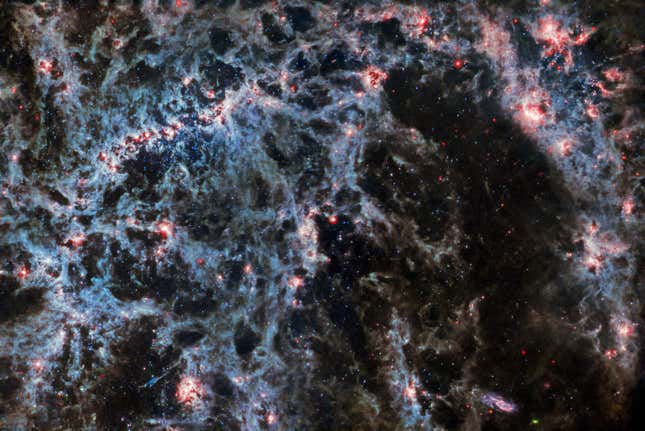
The same view of the galaxy as seen by MIRI alone.
Image: ESA/Webb, NASA & CSA, J. Lee and the PHANGS-JWST Team

There’s an extensive thought process behind what filters are applied in Webb imaging, and what aspects of each image to highlight when visible light colors are assigned to the infrared wavelengths the observatory takes in. Last year Gizmodo spoke to Webb’s image processors to learn about how they choose what parts of an image to emphasize, and how.

The NGC 5068 image was collected along with images of 18 other star-forming galaxies, which astronomers are combining with existing data on over 40,000 star clusters, nebulae, and molecular clouds taken by Hubble, the Very Large Telescope, and the Atacama Large Millimeter/submillimeter array.

Taken altogether, these catalogs are deepening astronomers’ knowledge of how stars (and what kinds) take shape in different recesses of space. With Webb’s perceptive gaze, scientists are cutting through the gas and dust that has literally clouded understandings in the past.

More: The Coolest Space Images of 2022

Adblock test (Why?)


https://news.google.com/rss/articles/CBMiUGh0dHBzOi8vZ2l6bW9kby5jb20vd2ViYi10YWtlcy1wb3J0cmFpdC1vZi1zdGFyLXN0dWRkZWQtYmFycmVkLWdhbGF4eS0xODUwNTAxMjQz0gEA?oc=5

2023-06-02 19:20:00Z
2106469849

Mysterious cosmic threads are reaching out from the Milky Way's monster black hole - Space.com

MeerKAT image of the galactic center with color-coded position angles of all filaments. (Image credit: Farhad Yusef-Zadeh/Northwestern University)

The Milky Way is full of cosmic threads reaching out from the supermassive black hole at our galaxy's center.

Hundreds of filaments of gas, each 5–10 light-years in length, line the galactic center and radiate outward along the plane of the galaxy like spokes on a bicycle wheel with our galaxy's black hole at the hub, new radio observations made by South Africa's MeerKAT telescope reveal.

"It was a surprise to suddenly find a new population of structures that seem to be pointing in the direction of the black hole," said Farhad Yusef-Zadeh of Northwestern University in a statement. "We found that these filaments are not random but appear to be tied to the outflow of our black hole."

Related: Milky Way galaxy: Everything you need to know about our cosmic neighborhood

In 1984 Farhad Yusef-Zadeh found huge, thin, magnetic filaments hanging perpendicular to the galactic plane (the imaginary line that separates the galaxy into a "top" and "bottom" half) near Sagittarius A*, the black hole at the core of our Milky Way galaxy that is over 4 million times larger than our sun. But his new discovery of horizontal, threaded filaments that look like lines of the dots and dashes of Morse code came as a surprise.

"We have always been thinking about vertical filaments and their origin," said Yusef-Zadeh. "I'm used to them being vertical. I never considered there might be others along the plane [of the galaxy]."

Despite superficial similarities, the two types of filament are substantially different to each other, and Yusef-Zadeh suspects that they have different origins.

For example, at about 150 light-years long the vertical filaments are much larger and don't specifically point back towards the black hole, but come in pairs and clusters. They number in the thousands and are filled with particles moving at almost the speed of light.

On the other hand, only a few hundred of the horizontal filaments have been discovered, and all of them located on just one side of the black hole. They appear to glow from thermal radiation emitted by warm molecular gas and given that they point radially away from the black hole, could signify an outflow of material directly from Sagittarius A* itself. 

Yusef-Zadeh estimates that the horizontal filaments may be only 6 million years old, and that "they must have originated with some kind of outflow from an activity that happened a few million years ago. It seems to be the result of an interaction of that outflowing material with objects near it."

An Event Horizon Telescope image of Sagittarius A* at the core of our galaxy.  (Image credit: EHT Collaboration.)

What these filaments could teach us about Sagittarius A* could ultimately be quite profound. The 'no-hair theorem,' coined by famed theoretician John Wheeler, posits that a black hole can be defined by only three properties: Its mass, its angular momentum (the rotational momentum of the black hole's spin) and its electric charge. 

Since black holes are not expected to carry a particularly strong electric charge, it means that black holes are effectively defined by only their mass and their spin and no other features (i.e. they have 'no hair'). For Sagittarius A* we already know the mass — 4.1 million times the mass of our sun — but its spin is less well known, thought to be no more than 10% of the speed of light.

RELATED STORIES:

"By studying [the filaments], we could learn more about the black hole's spin and accretion disc orientation," said Yusef-Zadeh. The latter could teach us more about how Sagittarius A* is feeding on material that wanders too close to it.

That the findings came as a surprise to Yusef-Zadeh shows that there is still much to learn about the galactic center and the black hole's interactions with the rest of the Milky Way.

"Our work is never complete," he said "We always need to make new observations and continually challenge our ideas and tighten up our analysis."

The findings were published June 2 in The Astrophysical Journal Letters.

Adblock test (Why?)


https://news.google.com/rss/articles/CBMiNGh0dHBzOi8vd3d3LnNwYWNlLmNvbS9taWxreS13YXktYmxhY2staG9sZS1maWxhbWVudHPSAQA?oc=5

2023-06-02 16:30:00Z
2100167851

First-of-its-kind Mars livestream by ESA spacecraft interrupted at times by rain on Earth - Phys.org

First-of-its-kind Mars livestream by ESA spacecraft interrupted at times by rain on Earth
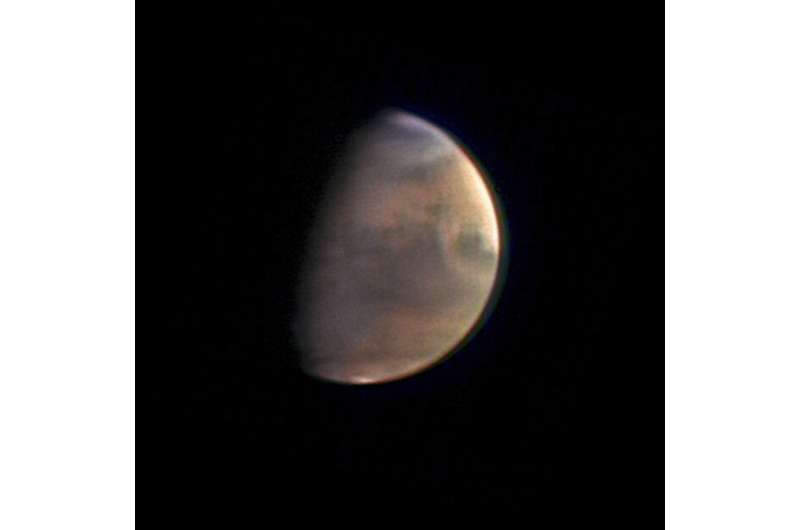
This image provided by the European Space Agency and taken with the ESA's High Resolution Stereo Camera (HRSC) aboard the Mars Express spacecraft shows Mars as the spacecraft approaches the planet from a distance of 5.5 million kilometers. Launched in 2003, the spacecraft marked it's 20th anniversary, Friday, June 2, 2023. Credit: European Space Agency via AP

A European spacecraft around Mars sent its first livestream from the red planet to Earth on Friday to mark the 20th anniversary of its launch, but rain in Spain interfered at times.

The European Space Agency broadcast the livestream with views courtesy of its Mars Express, launched by a Russian rocket from Kazakhstan in 2003.

It took nearly 17 minutes for each picture to reach Earth, nearly 200 million miles (300 million kilometers) away, and another minute to get through the ground stations.

The transmission was disrupted at times by at the deep space-relay antenna in Spain.

Still, enough images made it through to delight the European space officials hosting the hourlong livestream. The initial views showed about one-third of Mars, which gradually grew bigger in the frames before shrinking again as the spacecraft circled the planet. White clouds could clearly be seen in some of the shots.

"If you were currently sitting on board Mars Express ... this is what you would be seeing," said Simon Wood, the mission's spacecraft operations engineer. "We typically don't normally get images in this way."

Pictures and other data usually are stored aboard the spacecraft and later transmitted to Earth, according to Wood, when the spacecraft's antenna can be pointed this way.

Near real-time footage from so far away is "rather rare," according to ESA. The agency pointed to the by the Apollo moonwalkers more than a half-century ago and, more recently, live snippets from spacecraft deliberately crashing into the moon and an asteroid.

"These missions were all pretty close to home and others farther away sent perhaps an image or two in near . When it comes to a lengthy livestream from , this is a first," ESA said in a statement before the event.

The rain on the plains in Spain cut into the number of pictures shown. ESA devoted only an hour to the livestream because it did not want to overload the spacecraft's batteries.

Mars Express traveled to the with a lander, dubbed Beagle-2, which lost contact with Earth as it attempted to touch down on the Martian surface.

More than a decade later, NASA's Mars Reconnaissance Orbiter captured pictures of Beagle-2. Although it made it to the surface, the lander's solar panels didn't fully unfurl.

© 2023 The Associated Press. All rights reserved. This material may not be published, broadcast, rewritten or redistributed without permission.

Citation: First-of-its-kind Mars livestream by ESA spacecraft interrupted at times by rain on Earth (2023, June 2) retrieved 2 June 2023 from https://phys.org/news/2023-06-first-of-its-kind-mars-livestream-esa-spacecraft.html

This document is subject to copyright. Apart from any fair dealing for the purpose of private study or research, no part may be reproduced without the written permission. The content is provided for information purposes only.

Adblock test (Why?)


https://news.google.com/rss/articles/CBMiU2h0dHBzOi8vcGh5cy5vcmcvbmV3cy8yMDIzLTA2LWZpcnN0LW9mLWl0cy1raW5kLW1hcnMtbGl2ZXN0cmVhbS1lc2Etc3BhY2VjcmFmdC5odG1s0gFSaHR0cHM6Ly9waHlzLm9yZy9uZXdzLzIwMjMtMDYtZmlyc3Qtb2YtaXRzLWtpbmQtbWFycy1saXZlc3RyZWFtLWVzYS1zcGFjZWNyYWZ0LmFtcA?oc=5

2023-06-02 19:05:50Z
2097823745

Kamis, 01 Juni 2023

Private Astronaut Crew, Including First Arab Woman in Orbit, Returns from Space Station - Voice of America - VOA News

An all-private astronaut team of two Americans and two Saudis, including the first Arab woman sent into orbit, splashed down safely off Florida on Tuesday night, capping an eight-day research mission aboard the International Space Station.

The SpaceX Crew Dragon capsule carrying them parachuted into the Gulf of Mexico off the coast of Panama City, Florida, after a 12-hour return flight and blazing re-entry plunge through Earth's atmosphere.

The splashdown was carried live by a joint webcast presented by SpaceX and the company behind the mission, Axiom Space.

It concluded the second space station mission organized, equipped and trained entirely at private expense by Axiom, a seven-year-old Houston-based venture headed by NASA's former ISS program manager.

The Axiom 2 crew was led by retired NASA astronaut Peggy Whitson, 63, who holds the U.S. record for most time spent in orbit with 665 days in space over three long-duration missions to the ISS, including 10 spacewalks. She now serves as Axiom's director of human spaceflight.

"That was a phenomenal ride. We really enjoyed all of it," Whitson radioed to mission controllers moments after splashdown.

Ax-2's designated pilot was John Shoffner, 67, an aviator, race car driver and investor from Alaska.

Rounding out the crew as mission specialists were the first two astronauts from Saudi Arabia to fly aboard a private spacecraft: Ali Alqarni, 31, a fighter pilot for the Royal Saudi Air Force; and Rayyanah Barnawi, 34, a biomedical scientist in cancer stem cell research.

Barnawi was the first woman from the Arab world ever launched into Earth orbit and the first Saudi woman to fly in space, an achievement that came barely five years after women in the Persian Gulf kingdom gained the right to drive in June 2018.

In this image taken from video broadcast by SpaceX, crew members wave after the SpaceX Dragon capsule splashed down into the Gulf of Mexico, just off the Florida Panhandle, May 30, 2023. (SpaceX via AP)

In August 2022, Sara Sabry became the first Arab woman and the first Egyptian to fly to space on a brief suborbital ride operated by the Blue Origin astro-tourist venture of Jeff Bezos.

The ISS stay of Alqarni and Barnawi was also notable for overlapping with that of Sultan Al Neyadi, an ISS Expedition-69 crew member from the United Arab Emirates, marking the first time three astronauts from the Arab world were aboard the space station together.

The Axiom 2 mission, which launched on May 21, was the latest in a series of space expeditions bankrolled by private investment capital and wealthy passengers rather than by taxpayer dollars as NASA seeks to expand commercial access to low-Earth orbit.

Axiom, which sent its first four-member astronaut team to the ISS in April 2022, also has signed a contract with the U.S. space agency to build the first commercial addition to the orbiting laboratory.

California-based SpaceX, founded by Twitter owner and Tesla Inc. electric carmaker CEO Elon Musk, supplied the Falcon 9 rocket and crew capsule that ferried Axiom's team to and from orbit and controlled the flight.

NASA furnished the launch site at its Kennedy Space Center in Cape Canaveral, Florida, and assumed responsibility for the Axiom crew during its stay aboard the space station, orbiting some 400 kilometers above Earth.

Adblock test (Why?)


https://news.google.com/rss/articles/CBMifWh0dHBzOi8vd3d3LnZvYW5ld3MuY29tL2EvcHJpdmF0ZS1hc3Ryb25hdXQtY3Jldy1pbmNsdWRpbmctZmlyc3QtYXJhYi13b21hbi1pbi1vcmJpdC1yZXR1cm5zLWZyb20tc3BhY2Utc3RhdGlvbi0vNzExOTc1NC5odG1s0gF_aHR0cHM6Ly93d3cudm9hbmV3cy5jb20vYW1wL3ByaXZhdGUtYXN0cm9uYXV0LWNyZXctaW5jbHVkaW5nLWZpcnN0LWFyYWItd29tYW4taW4tb3JiaXQtcmV0dXJucy1mcm9tLXNwYWNlLXN0YXRpb24tLzcxMTk3NTQuaHRtbA?oc=5

2023-06-02 00:53:52Z
2084740937

James Webb Space Telescope finds water in super-hot exoplanet's atmosphere - Space.com

The James Webb Space Telescope has found traces of water vapor in the atmosphere of a super-hot gas giant exoplanet that orbits its star in less than one Earth day. 

The exoplanet in question, WASP-18 b, is a gas giant 10 times more massive than the solar system's largest planet, Jupiter. The planet is quite extreme, as it orbits the sun-like star WASP-18, which is located some 400 light-years away from Earth, at an average distance of just 1.9 million miles (3.1 million kilometers). For comparison, the solar system's innermost planet, Mercury, circles the sun at a distance of 39.4 million miles (63.4 million km). 

Due to such close proximity to the parent star, the temperatures in WASP-18 b's atmosphere are so high that most water molecules break apart, NASA said in a statement. The fact that Webb managed to resolve signatures of the residual water is a testament to the telescope's observing powers. 

Related: Exoplanets, dark matter and more: Big discoveries coming from James Webb Space Telescope, astronomers say

"The spectrum of the planet’s atmosphere clearly shows multiple small but precisely measured water features, present despite the extreme temperatures of almost 5,000 degrees Fahrenheit (2,700 degrees Celsius)," NASA wrote in the statement. "It’s so hot that it would tear most water molecules apart, so still seeing its presence speaks to Webb’s extraordinary sensitivity to detect remaining water."

WASP-18 b, discovered in 2008, has been studied by other telescopes, including the Hubble Space Telescope, NASA's X-ray space telescope Chandra, the exoplanet hunter TESS and the now-retired infrared Spitzer Space Telescope. None of these space telescopes, however, was sensitive enough to see the signatures of water in the planet's atmosphere.

"Because the water features in this spectrum are so subtle, they were difficult to identify in previous observations," Anjali Piette, a postdoctoral fellow at the Carnegie Institution for Science and one of the authors of the new research, said in the statement. "That made it really exciting to finally see water features with these JWST observations."

In addition to being so massive, hot and close to its parent star, WASP-18 b is also tidally locked. That means one side of the planet constantly faces the star, just like the moon's near side always faces Earth. As a result of this tidal locking, considerable differences in temperature exist across the planet's surface. The Webb measurements, for the first time, enabled scientists to map these differences in detail. 

The James Webb Space Telescope detected traces of water in the super hot atmosphere of exoplanet WASP-18 b

The signature of water detected in the super hot atmosphere of exoplanet WASP-18 b by the James Webb Space Telescope. (Image credit: NASA/JPL-Caltech (R. Hurt/IPAC))

The measurements found that the most intensely illuminated parts of the planet can be up to 2,000 degrees F (1,100 degrees C) hotter than those in the twilight zone. The scientists didn't expect such significant temperature differences and now think that there must be some not yet understood mechanism in action that prevents the distribution of heat around the planet's globe. 

"The brightness map of WASP-18 b shows a lack of east-west winds that is best matched by models with atmospheric drag," co-author Ryan Challener, of the University of Michigan, said in the statement. "One possible explanation is that this planet has a strong magnetic field, which would be an exciting discovery!" 

RELATED STORIES:

To create the temperature map, the researchers calculated the planet's infrared glow by measuring the difference in the glow of the parent star during the time the planet transited in front of the star's disk and then when it disappeared behind it. 

"JWST is giving us the sensitivity to make much more detailed maps of hot giant planets like WASP-18 b than ever before," Megan Mansfield, a Sagan Fellow at the University of Arizona and one of the authors of the paper describing the results. said in the statement. "This is the first time a planet has been mapped with JWST, and it’s really exciting to see that some of what our models predicted, such as a sharp drop in temperature away from the point on the planet directly facing the star, is actually seen in the data."

The new study was published online Wednesday (May 31) in the journal Nature.

Adblock test (Why?)


https://news.google.com/rss/articles/CBMiUGh0dHBzOi8vd3d3LnNwYWNlLmNvbS9qYW1lcy13ZWJiLXdhdGVyLWF0bW9zcGhlcmUtaG90LWp1cGl0ZXItZXhvcGxhbmV0LXdhc3AtMThi0gEA?oc=5

2023-06-01 18:00:30Z
2069488355

Webb Telescope Spots Water Plume '20 Times the Size of the Moon' Erupting From Enceladus - IGN

The James Webb Space Telescope has spotted a 6,000 mile-long plume of frozen water erupting from vast crevasses in the surface of the Saturnian moon Enceladus.

“When I was looking at the data, at first, I was thinking I had to be wrong. It was just so shocking to detect a water plume more than 20 times the size of the moon,” explained Geronimo Villanueva of NASA’s Goddard Space Flight Center, lead author of a new paper describing the event, which is set to be published in the journal Nature Astronomy. “The water plume extends far beyond its release region at the southern pole.”

Scientists believe that the vast mass of water is being drawn through cracks known as "Tiger Stripes" in Enceladus’ miles-thick icy shell, from the global subsurface ocean that is theorised to exist beneath.

A new JWST image of the 6,000 mile long Enceladus water plume. Credit: NASA, ESA, CSA, STScI, and G. Villanueva (NASA’s Goddard Space Flight Center). Image Processing: A. Pagan (STScI)<br />

A new JWST image of the 6,000 mile long Enceladus water plume. Credit: NASA, ESA, CSA, STScI, and G. Villanueva (NASA’s Goddard Space Flight Center). Image Processing: A. Pagan (STScI)

Despite measuring 313 miles across, Enceladus appears as little more than a pixel in the new JWST image (above), and is dwarfed by the colossal plume of frozen material issuing forth from the moon, which scientists estimate is thought to be pouring into space at the staggering rate of 79 gallons per second.

Enceladus treads a relatively tight orbit around Saturn, which allows it to complete a full rotation once every 33 hours. As it travels along its circular path, the plume moves away from the moon, forming a doughnut-shaped cloud of water ice in Enceladus’ wake, which is known as a "torus." It is estimated that around 30% of the water mass remains in this halo, while the rest travels outward into the Saturnian system.

“Right now, Webb provides a unique way to directly measure how water evolves and changes over time across Enceladus' immense plume, and as we see here, we will even make new discoveries and learn more about the composition of the underlying ocean,” said NASA Goddard’s Stefanie Milam, a co-author of the new paper. “Because of Webb’s wavelength coverage and sensitivity, and what we’ve learned from previous missions, we have an entire new window of opportunity in front of us.”

The global ocean moons of Saturn and Jupiter are considered to be amongst the most promising places to find extraterrestrial life in our solar system. The JWST is scheduled to capture more data on the plume next year, at which point it will also study the chemical elements on Enceladus’ surface, in an attempt to shed further light on the habitability of the alien world.

Incredible James Webb Space Telescope Images

Anthony is a freelance contributor covering science and video gaming news for IGN. He has over eight years experience of covering breaking developments in multiple scientific fields and absolutely no time for your shenanigans. Follow him on Twitter @BeardConGamer

Image Credit: NASA/JPL-Caltech/Space Science Institute

Adblock test (Why?)


https://news.google.com/rss/articles/CBMic2h0dHBzOi8vd3d3Lmlnbi5jb20vYXJ0aWNsZXMvd2ViYi10ZWxlc2NvcGUtc3BvdHMtd2F0ZXItcGx1bWUtMjAtdGltZXMtdGhlLXNpemUtb2YtdGhlLW1vb24tZXJ1cHRpbmctZnJvbS1lbmNlbGFkdXPSAQA?oc=5

2023-06-01 17:29:47Z
2045377917

Rabu, 31 Mei 2023

SpaceX mission returns from space station with ex-NASA astronaut, 3 paying customers - KCCU

A SpaceX capsule carrying four astronauts splashed down in the Gulf of Mexico near Panama City, Florida, late Tuesday.

The Crew Dragon capsule was seen as it streaked across the southeastern U.S. and made a sonic boom before it splashed into the water.

The nighttime return capped a nine-day mission that launched in a SpaceX Falcon rocket from the Kennedy Space Center in Florida and docked at the International Space Station in Earth's orbit.

The four-person crew included former NASA veteran Peggy Whitson and three paying passengers, including pilot John Shoffner and two astronauts from the Saudi Space Commission, Ali al-Qarni and Rayyanah Barnawi.

With Whitson's return, she extended her record-setting time in space. She's spent a cumulative 674 days in orbit – the most of any American or woman. She also moved into ninth overall for total duration, passing Russia's Fyodor Yurchikin.

The team conducted medical research, public outreach and more than 20 experiments, such as how low levels of gravity can produce stem cells, which have the ability to create various other types of cells, and affect human messenger RNA cells, which assist protein synthesis.

This is Axiom Space's second privately funded human mission to dock at the International Space Station. In April 2022, Axiom flew the first all-civilian mission to the International Space Station. That lasted 17 days, 15 of which were spent at the ISS.

Axiom says these flights help it to "continue to lay the groundwork" to eventually build and operate Axiom Station, which would be the world's first commercial space station.

Copyright 2023 NPR. To see more, visit https://www.npr.org.

Adblock test (Why?)


https://news.google.com/rss/articles/CBMic2h0dHBzOi8vd3d3LmtjY3Uub3JnLzIwMjMtMDUtMzEvc3BhY2V4LW1pc3Npb24tcmV0dXJucy1mcm9tLXNwYWNlLXN0YXRpb24td2l0aC1leC1uYXNhLWFzdHJvbmF1dC0zLXBheWluZy1jdXN0b21lcnPSAQA?oc=5

2023-05-31 05:44:00Z
2055080659