Jumat, 02 Februari 2024

Weird ancient tree from before dinosaurs found in Canadian quarry - CBC News

Forests of giant, scaly-stemmed club mosses rose from ancient swamps in Atlantic Canada 350 million years ago.

But below the canopy sprouted even stranger trees, whose fossils were recently discovered in a quarry in Norton, N.B.

"What it really does look like is one of those truffula trees from The Lorax," said Olivia King, one of the researchers that discovered the fossil. She referred to a famous children's picture book by Dr. Seuss that features fantastic, colourful trees decimated to produce clothing called "thneeds."

WATCH | You can compare the truffula trees in this review of The Lorax movie: 

The Lorax and Undefeated

12 years ago

Duration 4:07

CBC's Eli Glasner talks about two movies hitting theatres: the animated Dr. Seuss film The Lorax (and its controversial tie-ins) and the Oscar-winning football documentary Undefeated.

Like the truffula, the new fossil species, Sanfordiacaulis densifolia, was a little taller than a human, but not extremely tall (about three metres), and had a spindly stem poking into a dense mop of long leaves. That mop was more extreme than the truffula's in size — over five metres, or about the diameter of an above-ground pool.

"It's different than anything we see today," said Matthew Stimson, who co-discovered the fossil, which is described in a new study published in Current Biology on Friday.

How it was found in a New Brunswick quarry

Sanfordiacaulis lived at a time called the Mississippian, an early part of the Carboniferous period. It was before dinosaurs or even reptiles had evolved, and insects and salamander-like amphibians were just starting to colonize the land. At the time, New Brunswick had a subtropical to tropical climate, and its lakes were surrounded by swampy forests.

A woman with a white baseball cap lies on a grey boulder containing a dark fossil.
Olivia King, a researcher at St. Mary's University and the New Brunswick Museum, discovered the fossil with her colleague Matt Stimson at Sanford Quarry in Norton, N.B. (Matt Stimson)

King and Stimson are both graduate students at St. Mary's University in Halifax who also work for the New Brunswick Museum. They were searching for the tracks of those early animals, often in quarries that allowed them to, because those are places where fresh rock is constantly being exposed by digging. 

At Sandford quarry, the sandstone comes from the bottom of a very long, ancient lake that's so deep that near its bottom, there was no oxygen to promote decay. It preserved not just fish, but sections of the surrounding forest plunged into its depths by earthquake-triggered landslides.

While searching there in 2017, King and Stimson spotted a tree trunk embedded in a boulder. As they dug it out to expose more, they realized that the trunk was attached to branches and leaves that didn't belong to anything they recognized.

"This was something new, something unique," Stimson said. 

A man stands over a fossil
Prof. James Basinger, a paleobotanist at the University of Saskatchewan, who is not a co-author of the study, stands next to a part of the fossil. The tree trunk and attached leaves are exposed. The fossil leaves extend beyond the edges of the block, which was removed and trimmed before transport to the New Brunswick Museum. (Patrica G. Gensel)

They began sending photos to experts in fossil plants to help them identify it.

They also contacted the quarry owner, Laurie Sanford, who offered his staff and machinery to dig the boulder out and transport it to the New Brunswick Museum. The fossil is named after him for his contributions.

What it tells us about the history of trees

Robert Gastaldo, an emeritus professor at Colby College in Waterville, Maine, was among the paleobotanists called in to help identify and study the unusual plant. He recalls walking into the room where the huge block was stored, with the tree embedded in it. "And [I] went, 'Oh wow.'"

Not only was it large, but it's very unusual to find the crown of a tree preserved with a trunk, he said. It's also unusual for them to be preserved in three dimensions, instead of flattened during the fossilization process. 

Study co-author Adrian Park, a geologist with the New Brunswick Department of Natural Resources and Energy Development, found evidence of earthquake-triggered landslides at the fossil site. The researchers believe the sediment that encased the tree during an ancient landslide protected it from getting crushed by additional sediment piling overtop in the hundreds of millions of years that followed.

An illustration showing the heights of different ancient trees compared to a human silhouette.
An image from the study shows the tree heights of different fossil plants found before, during and after Sandfordiacaulis. For some, only the trunks have been found. (Gastaldo et al./Current Biology)

Gastaldo said very tall club moss trees and low undergrowth plants had previously been found in forests from the Mississippian, but researchers had not yet found evidence of a middle layer of intermediate-sized trees, like those in the "subcanopy" of modern tropical forests — until this one.

Its huge mop of dense foliage likely aimed to capture as much light as possible between the canopy and the undergrowth.

Gastaldo said the existence of such a strange tree suggests this was a time when plants, which had only recently colonized the land, were experimenting with many different forms and strategies.

King noted that in the case of the form taken by Sanfordiacaulis, "we don't see it before this time and we don't see it after. So it's a bit of a failed experiment."

That said, Sandfordiacaulis did have fleeting success — more digging led the researchers to find another four specimens, and it turned out that many of its leaves and branches had previously been collected, though not identified, suggesting it was quite a common plant in its forest.

The most similar modern plants, tree ferns and palms have far fewer leaves and didn't evolve until later.

What it tells us about ancient forests

Plant fossil researchers who weren't involved in the study were excited by the implications for what forests were like 350 million years ago.

Cindy Looy is a professor at the University of California, Berkeley, who teaches a course in paleobotany and who studies how ancient plants responded to major environmental changes, such as mass extinctions and deglaciations. She said she was struck by the image of what the tree would have looked like.

"That plant must have looked like almost a gigantic umbrella if you would have been standing under it. Hardly any light would escape that plant," she said. "It's an unusual one and pretty cool one."

Will Matthaeus is a postdoctoral researcher at Trinity College Dublin who measures and incorporates fossil plants into simulations of ancient ecosystems.

He said that while plants this ancient are generally strange-looking, "this is the top of the heap in terms of an unfamiliar-looking tree."

Both Looy and Matthaeus said finding an entire tree with trunk, branches and leaves was very rare. But they were most excited that this tree provides the first evidence that forests were complex enough to have a middle layer of plants, even 350 million years ago, between the canopy and the undergrowth. 

"They're looking back to a time when we don't really know what the forest ecosystem looked like," Matthaeus said. "Discoveries like this are groundbreaking in that sense."

The new study was supported by science and research funding from the Canadian, U.S. and U.K. governments and the New Brunswick Department of Natural Resources and Energy Development.

Adblock test (Why?)


https://news.google.com/rss/articles/CBMiNWh0dHBzOi8vd3d3LmNiYy5jYS9uZXdzL3NjaWVuY2UvdHJlZS1mb3NzaWwtMS43MTAyODg40gEgaHR0cHM6Ly93d3cuY2JjLmNhL2FtcC8xLjcxMDI4ODg?oc=5

2024-02-02 17:03:45Z
CBMiNWh0dHBzOi8vd3d3LmNiYy5jYS9uZXdzL3NjaWVuY2UvdHJlZS1mb3NzaWwtMS43MTAyODg40gEgaHR0cHM6Ly93d3cuY2JjLmNhL2FtcC8xLjcxMDI4ODg

Thai astronomers discover 13 galaxies with James Webb Space Telescope - Nation Thailand

They emerged when the universe was around 550-700 million years old, during the period known as the Epoch of Reionization.

In this era, the hot gases left over from the Big Bang began to clump together as stars and galaxies. The James Webb Space Telescope is exploring the dawn of the universe by gathering data on the mass, age, shape, and even the metallicity of these galaxies.

Thai astronomers discover 13 galaxies with James Webb Space Telescope

However, observing low-mass galaxies poses challenges as they lie on the very edge of the imaging capabilities of even the James Webb telescope, which orbits the Sun about 1.5 million kilometres away from the Earth.

After calculating data from these newly discovered galaxies, the astronomers found that they are currently producing new stars at a rate of 1-10 per year. The age of the stars within these galaxies ranges from 30 to 200 million years, consistent with the theoretical predictions of astronomers.

Adblock test (Why?)


https://news.google.com/rss/articles/CBMiOGh0dHBzOi8vd3d3Lm5hdGlvbnRoYWlsYW5kLmNvbS90aGFpbGFuZC9nZW5lcmFsLzQwMDM1MjMw0gEA?oc=5

2024-02-02 06:15:00Z
CBMiOGh0dHBzOi8vd3d3Lm5hdGlvbnRoYWlsYW5kLmNvbS90aGFpbGFuZC9nZW5lcmFsLzQwMDM1MjMw0gEA

Meet My Friend, the Heartbreak Heron - TheTyee.ca

On the top of the apartment building kitty-corner to mine, a single blue heron sits on the roof. Almost every day, it’s there: wind, rain, snow or subarctic temperatures, the heron sits alone. Sometimes the bird is so still that I think it’s frozen in place. Other times, the wind ruffles its long feathers, sending them rippling out like long silver streamers.

While watching this creature, it occurred to me, do animals get bored? What exactly is that heron thinking about? Is it ruminating on past wrongs, planning a diabolical revenge, or simply thinking, “Where can I get some good takeout on this here roof?” I’m not sure why the heron talks like a southern gentleman, but the shadow of Foghorn Leghorn lingers long inside my head in all things bird related.

Animals are not humans, of course, so it’s impossible to know what goes on in this bird’s brain. It certainly looks like it is thinking hard, hunched over like an ancient reminder of dinosaurs past. Herons are raptors, after all. Birds of prey. Maybe this is what occupies its days: genetic memories of a glorious rampaging, a time long before humans and their all-consuming ways had taken over most of the planet.

The question of animal sentience is an interesting one, and once you start to think about it, more questions arise. How might bird thoughts differ from those of racoons or skunks? With octopus intelligence well established, how do we justify eating the poor suckers? But truly this is the case for almost all creatures, big or small. These days, I feel bad if I kill a silverfish. What if his silverfish mother is waiting for him to squiggle home and he never does? The guilt that comes just from existing in this world!

But back to our buddy the heron.

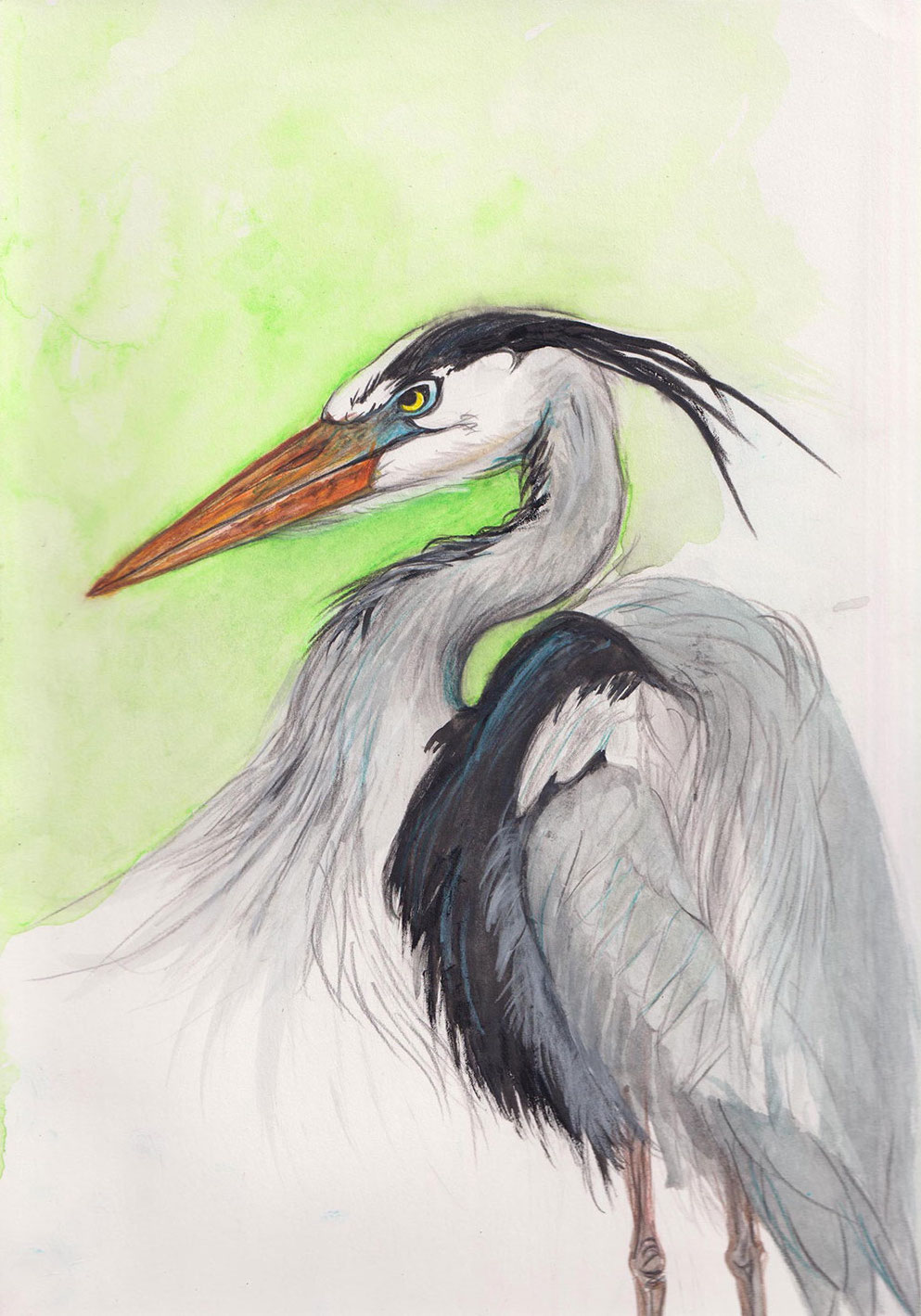
A vertical watercolour illustration of a heron features a bird with light grey, black and blue highlighted feathers facing the left of the screen. It is set against a light green background.
To the human eye, at least, each animal is distinct in its personality, needs and wants. Illustration for The Tyee by Dorothy Woodend.

When it is sitting atop the roof, staring bleakly down at the human world, what does it see? Tourists headed out to zip gaily around the park on rented bikes. Locals staggering home with groceries and bottles of wine. From this vantage point, the heron sees all.

The other birds in the neighbourhood are equally busy, the crows staging ongoing wars with the seagulls, the riot of starlings making an unholy racket, and the flying jewel of a hummingbird, sitting still for an instant on the bare branches of a cherry tree, before zipping off on a critical errand, like a bullet of emerald green and ruby red.

To the human eye, at least, each animal is distinct in its personality, needs and wants. The crows are gregarious and social; the seagulls are the bully boys of the bird world. My neighbour is convinced that one particularly thuggish gull is trying to break into her apartment. Maybe she’s right? And deep in the night, the call of an owl: you can hear them, but you rarely see them. I still recall one sighting that was only a shadowy fleeting presence so riveting that all the hair on the back of my neck stood up like a mini hirsute army.

The heron rookery in Stanley Park is only a couple of blocks away and has been going so strong, for many years, that it is mentioned on the Wikipedia page dedicated to the habits and lifestyle of great blue herons.

The Stanley Park rookery is such a beloved local West End fixture that it features a heron cam, an adopt-a-nest initiative ($54!) and a documentary film. Coolio! At least to me. Other folks are less than thrilled with the raucous noise and interesting smells emanating from heron central.

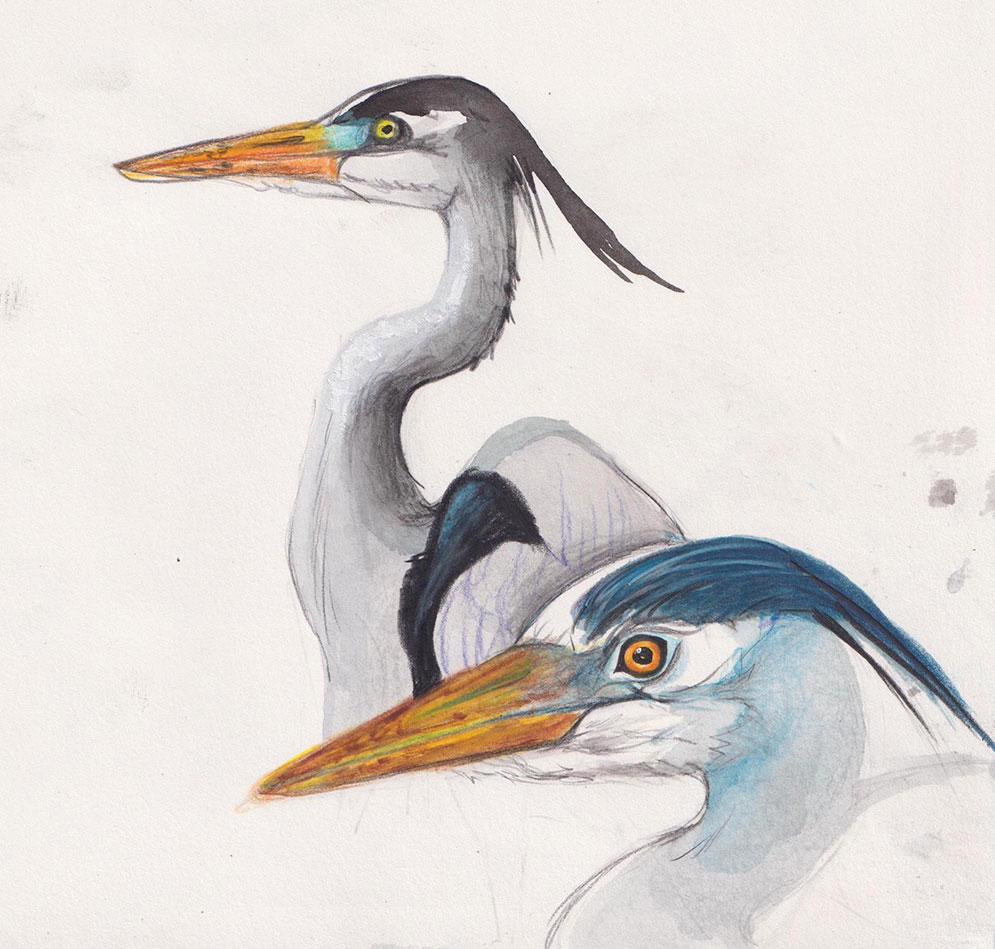
An illustration of two herons from the chest up, facing left. The one in the background is grey and white, and the one in the front is blue and white. They are set against a white background.
Not far from the apartment where the heron sat for weeks, a heron rookery thrives in Stanley Park. Illustration for The Tyee by Dorothy Woodend.

When you look closely at herons, they are startling in the design elements, like something dreamed up by Charles Rennie Mackintosh. The famed Scottish artist, who was a prominent member of the Glasgow School art and design movement, couldn’t have dreamed up a more elegant palette: slate blue, silver grey, with a delicate stippled border of darker feathers, handsome in extremis. Who could not love this lovely fella?

It's an ongoing human habit to transfer emotions, needs and wants onto some poor unsuspecting animal. We’ve been doing it since we clambered out of the trees, picked up a bit of charcoal and started drawing pictures of beasts, both big and small, on cave walls. According to researchers, the oldest known depiction of an animal is an Indonesian cave painting of a pig, of all creatures.

Herons aren’t immune to this anthropomorphic habit. They’re probably even more prone to it, sitting as still as they do, so that we people can gaze long and hard upon them.

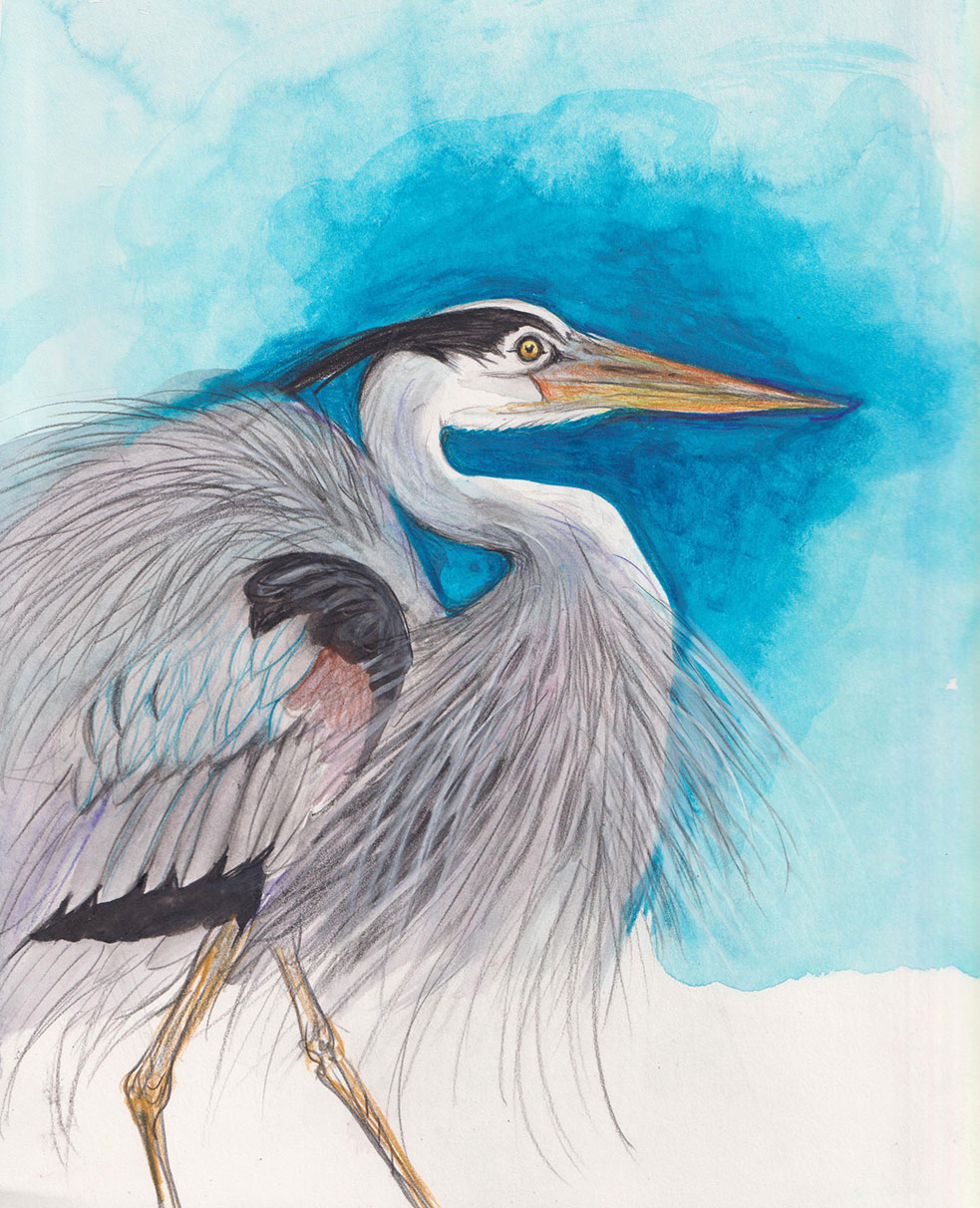
A watercolour illustration of a blue heron features a bright blue background and a full-body depiction of an elegant great blue heron standing, facing the right of the frame.
My fleeting friend. Illustration for The Tyee by Dorothy Woodend.

The other day, I looked out the window and the heron was gone. No forwarding address, no friendly wave to say so long. It just vanished. But in his absence, I’ve decided he is a he — a female bird probably has other priorities and a greater social circle as well. She’s probably cackling with the other female herons, about how silly the males in this town are. Maybe that’s what he’s doing up there, thinking about love gone wrong. The loneliness seems palpable. So maybe it’s not boredom, but heartbreak.

The Heartbreak Heron, as I now think of him, has come to symbolize all the lone creatures, taking a stand out there in the wide, wild world.

Maybe when the springtime season of romance rolls back around, the lone bird will take to the skies and find love once more. There’s hope for all us creatures. At least, I hope so.  [Tyee]

Adblock test (Why?)


https://news.google.com/rss/articles/CBMiSmh0dHBzOi8vd3d3LnRoZXR5ZWUuY2EvQ3VsdHVyZS8yMDI0LzAyLzAyL01lZXQtTXktRnJpZW5kLUhlYXJ0YnJlYWstSGVyb24v0gEA?oc=5

2024-02-02 05:08:14Z
CBMiSmh0dHBzOi8vd3d3LnRoZXR5ZWUuY2EvQ3VsdHVyZS8yMDI0LzAyLzAyL01lZXQtTXktRnJpZW5kLUhlYXJ0YnJlYWstSGVyb24v0gEA

Kamis, 01 Februari 2024

Millions of stars glow in Webb telescope's unprecedented spiral galaxies portrait - Crossroads Today

(CNN) — The James Webb Space Telescope has captured scintillating portraits of 19 spiral galaxies — and the millions of stars that call them home — in unprecedented detail never seen before by astronomers.

Webb’s singular ability to observe the universe in different wavelengths of infrared light, such as near-infrared and mid-infrared, showcases the stars, gas and dust within the intricate structure of each galaxy.

Adblock test (Why?)


https://news.google.com/rss/articles/CBMiswFodHRwczovL3d3dy5jcm9zc3JvYWRzdG9kYXkuY29tL25ld3Mvd29ybGQtbmV3cy9taWxsaW9ucy1vZi1zdGFycy1nbG93LWluLXdlYmItdGVsZXNjb3BlLXMtdW5wcmVjZWRlbnRlZC1zcGlyYWwtZ2FsYXhpZXMtcG9ydHJhaXQvYXJ0aWNsZV9hYzgwNGVlNy00OTJkLTU1ZGQtYTdmMi1mMDBiZjVkNmZkZjYuaHRtbNIBAA?oc=5

2024-02-01 16:55:01Z
CBMiswFodHRwczovL3d3dy5jcm9zc3JvYWRzdG9kYXkuY29tL25ld3Mvd29ybGQtbmV3cy9taWxsaW9ucy1vZi1zdGFycy1nbG93LWluLXdlYmItdGVsZXNjb3BlLXMtdW5wcmVjZWRlbnRlZC1zcGlyYWwtZ2FsYXhpZXMtcG9ydHJhaXQvYXJ0aWNsZV9hYzgwNGVlNy00OTJkLTU1ZGQtYTdmMi1mMDBiZjVkNmZkZjYuaHRtbNIBAA

Skyscraper-size asteroid will buzz Earth on Friday, safely passing within 1.7 million miles - Winnipeg Free Press

CAPE CANAVERAL, Fla. (AP) — An asteroid as big as a skyscraper will pass within 1.7 million miles of Earth on Friday.

Don’t worry: There’s no chance of it hitting us since it will pass seven times the distance from Earth to the moon.

NASA’s Center for Near Earth Object Studies estimates the space rock is between 690 feet and 1,575 feet (210 meters and 480 meters) across. That means the asteroid could be similar in size to New York City’s Empire State Building or Chicago’s Willis Tower.

This image provided by Virtual Telescope Project out of Italy shows a single 180-second exposure asteroid that was approaching Earth, about 4 million kilometers, Thursday, Jan. 31, 2024. Astronomers say an asteroid as big as a skyscraper will pass within 1.7 million miles of Earth on Friday. There's no chance of it hitting us since it will pass seven times the distance from Earth to the moon. (Virtual Telescope Project via AP)

Discovered in 2008, the asteroid is designated as 2008 OS7. It won’t be back our way again until 2032, but it will be a much more distant encounter, staying 45 million miles (72 million kilometers) away.

The harmless flyby is one of several encounters this week. Three much smaller asteroids also will harmlessly buzz Earth on Friday, no more than tens of yards (meters) across, with another two on Saturday. On Sunday, an asteroid roughly half the size of 2008 0S7 will swing by, staying 4.5 million miles (7.3 million kilometers) away.

___

The Associated Press Health and Science Department receives support from the Howard Hughes Medical Institute’s Science and Educational Media Group. The AP is solely responsible for all content.

Adblock test (Why?)


https://news.google.com/rss/articles/CBMiowFodHRwczovL3d3dy53aW5uaXBlZ2ZyZWVwcmVzcy5jb20vYXJ0cy1hbmQtbGlmZS9saWZlL3NjaS10ZWNoLzIwMjQvMDIvMDEvc2t5c2NyYXBlci1zaXplLWFzdGVyb2lkLXdpbGwtYnV6ei1lYXJ0aC1vbi1mcmlkYXktc2FmZWx5LXBhc3Npbmctd2l0aGluLTEtNy1taWxsaW9uLW1pbGVz0gEA?oc=5

2024-02-01 16:12:09Z
CBMiowFodHRwczovL3d3dy53aW5uaXBlZ2ZyZWVwcmVzcy5jb20vYXJ0cy1hbmQtbGlmZS9saWZlL3NjaS10ZWNoLzIwMjQvMDIvMDEvc2t5c2NyYXBlci1zaXplLWFzdGVyb2lkLXdpbGwtYnV6ei1lYXJ0aC1vbi1mcmlkYXktc2FmZWx5LXBhc3Npbmctd2l0aGluLTEtNy1taWxsaW9uLW1pbGVz0gEA

Upgrading grinding ergonomics - Canadian Metalworking

CC-GRIND ROBUST grinds a workpiece.

In recent research, the CC-GRIND ROBUST grinding disc produces considerably less noise during use than the grinding wheels used to date. This also was confirmed by noise measurements taken under operating conditions at customers’ premises. Noise emissions fell substantially from over 100 to around 94 dB(A) when using a corded angle grinder, and from over 96 to less than 89 dB(A) when using a cordless angle grinder.

While there is a lot of emphasis placed on health and safety, ergonomics also is an important consideration on the shop floor. A focus on comfortability can lead to long-term success, higher-quality work, and happier workers.

Ergonomics is especially important in grinding operations, which often have noise, dust, and vibration emissions that can lead to decreased safety and comfort.

Following common best practices can help improve ergonomics in grinding work.

Body Stresses and Vibration Emissions

One-off grinding jobs may not necessarily create immediate bodily stresses and strains. However, in today’s manufacturing environment, fabricators are often performing these tasks for the majority of their workday, meaning they are subjected to constant physically taxing work. However, operators can take a few steps to limit the bodily stresses that accompany grinding operations.

Use an Adjustable Vise. This is a simple tool that can make a huge difference when it comes to ergonomics. Not all manufacturers will think about vises, but choosing one that is adjustable will allow for the workpiece to be placed at a proper and comfortable angle for the operator.

For example, every operator might have a different angle of operation that they are comfortable with. An operator who is taller may want to move the workpiece to a different angle so that it sits at waist height and does not create any excess fatigue on the shoulders or neck when grinding.

It's very common to see operators grinding at an improper height. If the workpiece is too high, this can be extremely taxing on arms and shoulders. If it is too low, this can lead to hunching over and back strain. An adjustable vise will not only limit strain and fatigue, but it may also lead to improved performance.

Choose a Tool With an Ergonomic Design. As ergonomics becomes more important, the design of power tools has increasingly followed suit. The term haptic perception is used to describe the active feeling of size, contours, surface structure, and weight of an object by integrating all skin senses and depth sensitiveness.

Handle and trigger placement along with an ergonomic shape and optimized haptics can make all the difference in improved operational comfort. For example, a handle formed with rubber reduces the vibration produced during grinding work by half.

Look for a Grinding Disc With Aggressive Material Removal Rates. As products evolve and integrate the latest technology, a grinding disc with an optimized backer shape will make an ideal amount of contact with the workpiece, which ensures high stock removal coupled with less pressure required. This means operators can exert less force and complete work faster than they would using a standard flap disc or griding wheel.

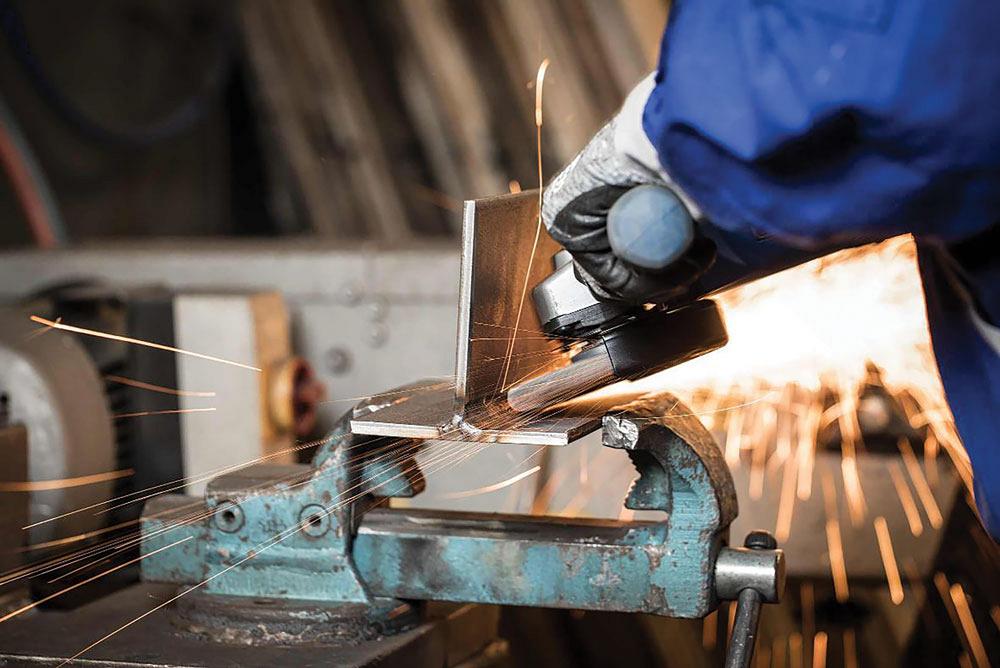
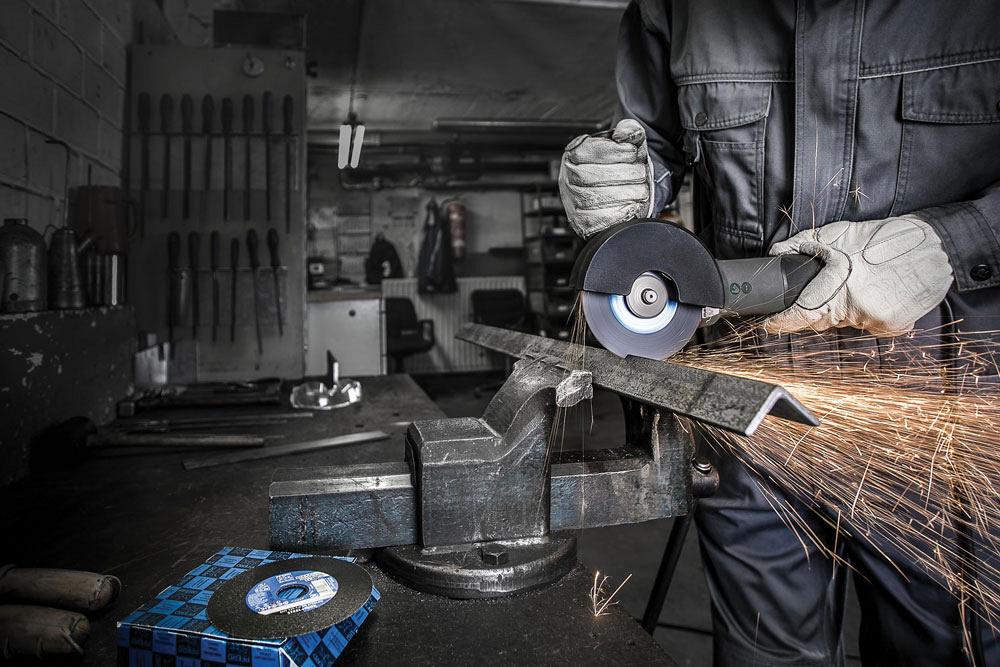
 An operator grinds a part on a vise.

Not all vises are created equal. A static vise can limit an operator’s range of motion and strain their arms. Choosing one that is adjustable will allow for the workpiece to be placed at a proper and comfortable angle for the operator.

Wear Gloves. A protective glove can combine vibration protection with comfort.

The vibrations caused by the grinding process are substantially dampened at the contact surfaces, without impairing dexterity. A glove should be heat resistant, spark resistant, and free of health-hazardous substances.

Noise Issues

Protecting an operator’s hearing and ears during the grinding process is essential, especially because grinding operations typically generate high and sustained noise levels that can damage pressure-sensitive organs within the ear. Prolonged exposure to excessive noise can be detrimental to health and safety. However, even limited noise exposure can have adverse affects, which is why it is important to limit the amount of grinding noise and ensure that workers have properly fitted PPE.

Choose Tools That Limit Noise. While protecting against noise is always advised, it’s important to look for tools that prevent noise from being generated in the first place. Look for grinding discs that reduce overall noise exposure by finishing jobs faster or those that simply create less noise.

Choose noise-abating measures within the process itself, for example, using low-noise machines and drives coupled with adjusting the acoustics in the room.

Wear Proper Ear Protection. PPE will help reduce harmful noise exposure. Manufacturers can work with in-ear or over-ear hearing protection to ensure that noise emissions are limited. However, not all hearing protection is created equal.

For example, it’s important to evaluate how earplugs reduce continuous and impulse noise.

Ear protection like earplugs should be light and comfortable enough to wear all day long, especially when grinding operations take up most of a worker’s day.

In environments where communication is necessary, there are hearing protection options available that make this possible.

The right tools and PPE will help reduce noise exposure.

A person deflects away grinding sparks.

Using a grinder with a guard can help an operator fine-tune where the sparks fly without contorting his or her body to reduce spark exposure.

Dust and Spark Debris

Air quality within working rooms must more or less correspond to outside air. From a health point of view, a dust particle’s size and its pollutant content both matter.

A particle with a diameter larger than 10 µm, also known as called coarse dust, gets caught more easily on nasal hairs or mucous membranes. Smaller dust particles, however, can penetrate deep into the lung via the windpipe and bronchi. For this reason, fine dust is also termed as inhalable or respirable dust.

Use a Flap Disc. A flap disc, as opposed to a traditional grinding wheel, will create a lot less dust. Some of the latest disc technology does not have bond and reinforcement elements that contribute to dust creation.

The aggressiveness of the abrasive grit and the optimum contact angle to the workpiece also mean that the material creates less dust. This is because a flap disc tends to produce chips, not dust. The larger and heavier the chips, the lower the risk of dust entering the lungs.

Use an Adjustable Guard. Adjust the guard when grinding to make sure that the sparks are flying away from both the operator and workers in the area, as opposed to towards them. Being able to fine-tune where the sparks fly will make it easier for the operator to perform grinding operations without contorting his or her body to reduce spark exposure.

Ensure Proper Ventilation. It’s important to make sure that an operator wears proper PPE for ventilation. A dust mask is a good starting point. Look for a mask that provides optimum protection from dust, up to 30 times the maximum workplace concentration.

Also, look for ergonomic features like a breath-out valve, which minimizes the build up of heat and humidity from the user’s breath, or an integrated nose clip that can be adapted to fit comfortably and guarantees a tight fit over the mouth and nose.

Steve Schnoll is training and development manager at PFERD Inc., 9201 W. Heather Ave., Milwaukee, Wis. 53224, us.pferd.com.

Adblock test (Why?)


https://news.google.com/rss/articles/CBMid2h0dHBzOi8vd3d3LmNhbmFkaWFubWV0YWx3b3JraW5nLmNvbS9jYW5hZGlhbmZhYnJpY2F0aW5nYW5kd2VsZGluZy9hcnRpY2xlL21ldGFsZmluaXNoaW5nL3VwZ3JhZGluZy1ncmluZGluZy1lcmdvbm9taWNz0gEA?oc=5

2024-02-01 12:00:00Z
CBMid2h0dHBzOi8vd3d3LmNhbmFkaWFubWV0YWx3b3JraW5nLmNvbS9jYW5hZGlhbmZhYnJpY2F0aW5nYW5kd2VsZGluZy9hcnRpY2xlL21ldGFsZmluaXNoaW5nL3VwZ3JhZGluZy1ncmluZGluZy1lcmdvbm9taWNz0gEA

Urgent: Japan's moon probe SLIM in dormant state with solar power generation unavailable: JAXA - Xinhua

TOKYO, Feb. 1 (Xinhua) -- Japan's lunar probe has re-entered a dormant state and suspended activities as it reached sunset, rendering solar power generation unavailable, the country's space agency said on Thursday.

The planned activities for the Smart Lander for Investigating Moon (SLIM), which made Japan the world's fifth lunar landing country, concluded on Wednesday, the Japan Aerospace Exploration Agency (JAXA) said.

On Monday, the moon lander started functioning after being switched off due to solar cell failures following its moon touchdown earlier.

Adblock test (Why?)


https://news.google.com/rss/articles/CBMiVGh0dHBzOi8vZW5nbGlzaC5uZXdzLmNuL2FzaWFwYWNpZmljLzIwMjQwMjAxL2IzYzVhYmVhZTBjMjQ3NzdhODRhMDlmYjQ4ZDhjMWI0L2MuaHRtbNIBAA?oc=5

2024-02-01 06:43:15Z
CBMiVGh0dHBzOi8vZW5nbGlzaC5uZXdzLmNuL2FzaWFwYWNpZmljLzIwMjQwMjAxL2IzYzVhYmVhZTBjMjQ3NzdhODRhMDlmYjQ4ZDhjMWI0L2MuaHRtbNIBAA