Kamis, 04 April 2024

One Tech Tip: How to use apps to track and photograph the total solar eclipse - Yahoo Canada Finance

Monday's total solar eclipse might become one of the most filmed and photographed events of the year.

As the moon passes in front of the sun, plunging a swath of North America into a few minutes of darkness, throngs will take pictures or videos of the moment. But powerful solar rays and drastic changes in lighting pose unique challenges in catching that perfect image.

Here are some pointers on how to get the best shot:

How can I find the best place to capture the eclipse?

First, get in the right position. You'll want to be as close as possible to the path of totality, which passes over Mexico's Pacific coast and ends in eastern Canada. Fifteen U.S. states get to see the full eclipse.

ADVERTISEMENT

There are online maps to check if you'll be anywhere near the path. NASA's map shows how many minutes of totality there will be if you're inside the path depending on location, and how much of a partial eclipse you'll see if you're outside of it.

For spectators in Mexico and Canada, eclipse expert Xavier Jubier's website overlays the eclipse's path on Google Maps, which allows zooming into street level detail.

What can I use to plan a good shot?

With so many factors in play including cloud cover and the sun's position in the sky, planning is key to getting the best image.

There are a host of smartphone apps for eclipse chasers. The American Astronomical Society has compiled a list of useful ones for both iOS and Android devices, including its own Totality app that shows your location on a map of the totality path.

The Solar Eclipse Timer uses your phone’s GPS to play an audio countdown to the moment of totality and highlights key moments. The app's maker advises using a separate phone for taking photos.

Eclipse Calculator 2 for Android devices uses the phone's camera to depict how the event will look in the sky from your position, using lines overlaid on top of the camera image. For iPhone users, apps like Sky Guide and SkySafari have eclipse simulators. There are other iOS apps that use augmented reality to simulate the eclipse, but they're pricier and not yet on the society's list.

How can I take a great photo of the eclipse?

Digital SLR cameras will produce the best photos. Their manual exposure controls and ability to add zoom lenses and accessories like remote shutter buttons will let you make great pictures.

Associated Press chief photographer Julio Cortez advises using a smaller aperture — f11 or f17 — to keep the focus "a little bit sharper.” When he shot the 2017 total solar eclipse, he used an ISO setting of 1250 and 1/500 shutter speed.

The rest of us have our smartphones.

NASA published detailed guidelines for smartphone eclipse photography in 2017 with the caveat that “smartphones were never designed to do sun and moon photography." That's because the wide-angle lenses on most devices won’t let you capture close-up detail. But new phones released since then come with sophisticated sensors, multiple lenses and image stabilization software that give a better chance.

Some experts suggest HDR, or High Dynamic Range, mode, which takes a series of pictures at different light levels and then blends them into a single shot — ideal for combining an eclipse’s very dark and very bright areas.

But don’t use flash. You can spoil the moment by ruining the vision of those around you whose eyes have adapted to darkness.

What will I need to protect against the sun?

The American Astronomical Society advises using a solar filter to protect cameras against intense sunlight and heat.

You can buy a filter that screws onto DSLR lenses, but it will take time to remove when totality happens. Cortez made his own with cardboard, tinted film and fasteners that he can quickly rip off.

For smartphones, you can use a spare pair of eclipse glasses and hold it over the lens, or buy a smartphone filter. There's no international standard, but the society's website has a list of models it considers safe. Make sure macro mode is not on.

If you plan to shoot for an extended time, use a tripod. To line up his camera after mounting it on a tripod, Cortez uses a solar finder, which helps locate the sun without damaging your eyes or equipment.

Cortez also advises bringing a white towel to cover up your gear after setting up to keep it from overheating as you wait for the big moment.

Can I take a selfie with the eclipse?

It's very tempting to make a TikTok or Instagram-friendly eclipse video. Perhaps you want to selfie video, narrating into the camera while the cosmic ballet between sun and moon plays out over your shoulder.

Be careful: While you might think your vision isn't at risk because you're not looking at the sun, your phone's screen could reflect harmful ultraviolet light, eye experts have warned.

And if you're using a solar filter on the selfie camera, it will turn the picture dark and you won't show up.

___

Is there a tech challenge you need help figuring out? Write to us at onetechtip@ap.org with your questions.

Kelvin Chan, The Associated Press

Adblock test (Why?)


https://news.google.com/rss/articles/CBMiSGh0dHBzOi8vY2EuZmluYW5jZS55YWhvby5jb20vbmV3cy9vbmUtdGVjaC10aXAtYXBwcy10cmFjay0wNzM1MTkxODMuaHRtbNIBAA?oc=5

2024-04-04 07:35:19Z
CBMiSGh0dHBzOi8vY2EuZmluYW5jZS55YWhvby5jb20vbmV3cy9vbmUtdGVjaC10aXAtYXBwcy10cmFjay0wNzM1MTkxODMuaHRtbNIBAA

Rabu, 03 April 2024

Health unit offers tips for viewing total solar eclipse safely - BradfordToday

NEWS RELEASE
SIMCOE MUSKOKA DISTRICT HEALTH UNIT
*************************
On April 8, 2024, between approximately 2 and 4:30 p.m., there will be a rare total solar eclipse.

A solar eclipse occurs when the moon passes between Earth and the sun. While the sky will darken and bright stars and planets may emerge, looking at the sun without eye protection, even if only briefly during the period of the eclipse, can cause serious permanent damage to your vision, including retinal burns, blurred vision and loss of sight. The Simcoe Muskoka District Health Unit recommends taking precautions to protect your vision during this once-in-a-lifetime celestial event.

The safest way to watch the eclipse is through virtual channels, such as by livestream. You can also view the solar eclipse safely by using international standard ISO 12312-2 certified eye protection glasses with special filters to watch all the phases of a solar eclipse. Ensure that the lenses are free of damage, including wrinkles or scratches, and that the glasses fully cover your field of vision. Look away from the sun before putting on and after taking off the glasses. It is not safe to view the eclipse through regular sunglasses, camera/phone lens, telescope, binoculars, or any other optical device. If you don’t have special glasses designed for eclipse watching, there are other ways to watch an eclipse, such as an eclipse projector, which you can easily learn how to make.

Children’s eyes let in more light to the retina than adult eyes, so they are at higher risk of harm if they look at the sun without proper eye protection. Help children use their eye protection correctly and provide supervision. If not able to fully supervise and ensure a safe viewing experience with eye protection on, consider alternate viewing strategies such as watching by livestream. You may choose to keep children, and other individuals who may not fully comprehend the risks involved, indoors with closed window coverings as an added precaution.

Our retinas do not have pain sensors and eye damage may not be immediate. Symptoms can take 12 to 48 hours to appear. If you begin to experience temporary visual loss, blurred vision, or eyesight loss during or after the event, speak to an eye care professional, such as an optometrist or your health-care provider as soon as possible. If you are experiencing blindness after viewing the eclipse (immediate or delayed), seek emergency care immediately.

If travelling or driving during the eclipse, avoid looking at the eclipse from a vehicle to protect your eyes and avoid collisions. Plan for traffic delays and if on a highway, it is advised not to stop, take pictures or get out of your vehicle to view the eclipse.

For more information visit smdhu.org, or call Health Connection at 705-721-7520 or 1-877-721-7520, weekdays from 8:30 a.m. to 4:30 p.m.

*************************

Adblock test (Why?)


https://news.google.com/rss/articles/CBMibmh0dHBzOi8vd3d3LmJyYWRmb3JkdG9kYXkuY2EvbG9jYWwtbmV3cy9oZWFsdGgtdW5pdC1vZmZlcnMtdGlwcy1mb3Itdmlld2luZy10b3RhbC1zb2xhci1lY2xpcHNlLXNhZmVseS04NTQwNzQ40gEA?oc=5

2024-04-03 13:00:00Z
CBMibmh0dHBzOi8vd3d3LmJyYWRmb3JkdG9kYXkuY2EvbG9jYWwtbmV3cy9oZWFsdGgtdW5pdC1vZmZlcnMtdGlwcy1mb3Itdmlld2luZy10b3RhbC1zb2xhci1lY2xpcHNlLXNhZmVseS04NTQwNzQ40gEA

How you can stay safe during the 2024 total solar eclipse - Global News

The president of the New Brunswick Association of Optometrists is warning people to stay safe during the total solar eclipse on April 8.

“It’s an amazing opportunity and experience for us New Brunswickers to have this, but we need to make sure that we have knowledge and we’re well-educated to be safe,” Dr. Alexis Keeling said.

According to Keeling, the sun isn’t any stronger during the eclipse than usual, but even on normal days the sun’s rays can damage a part of eyes called the macula.

That includes potentially permanent blindness.

“The macula does not have any pain receptors, so people don’t know they’re doing damage and causing potential blindness when they’re looking at the sun,” she said.

The damage takes about 24 to 48 hours to take effect, meaning people might not know they’ve gone blind until days after the eclipse.

Protective glasses

Breaking news from Canada and around the world sent to your email, as it happens.

There are certified eclipse glasses that protect eyes from the sun’s rays. They’re different from sunglasses — Keeling said they’re about 200 times stronger and darker.

The Canadian Association of Optometrists has more information about safety on its website.

Keeling said eclipse glasses should have an ISO number — an international safety standard — of 12312-2.

Click to play video: 'How to avoid buying counterfeit solar eclipse glasses'

How to avoid buying counterfeit solar eclipse glasses

Fredericton resident Gilles Grondin said he remembers watching a solar eclipse about six decades ago as a teenager. At that time, they used welding shields to protect their eyes. This time he said he plans to view the eclipse with special lenses.

“We’re going to watch it with my family, my daughter and grandkids, my own little family,” he said.

While people need to be cautious, Keeling said babies and pets are less likely to look into the sun and damage their eyes.

“There’s an innate natural instinct that all humans, animals have, we don’t look at the sun,” she said.

“Most of our pets probably won’t know or probably won’t realize what’s going on,” said veterinarian Nicole Jewett, the registrar for the New Brunswick Veterinary Medical Association.

She said pets may be a bit confused by the sudden darkness, but said the best thing to do is keep routines the same.

And Keeling had one more piece of advice.

“Have fun, get outside, and let’s hope it’s not cloudy,” she said.

More on Canada

&copy 2024 Global News, a division of Corus Entertainment Inc.

Adblock test (Why?)


https://news.google.com/rss/articles/CBMiTmh0dHBzOi8vZ2xvYmFsbmV3cy5jYS9uZXdzLzEwMzk4MDUwLzIwMjQtdG90YWwtc29sYXItZWNsaXBzZS1ob3ctdG8tc3RheS1zYWZlL9IBUmh0dHBzOi8vZ2xvYmFsbmV3cy5jYS9uZXdzLzEwMzk4MDUwLzIwMjQtdG90YWwtc29sYXItZWNsaXBzZS1ob3ctdG8tc3RheS1zYWZlL2FtcC8?oc=5

2024-04-02 22:13:52Z
CBMiTmh0dHBzOi8vZ2xvYmFsbmV3cy5jYS9uZXdzLzEwMzk4MDUwLzIwMjQtdG90YWwtc29sYXItZWNsaXBzZS1ob3ctdG8tc3RheS1zYWZlL9IBUmh0dHBzOi8vZ2xvYmFsbmV3cy5jYS9uZXdzLzEwMzk4MDUwLzIwMjQtdG90YWwtc29sYXItZWNsaXBzZS1ob3ctdG8tc3RheS1zYWZlL2FtcC8

NASA wants to come up with a new clock for the moon, where seconds tick away faster - CityNews Vancouver

NASA wants to come up with an out-of-this-world way to keep track of time, putting the moon on its own souped-up clock.

It’s not quite a time zone like those on Earth, but an entire frame of time reference for the moon. Because there’s less gravity on the moon, time there moves a tad quicker — 58.7 microseconds every day — compared to Earth. So the White House Tuesday instructed NASA and other U.S agencies to work with international agencies to come up with a new moon-centric time reference system.

“An atomic clock on the moon will tick at a different rate than a clock on Earth,” said Kevin Coggins, NASA’s top communications and navigation official. “It makes sense that when you go to another body, like the moon or Mars that each one gets its own heartbeat.”

So everything on the moon will operate on the speeded-up moon time, Coggins said.

The last time NASA sent astronauts to the moon they wore watches, but timing wasn’t as precise and critical as it now with GPS, satellites and intricate computer and communications systems, he said. Those microseconds matter when high tech systems interact, he said.

Last year, the European Space Agency said Earth needs to come up with a unified time for the moon, where a day lasts 29.5 Earth days.

The International Space Station, being in low Earth orbit, will continue to use coordinated universal time or UTC. But just where the new space time kicks in is something that NASA has to figure out. Even Earth’s time speeds up and slows down, requiring leap seconds.

Unlike on Earth, the moon will not have daylight saving time, Coggins said.

The White House wants NASA to come up with a preliminary idea by the end of the year and have a final plan by the end of 2026.

NASA is aiming to send astronauts around the moon in September 2025 and land people there a year later.

Adblock test (Why?)


https://news.google.com/rss/articles/CBMiOWh0dHBzOi8vdmFuY291dmVyLmNpdHluZXdzLmNhLzIwMjQvMDQvMDIvbmFzYS1jbG9jay1tb29uL9IBAA?oc=5

2024-04-03 00:00:25Z
CBMiOWh0dHBzOi8vdmFuY291dmVyLmNpdHluZXdzLmNhLzIwMjQvMDQvMDIvbmFzYS1jbG9jay1tb29uL9IBAA

Selasa, 02 April 2024

What to know about next week's total solar eclipse in the US, Mexico and Canada - Phys.org

What to know about next week's total solar eclipse in the US, Mexico and Canada

This article has been reviewed according to Science X's editorial process and policies. Editors have highlighted the following attributes while ensuring the content's credibility:

fact-checked

reputable news agency

proofread

What to know about next week's total solar eclipse in the US, Mexico and Canada
A total solar eclipse April 8 will enter over Mexico's Pacific coast, dash up through Texas and Oklahoma, crisscross the Midwest, Mid-Atlantic and New England, before exiting over eastern Canada into the Atlantic. Credit: AP Photo, File

North America is on the verge of another masking of the sun.

Monday's total solar eclipse will make landfall along Mexico's Pacific coast and cross into Texas and 14 other U.S. states, before exiting over Canada.

It will last almost twice as long, with an even wider audience, than the total solar eclipse that stretched coast-to-coast in the U.S. in 2017.

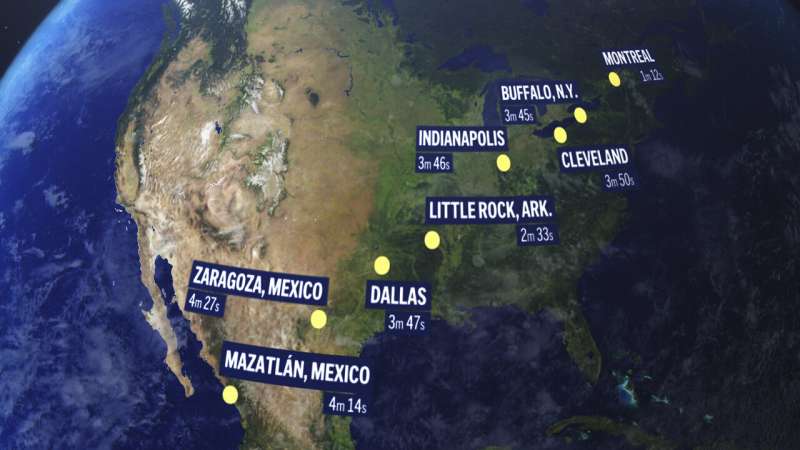
The will shroud the sun for up to 4 minutes, 28 seconds, a spectacle normally unfolding in remote corners of the globe but this time passing over major cities like Dallas, Indianapolis and Cleveland. An estimated 44 million people live within the path of totality, with another couple hundred million within 200 miles (320 kilometers), guaranteeing the continent's biggest eclipse crowd ever.

Practically everyone on the continent will get to see a . You can watch the whole thing unfold online, too. NASA is offering several hours of streaming online from several cities along the totality path. The Associated Press will bring live coverage of watch parties and festivities.

And don't forget your special glasses to safely watch the eclipse.

It all depends on the weather, of course. The National Weather Service is providing daily updates of its cloud cover forecasts along the path.

Here's more to know about Monday's celestial showstopper:

What's a total solar eclipse?

The moon will line up perfectly between the Earth and the sun at midday, blotting out the sunlight. The full eclipse will last longer than usual because the moon will be just 223,000 miles (360,000 kilometers) from Earth, one of the year's closest approaches. The closer the moon is to Earth, the bigger it is in the sky from our perspective, resulting in an especially long and intense period of sun-blocked darkness. Totality will last the longest over Mexico at 4 minutes, 28 seconds. Elsewhere along the track, like in Syracuse, New York, totality will last just 1 1/2 minutes.

What's the eclipse path?

The moon's shadow will slice a diagonal line from the southwest to the northeast across North America, briefly plunging communities along the track into darkness. Totality will enter the continent at Mazatlan, Mexico, and exit at Newfoundland in Canada. In between, 15 U.S. states from Texas to Maine will experience totality, including snippets of Tennessee and Michigan. It will be a repeat for Cape Girardeau, Missouri, and Carbondale, Illinois, which were also in prime position for 2017's total solar eclipse.

A comet during the eclipse?

During totality, you may be able to spot a comet along with four planets, if you're lucky. Jupiter will be to the left of the sun and Venus to the right. Saturn and Mars will be to the right of Venus, but fainter. The solar system's three other planets will be in the vicinity, but virtually impossible to see with the naked eye. Comet 12P/Pons-Brooks is swinging past Earth, as it does every 71 years. Still faint, it will be positioned near Jupiter during the eclipse. But it will take a sudden outburst of dust and gas to see this so-called devil comet without a telescope, according to Anita Cochran of the University of Texas at Austin. But don't waste time looking for it. "There is lots to see and not that long a time," she said via email.

Last total solar eclipse in the U.S.?

The U.S. hasn't experienced a total solar eclipse since Aug. 21, 2017, although a "ring of fire" solar eclipse crossed a part of the country last October. The moon was too far away then to completely blot out the sun, leaving a brilliant, burning ring around our star. The dramatic "ring of fire" stretched from Oregon to Texas, and crossed over Central America and Colombia, before exiting over Brazil. Kerrville, Texas, just west of San Antonio, is back in the bull's-eye and expecting another packed house.

When's the next one?

After Monday, the next total solar eclipse won't occur until 2026. But it will graze the top of the world, dipping into Greenland, Iceland and Spain. The next one in 2027 will march across Spain and northern Africa, with totality lasting an incredible 6 1/2 minutes. North Americans will have to wait until 2033 for another total solar eclipse, but it will be limited to Alaska. In 2044, Western Canada, Montana and North Dakota will have front-row seats. And in 2045, the U.S. will once again experience a coast-to-coast .

© 2024 The Associated Press. All rights reserved. This material may not be published, broadcast, rewritten or redistributed without permission.

Citation: What to know about next week's total solar eclipse in the US, Mexico and Canada (2024, April 2) retrieved 2 April 2024 from https://phys.org/news/2024-04-week-total-solar-eclipse-mexico.html

This document is subject to copyright. Apart from any fair dealing for the purpose of private study or research, no part may be reproduced without the written permission. The content is provided for information purposes only.


Explore further

The next total solar eclipse is in April: Here's what to know and where to see it

18 shares

Feedback to editors

Adblock test (Why?)


https://news.google.com/rss/articles/CBMiQmh0dHBzOi8vcGh5cy5vcmcvbmV3cy8yMDI0LTA0LXdlZWstdG90YWwtc29sYXItZWNsaXBzZS1tZXhpY28uaHRtbNIBQWh0dHBzOi8vcGh5cy5vcmcvbmV3cy8yMDI0LTA0LXdlZWstdG90YWwtc29sYXItZWNsaXBzZS1tZXhpY28uYW1w?oc=5

2024-04-02 08:05:53Z
CBMiQmh0dHBzOi8vcGh5cy5vcmcvbmV3cy8yMDI0LTA0LXdlZWstdG90YWwtc29sYXItZWNsaXBzZS1tZXhpY28uaHRtbNIBQWh0dHBzOi8vcGh5cy5vcmcvbmV3cy8yMDI0LTA0LXdlZWstdG90YWwtc29sYXItZWNsaXBzZS1tZXhpY28uYW1w

Launch Roundup: SpaceX continues high cadence, Delta IV Heavy to launch following scrub - NASASpaceFlight.com - NASASpaceflight.com

Launch Roundup: SpaceX continues high cadence, Delta IV Heavy to launch following scrub - NASASpaceFlight.com

Adblock test (Why?)


https://news.google.com/rss/articles/CBMiPGh0dHBzOi8vd3d3Lm5hc2FzcGFjZWZsaWdodC5jb20vMjAyNC8wNC9sYXVuY2gtcm91bmR1cC0wNDAxL9IBAA?oc=5

2024-04-01 21:28:03Z
CBMiPGh0dHBzOi8vd3d3Lm5hc2FzcGFjZWZsaWdodC5jb20vMjAyNC8wNC9sYXVuY2gtcm91bmR1cC0wNDAxL9IBAA

Senin, 01 April 2024

Saanich father-son duo chasing solar eclipse to Texas - Oak Bay News

In search of the clearest skies possible, two Saanich residents will make the trek to Texas chasing the path of a full solar eclipse on April 8.

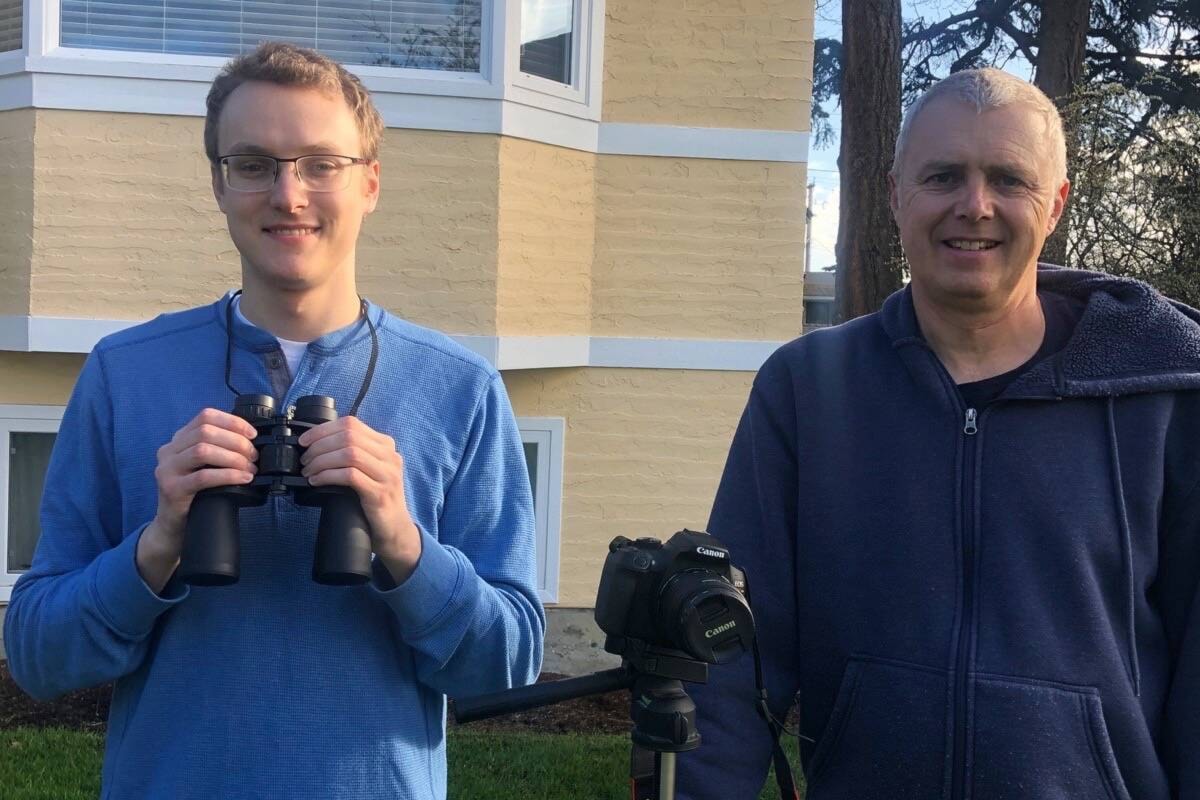
Father and son Steve Hickton and Connor Hickton coincidentally took the same astronomy course at UVic, 20 years apart.

“That kind of got us hooked,” Steve said.

Comparing notes, the avid astronomers first felt the thrill of a solar eclipse in 2017, falling in love with eclipse chasing during a last-minute trek south to Amity, Ore.

That year, eclipse chasers had booked up all hotels in the region well before they thought of it, leaving the Hicktons staying in Portland and hitting the road at 3 a.m. with Connor navigated expertly on state roads to get them to an elementary school parking lot, where they watched the solar eclipse with several hundred people.

“I thought it was complete overkill what I was doing, but whenever we hit a major road it was swamped so we were doing the right thing,” Connor said.

The game plan is similar for this solar eclipse – where the sun blocks the moon – that crosses North America, passing over eastern United States and Canada. Weather permitting, the first location in continental North America that will experience totality is Mexico’s Pacific coast just after 11 a.m.

READ ALSO: Hundreds watch moon cross sun’s path over Saanich

Looking to revisit the neat experience, they saw this one coming and discovered similar challenges. The path starts in Mexico and crosses the U.S. in Texas and the midwest, then far east Canada. Clear skies are an issue.

“It goes right over Niagara Falls which would be a spectacular view but it will be cloudy there,” Connor noted.

So they settled on San Antonio where Steve biked through when he was Connor’s age, 25. The path of the eclipse cuts through the city, but like last time, they have to get out of town a bit early to get the best bang for their buck.

“The closer you are to the middle (of the path of totality) the longer the viewing you get.” The duration drops off the farther you stray from the path’s centre line. They hope for a solid couple of minutes.

Despite starting planning six months ago they still faced “Taylor Swift pricing” for flights and hotels, Steve said. Connor’s even heard of hotels that had booked rooms a year ago, and opted to dish out refunds and re-book the rooms.

Their target is April 8 at 1:30 p.m., so they fly in on April 5 into Houston and out again April 12.

“We thought it’d be fun to also go to the space centre, make it a science trip,” Steve said.

Connor subscribed to a cloud cover app to find clearest possible skies and they’ll again stick to back roads while finding a site to enjoy the event.

READ ALSO: When the sun disappears, here’s what you need to know

Steve admitted it seems like a long way to go for just a few minutes, but even the time leading up to it are interesting.

“It’s just so unnatural, you could see why people 1,000 years ago were freaked out about it. The sky gets dark the shadows get weird,” he said. “It’s a really weird effect.”

They say it’s freaky seeing the skies get darker and darker, from sunlight to dusk in maybe 20 minutes. <assuming this is a quote, but you’ve got quotes from Steve and Connor in a row and it’s a bit awkward. Maybe paraphrase?

“All of a sudden during the peak of it, it gets really cold as well … I remember hearing the crickets start to chirp because they thought it was nighttime, it’s such an unnatural phenomenon,” Connor said.

Eye damage can result if you look directly at the sun, even during a partial eclipse. The pair is armed with gear to watch and photograph the phenomenon safely.

While a solar eclipse occurs once or twice a year somewhere on the planet according to NASA, location and weather make seeing them a challenge. It can be 400 to 1,000 years for one to reappear at any given site.

Adblock test (Why?)


https://news.google.com/rss/articles/CBMiYmh0dHBzOi8vd3d3Lm9ha2JheW5ld3MuY29tL2NvbW11bml0eS9zYWFuaWNoLWZhdGhlci1zb24tZHVvLWNoYXNpbmctc29sYXItZWNsaXBzZS10by10ZXhhcy03MzM2MTYx0gEA?oc=5

2024-04-01 19:47:00Z
CBMiYmh0dHBzOi8vd3d3Lm9ha2JheW5ld3MuY29tL2NvbW11bml0eS9zYWFuaWNoLWZhdGhlci1zb24tZHVvLWNoYXNpbmctc29sYXItZWNsaXBzZS10by10ZXhhcy03MzM2MTYx0gEA