Washington • New research released Friday captures a fossilized snapshot of the day nearly 66 million years ago when an asteroid smacked Earth, fire rained from the sky and the ground shook far worse than any modern earthquake.
The researchers say they found evidence in North Dakota of the asteroid hit in Mexico, including fish with hot glass in their gills from flaming debris that showered back down on Earth. They also reported the discovery of charred trees, evidence of an inland tsunami and melted amber.
Separately, University of Amsterdam's Jan Smit disclosed that he and his colleagues even found dinosaur footsteps from just before their demise.
Smit said the footprints — one from a plant-eating hadrosaur and the other of a meat eater, maybe a small Tyrannosaurus Rex — is "definite proof that the dinosaurs were alive and kicking at the time of impact ... They were running around, chasing each other" when they were swamped.
"This is the death blow preserved at one particular site. This is just spectacular," said Purdue University geophysicist and impact expert Jay Melosh, who wasn't part of the research but edited the paper released Friday by the journal Proceedings of the National Academy of Sciences .
Melosh called it the field's "discovery of the century." But other experts said that while some of the work is fascinating, they have some serious concerns about the research, including the lack of access to this specific Hell Creek Formation fossil site for outside scientists. Hell Creek — which spans Montana, both Dakotas and Wyoming — is a fossil treasure trove that includes numerous types of dinosaurs, mammals, reptiles and fish trapped in clay and stone from 65 to 70 million years ago.
Kirk Johnson , director of the Smithsonian National Museum of Natural History who also has studied the Hell Creek area for 38 years, said that the work on the fish, the glass and trees "demonstrates some of the details of what happened on THE DAY. That's all quite interesting and very valid stuff." But Johnson said that because there is restricted access to the site, other scientists can't confirm the research. Smit said the restrictions were to protect the site from poachers.
Johnson also raised concerns about claims made by the main author, Robert DePalma, a University of Kansas doctoral student, that appeared in a New Yorker magazine article published Friday but not in the scientific paper. DePalma did not return an email or phone message seeking comment.
For decades, the massive asteroid crash that caused the Chicxulub crater in Mexico's Yucatan Peninsula has been considered the likely cause of the mass extinction often called the "KT boundary" for the division between two geologic time periods. But some scientists have insisted that massive volcanic activity played a role. Johnson and Melosh said this helps prove the asteroid crash case.
There were only a few dinosaur fossils from that time, but the footsteps are most convincing, Smit said.
Article continues below
There was more than dinosaurs, he said. The site includes ant nests, wasp nests, fragile preserved leaves and fish that were caught in the act of dying. He said that soon after fish die they get swollen bellies and these fossils didn't show swelling.
The researchers said the inland tsunami points to a massive earthquake generated by the asteroid crash, somewhere between a magnitude 10 and 11. That's more than 350 times stronger than the 1906 San Francisco earthquake.
Purdue's Melosh said as he read the study, he kept saying "wow, wow, what a discovery."
The details coming out of this are "mind-blowing," he said.
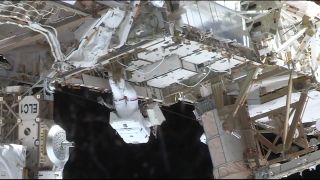
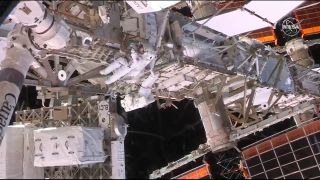
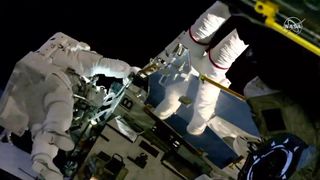
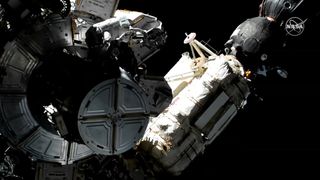
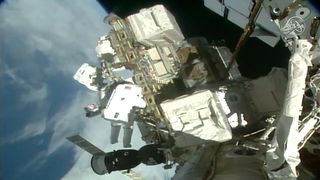
NASA astronauts Nick Hague and Christina Koch successfully completed a spacewalk at the International Space Station today to continue an ongoing power upgrade at the orbiting lab.
The spacewalkers spent 6 hours and 45 minutes working to replace a set of old nickel-hydrogen batteries with new lithium-ion batteries located on the station's P4 truss, where one of the station's solar arrays is located. These batteries hold the charge generated by the solar arrays and power the space station when it's not in direct sunlight.
Hague and Koch did work that's similar to what was done during the previous spacewalk on March 22. During that spacewalk, Hague and NASA astronaut Anne McClain swapped out six old nickel-hydrogen batteries with three new lithium-ion batteries on another power channel at the station's P4 truss.
Although these two spacewalks were planned to be almost identical, NASA had to make a quick change in plans after encountering a problem with one of the new lithium-ion batteries installed last week. After that spacewalk was completed, ground controllers at NASA's Johnson Space Center in Houston activated the newly upgraded power channel to test out the new batteries.
The ground crew "saw more voltage than expected" in one of the three batteries and were "not sure why" it was malfunctioning, Branelle Rodriguez, NASA's lead space station mission evaluation manager, said during a live webcast of today's spacewalk. "Essentially, we don't know if that battery is good anymore," Rodriguez said. So, that lithium-ion battery will need to be replaced with the two nickel-hydrogen batteries that it was intended to replace — undoing some of the work that Hague and McClain did last week.
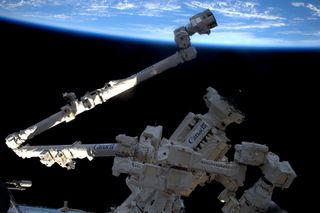
As one of their "get-ahead tasks" today, Koch and Hague did some work to prepare for that battery swap, but they didn't actually replace it themselves. The bulk of that work is done robotically from the ground using the station's Canadarm2 robot arm. All the spacewalkers needed to do was disconnect some cables and move the adapter plate — one of the three that Hague and McClain installed last week — out of the way, leaving all the "heavy lifting" to Canadarm 2.
Technically, the batteries don't actually weigh anything in microgravity, but the 428-lb. (194 kilograms) units are each about the size of a minifridge and can be difficult for an astronaut to lug around outside the station.
The Canadarm2 robot arm outside the International Space Station
Over the next week, ground controllers will remotely operate Canadarm2 to put the two old nickel-hydrogen batteries back in their original spot. Once NASA launches a spare lithium-ion battery, astronauts will install it during a future spacewalk, Rodriguez said.
Some minor hiccups
Although the spacewalkers successfully completed all of their main tasks and "get-ahead tasks" with time left to spare, it wasn't exactly "smooth sailing" for the astronauts today. They did experience a few minor technical difficulties, though thankfully, none of those obstacles jeopardized the mission.
Nick Hague hit his first bump in the road while loosening the bolts on one of the old nickel-hydrogen batteries that the spacewalkers were replacing. As often happens during spacewalks, one of the bolts just didn't want to budge. Ground controllers helped him troubleshoot, and he managed to break it free. Shortly afterward, he encountered more trouble while installing a portable foot restraint, but he eventually got that piece of hardware to cooperate, too, without putting the mission behind schedule.
"That must be a great view, European Space Agency astronaut Thomas Pesquet, who served as the spacewalk communicator alongside the ground control team, told Hague.
"Hard to describe — not sure I have the words," Hague replied. "I sure wish everybody down there on the team could see it."
"We do have a view of you, so that's even better,” Pesquet said, to which Hague replied, "I'm not so sure about that."
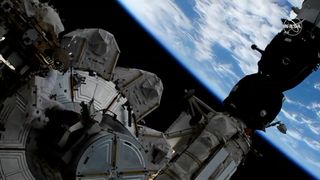
One of the space station's external cameras captured this beautiful view of Earth as NASA astronaut Christina Koch grabbed some supplies from the Quest airlock.
Later, while both spacewalkers were getting ready to move the third and final adapter plate, Hague reported seeing some debris. "Um, I see metal flakes coming out of the socket," Hague said. He then inspected the work site to figure out what those flakes were and where they came from, but it's still not clear what caused these flakes to appear.
Koch also encountered a minor problem with her spacesuit. Ground controllers told her that she had a "possibly failed" carbon-dioxide sensor in her suit and asked her to closely monitor herself for any signs of rising carbon-dioxide levels. Thankfully, Koch did not report any physical symptoms of breathing high levels of carbon dioxide — something that could potentially cause respiratory failure.
More spacewalks to come
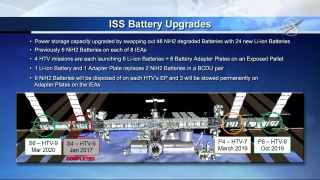
The two spacewalks this month are a continuation of work that began in 2017, when the Expedition 50 crew replaced a total of 12 nickel-hydrogen batteries with six lithium-ion batteries over the course of two spacewalks.
It will take at least another four spacewalks to complete the work, NASA's space station program manager Kenneth Todd said during a news conference earlier this month. Although those spacewalks have not yet been scheduled, NASA is aiming to tackle those in late 2019 and early 2020.
This NASA infographic shows where all of the separate sets of batteries are located and when they will be (or already were) replaced.
By the end of these spacewalks, a total of 48 nickel-hydrogen batteries will have been replaced with 24 lithium-ion batteries. These batteries are expected to last until the end of the space station's life. While they are certified to last for 10 years, NASA expects them to be fully functional for about 20 years, NASA spokesperson Kelly Humphries told Space.com in an email. NASA is planning to end its funding of the International Space Station in 2024, although lawmakers are currently fighting to extend operations until 2030.
A major milestone that wasn't
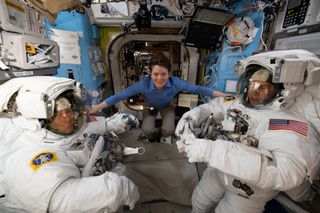
Today's spacewalk would have been the first to be done by a crew of only women, but a spacesuit sizing issue led NASA to swap crew assignments, thereby postponing this historic milestone for women in space.
McClain, who was originally scheduled to join Koch on today's spacewalk, decided that the size-large spacesuit she had planned to wear today would not fit properly. Because only one medium-size suit at the station had been prepped for the current series of spacewalks, and Koch was planning to wear it today, Hague wore the large suit instead and took McClain's place. McClain is now scheduled to take another spacewalk on April 8 with Canadian Space Agency astronaut David Saint-Jacques.
During that next spacewalk, the astronauts will be working on some maintenance tasks unrelated to the ongoing battery-replacement work. Instead, McClain and Saint-Jacques will be installing some jumper cables to give Canadarm2 a redundant power supply. They will also be upgrading the station's wireless communications network by installing new cables.
NASA astronaut Anne McClain assists Christina Koch (left) and Nick Hague (right) during a spacesuit fit check.
Today's spacewalk was the first for Koch and the second for Hague, who has now accrued a total of 13 hours and 24 minutes of spacewalking time. It was the 215th spacewalk that astronauts have done to build and maintain the International Space Station.
Koch is now the 14th woman to have completed a spacewalk, and McClain became the 13th during her spacewalk on March 22. For comparison, more than 200 men have taken spacewalks. Since the very first spacewalk in 1965, there have been 404 spacewalks in all, only 39 of which involved a female spacewalker.
While it may be disappointing that NASA didn't end up doing the first all-female spacewalk in history today, agency officials have assured observers that the milestone is "inevitable," because more and more women are joining NASA's astronaut corps.
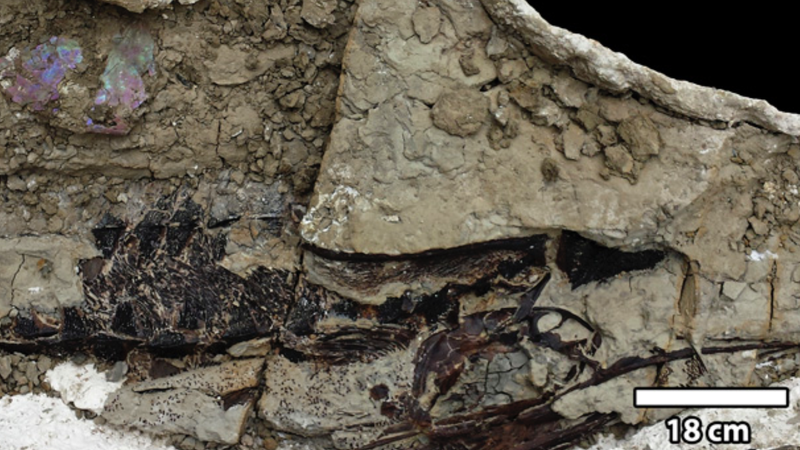
Plaster cast of a Tanis deposit fossil showing a freshwater fish (dark brown) next to a marine ammonite (iridescence at top left).Photo: DePalma et al (PNAS 2019)
At one of the most important ancient graveyards on Earth in North Dakota, paleontologists unearthed the fossilized remains of fish seemingly killed by the effects of the asteroid that ended the Cretaceous.
We know that a large asteroid struck the Earth 66 million years ago, and around the same time, the dinosaurs went extinct. We’re not completely sure whether the asteroid was solely responsible for the mass extinction, but you might ask, “Shouldn’t we see remnants of animals killed by the asteroid’s effects?” Well, now we have found some.
Advertisement
“This is the last day of the Cretaceous,” David Burnham, professor in the Department of Geology at the University of Kansas and one of the study’s authors, told Gizmodo.
When a giant meteorite strikes, you’d expect chaotic effects, like rocks altered by the impact’s high pressures and temperatures, enormous earthquakes, and tsunamis. But Earth’s rocks don’t directly preserve single days of the planet’s several billion-year-old history. You’ve got to get creative when it comes to teasing apart the geologic record. For example, around the world, layers of rock 66 million years old seem to contain excess iridium, presumably deposited by the Chicxulub impactor that struck near what is today the Yucatán Peninsula of Mexico. Then there are tektites, small, glassy spheres of compressed and heated rock. Theoretically, there should also be fossilized evidence of animals killed by the asteroid’s effects.
The Tanis formationScreenshot: DePalma et al (PNAS)
Advertisement
This is what makes the new research, led by Robert DePalma at the University of Kansas, so exciting—the description of a pair of sediment laters at the Tanis site of the The Hell Creek Formation in southwestern North Dakota. Both layers contain an excess of iridium, but only the lower level contains glass pieces that seemed to have been deposited from an inland-moving force. They take this to mean that they’re observing two events: The upper layer is the settling dust from after the impact. The lower is a large deposit of sediment from the hours following the impact.
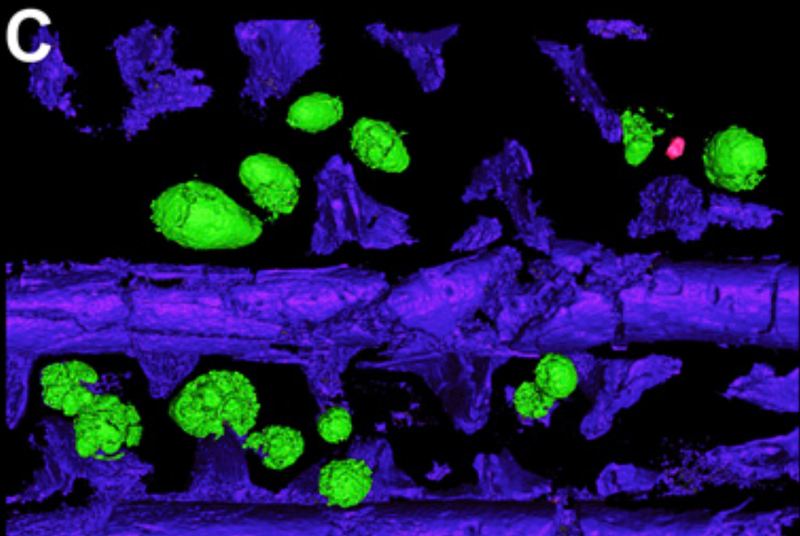
But if the rocks alone don’t convince you, perhaps the fossils in the event deposit will. A large swath of ocean traveled up the interior of the United States during the Cretaceous, terminating not far from the Tanis region. But the rocks at Tanis preserve a mixture of both freshwater fish, like paddlefish and sturgeon, and marine mollusks called ammonites—implying that around this time, the ocean had mixed with freshwater rivers. And lodged inside the fossilized paddlefish’s gills were more of the glass spherules. It appeared that wave containing shocked glass from the impact over 3,050 kilometers (1,895 miles) away had inundated the area, and in their dying breaths, the fish had inhaled some of them.
X-ray image showing spherules embedded in a paddlefish gill.Image: DePalma et al (PNAS)
Advertisement
Other researchers were impressed by the work. “When I first read it, I kept saying ‘wow, wow, wow,’” H. Jay Melosh, distinguished professor of Earth, atmospheric, and planetary science at Purdue University, told Gizmodo. “I think this is one of the most spectacular paleontological discoveries of the century. It’s a snapshot of the moment at which major deaths were occurring right after the impact.”
The researchers point out that there are other scenarios that might have brought the glass particles up to Tanis. Maybe there were meteorological events like gale-force winds, or landslides, the authors write in the paper, published in PNAS.
But the observations have far-reaching implications. The authors write:
“Observations at Tanis expand our knowledge of the Chicxulub impact’s damaging effects and their far-reaching scope. The highly probable link between impact-induced seismic shaking and the onshore inundation surge at Tanis reveals an important additional mechanism by which the Chicxulub impact could have caused catastrophic conditions in the Western Interior, and possibly worldwide, far from the impact site.
Advertisement
It’s amazing to imagine how abruptly life on Earth changed in the hours and days after the Chicxulub asteroid hit. And it’s equally amazing that we could find direct evidence from that time locked away in the remains of the creatures who experienced it.
It's the classic predator-prey matchup. A stealthy rattlesnake, patiently waiting for the right moment to strike a seemingly unsuspecting and vulnerable kangaroo rat.
But high-speed video from researchers in Southern California reveals the surprising power of the little desert rodent's reflexes and stunning combination of strength and agility. Unable to jump clear of the snake's ambush strike, the kangaroo rat unveils one more line of defense -- a twisting leg kick that knocks the snake to the ground, leaving it with a mouthful of dust and dirt instead of dinner.
"These lightning-fast and powerful maneuvers, especially when executed in nature, tell us about the effective strategies for escaping high-performing predators," said Timothy Higham, associate professor in the Department of Evolution, Ecology and Organismal Biology at UC Riverside. "Those that are successful at evading the strike will suggest ways in which the kangaroo rat might be evolving in response to the intricacies of the predatory movements."
The research team, which includes students from UC Riverside, San Diego State University and UC Davis, tracked snakes' hunting behavior, then placed the high-speed cameras in locations where they interacted with kangaroo rats. The video they is beleived to be the first detailed look at how kangaroo rats defend themselves against such a fearsome and secretive predator, according to researchers.
Scottish SPCA
Consider that a human eye can blink in about 150 milliseconds. That's not as fast as a rattlesnake can strike its prey, but not always fast enough if the target is a kangaroo rat.
"Kangaroo rats that responded quickly were frequently able to jump clear of the snake completely, leaving the serpent biting nothing but dust as the kangaroo rat rocketed seven to eight body lengths into the air," said Rulon Clark, an associate professor of biology at San Diego State University. "But in perhaps the most surprising finding of our research, kangaroo rats that did not react quickly enough to avoid the strike had another trick up their sleeves: They often were able to avoid being envenomated by reorienting themselves in mid-air and using their massive haunches and feet to kick the snakes away, ninja-style."
The spin-kick captured on camera unravels a years-long mystery. Previous videos used lower-speed cameras, which didn't pick up the defensive trickery. In those videos, it appeared that the snakes actually bit their prey, but blood tests on the kangaroo rats showed no signs of venom.
"In this new work, we used cameras with much higher recording speed and resolution, which helped show in exquisite detail that kangaroo rats not only have record-breaking reaction time, but can also use their long tails to reorient their bodies while jumping, thereby optimally positioning themselves for both defensive kicking and landing on their feet," said Malachi Whitford, a doctoral student at San Diego State University.
Hair-trigger reflexes and superior athleticism are only part of the equation. Researchers also noted that kangaroo rats have senstive hearing, which means they can pick of the low frequency sounds to foil ambushes. Their large hindlimb muscles and robust tendons allow them to jump so well.
Check out more videos from the research team here.
Image of the Galactic Centre. Credit: European Southern Observatory (ESO).
The GRAVITY Collaboration, a team of researchers at several renowned institutes including the Max Planck Institute, LESIA Paris Observatory and the European Southern Observatory, has recently tested part of the Einstein Equivalence Principle, namely the local positon invariance (LPI), near the galactic center supermassive black hole. Their study, published on Physics Review Letters (PRL), investigated the dependency of different atomic transitions on the gravitational potential in order to give an upper limit on LPI violations.
"General relativity and in general all metric theories of gravity are based on the equivalence of inertial mass and gravitational mass, formalized in the Einstein equivalence principle," Maryam Habibi, one of the researchers who carried out the study, told Phys.org. "General relativity is the best theory of gravity that we have, however, there are still many unanswered puzzles that are closely tied to our incomplete understanding of gravity."
The equivalence principle, a crucial part of Einstein's general relativity theory, states that the gravitational force experienced in any small region of space-time is the same as the pseudo-force experienced by an observer in an accelerated frame of reference. Testing this principle is of key importance, as it could lead to interesting observations and broaden our current understanding of gravity.
"Einstein's equivalence principle consists of three main principles," Habibi explained. "One of them, called the local position invariance (LPI), states that non-gravitational measurements should be independent of the location in space time (characterized by gravitational potential) where they are carried out. The main part of our study focuses on testing the LPI principle."
Past observations suggest that most, if not all, massive galaxies contain a supermassive black hole, which is typically located at the center of a galaxy. The mass of the Milky Way's galactic center supermassive black hole is 4 million times greater than that of the sun. It thus generates the strongest gravitational field in the galaxy, which makes it the ideal place to hunt for unexplored phenomena and test general relativity principles.
Star S2, one of the brightest stars in the Milky Way's innermost region, has its closest encounter with the galactic center supermassive black hole at a distance of 16.3 light hours. In other words, the star takes 16 years to make a complete orbit around the black hole, which in astronomical time scales is extremely short. S2 moves in and out of the black hole's gravitational field, hence the GRAVITY collaboration team decided to use it to test part of Einstein's equivalence principle.
"As it was predicted, and we showed in a previous study published in June 2018, during the closest approach of the star S2 to the black hole we observe the 'gravitational redshift' in the light of the star," Habibi explained. "Gravitational redshift occurs because intense gravity on the star's surface slows the vibration of light waves, stretching them and making the star appear redder than normal from Earth."
To test Einstein's LPI principle, the researchers used two different types of atoms in S2's stellar atmosphere: hydrogen and helium atoms. The LPI principle states that the gravitational redshift seen in a star that is flying in and out of a strong gravitational field only depends on the gravitational potential and does not rely on other parameters, such as the internal structure of the atom.
Image shows one of the Unit Telescopes of ESO’s Very Large Telescope (VLT) array, pointing a laser beam towards the Milky Way to create an artificial star. Credit: European Southern Observatory (ESO).
"We measured the frequency change of light from these atoms moving through a varying potential," Habibi said. "The vibration of light waves was measured by fitting the line-of-sight velocity of the S2's spectrum using the Hydrogen and Helium spectral lines separately. By measuring the difference in frequency change for both atoms we were able to give an upper limit on the LPI violation during the pericenter passage. If there was an obvious violation of LPI, we should have measured very different vibration of light waves, from the helium and hydrogen lines."
The equivalence principle and general relativity at large are merely theories, thus they need to be tested in order to ascertain their validity. So far, most researchers have carried out tests on Earth and in the solar system.
However, these theories should also be tested in extreme scenarios, as this can determine whether they still hold and lead to more conclusive evidence. Such tests could rule out some of the principles that shape our current understanding of gravity or identify violations from the theory of general relativity.
"Testing the equivalence principle in all different regimes is important as several alternative theories of gravitation predict a violation from it under extreme conditions," Felix Widmann, another researcher involved in the study, told Phys.org. "For me the most meaningful finding of our study is that we were able to test the equivalence principle in this most extreme case: close to a supermassive black hole that is over 20 thousand light years away. The limits we put on a violation are not very restrictive yet, but they are in a gravitational regime that was completely untested before."
Habibi, Widmann and their colleagues were among the first to test part of the equivalence principle near the Milky Way's central supermassive black hole. Their work provides valuable insight about the validity of general relativity, particularly the LPI principle.
"The past year was exceptionally successful for the GRAVITY collaboration," Widmann said. "For the first time, we observed relativistic effects in the orbit of a star around a supermassive black hole and used this star to test the Equivalence Principle. We also observed material orbiting very close to the black hole, another observation which would have been impossible without GRAVITY. However, this is more of a start than an end for us."
With the optimal season for galactic center observation just around the corner, the researchers at GRAVITY collaboration will continue to point their telescopes to S2 and the galactic center supermassive black hole. According to Widmann, the team might soon be able to detect subtler relativistic effects in the orbit of S2, which will allow them to test the theory of general relativity once again. In their future observations, the researchers also hope that they will see more flare activity around the black hole, as this would enable further studies aimed at broadening their understanding of the Milky Way's galactic center black hole and black holes in general.
"With future telescopes like the Extremely Large Telescope, which has a mirror of 39m in diameter, we will be able to perform similar experiments and look for 1 million times smaller effects of possible violations of LPI, compared to what it is possible today," Widmann added. "This will allow us to test the other part of Einstein's equivalence principle, called weak equivalence principle, which states that an object in gravitational free fall is physically equivalent to an object that is accelerating with the same amount of force in the absence of gravity. The galactic center is a unique observatory and with GRAVITY and future telescopes we want to learn as much about it as possible."
More information:
A. Amorim et al. Test of the Einstein Equivalence Principle near the Galactic Center Supermassive Black Hole, Physical Review Letters (2019). DOI: 10.1103/PhysRevLett.122.101102
Detection of the gravitational redshift in the orbit of the star S2 near the Galactic centre massive black hole, Astronomy & Astrophysics (2018). DOI: 10.1051/0004-6361/201833718
Citation:
Testing Einstein's equivalence principle near a supermassive black hole (2019, March 29)
retrieved 29 March 2019
from https://phys.org/news/2019-03-einstein-equivalence-principle-supermassive-black.html
This document is subject to copyright. Apart from any fair dealing for the purpose of private study or research, no
part may be reproduced without the written permission. The content is provided for information purposes only.
NASA has created the perfect job for anyone who really enjoys staying in bed all day, as long as they don't mind continuing to do just that for 60 days without a break.
The study hopes to figure out what effective countermeasures there are against bone and muscle atrophy when humans are placed in a weightless environment and how artificial gravity can have a positive impact. This is important for the astronauts who will eventually spend extended periods of time in space beyond the limited stays currently experienced aboard the International Space Station.
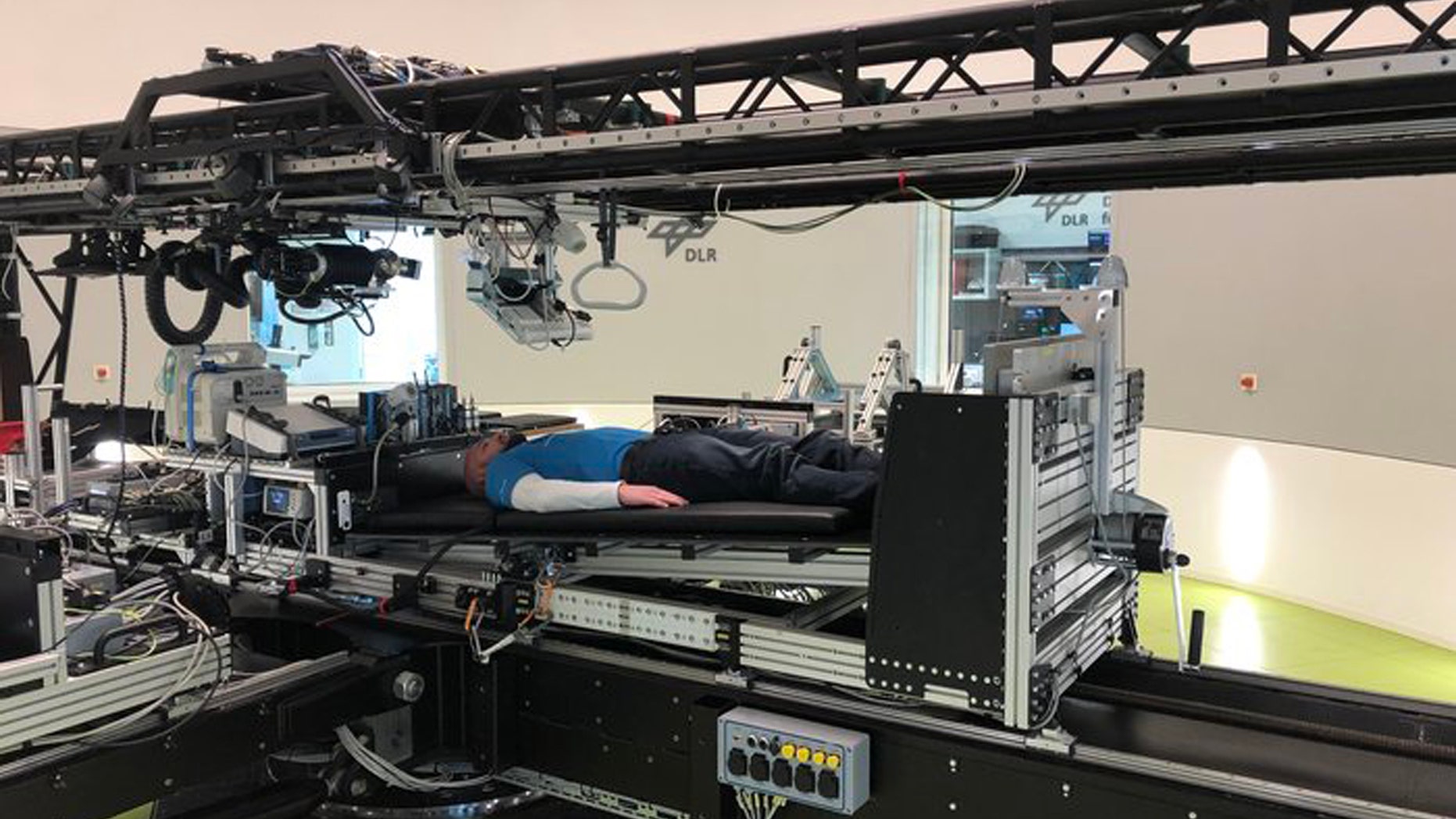
As part of the study, 12 male and 12 female volunteers will spend 60 days in bed in the :envihab facility at the DLR Institute of Aerospace Medicine in Cologne. Their full stay will actually be 89 days, with the remaining 19 days used as pre-test and recovery periods. In return for their time, each volunteer will receive $19,000 in compensation.
More From PCmag
While that may sound like easy money to make, the test is sure to be quite stressful and potentially unpleasant. As DLR explains, "All experiments, meals, and leisure pursuits will take place lying down during the bed-rest phase. The participants will be restricted in their movements, so that the strain on muscles, tendons and the skeletal system is reduced. The beds are angled downwards towards the head end by six degrees. This will simulate the displacement of bodily fluids experienced by astronauts in a microgravity environment."
According to Leticia Vega, Associate Chief Scientist for International Collaborations for NASA's Human Research Program, the restrictions placed on the volunteers produce effects that are "similar to what astronauts experience in space," which can then be combined with what's known from studying humans in the weightless environment aboard ISS.
/arc-anglerfish-arc2-prod-sltrib.s3.amazonaws.com/public/G6PXXGIPMBA2ZDUIL6KHCTQLKU.jpg)