Callahan has one season left on his deal and was placed on long-term injured reserve after suffering a career-ending back injury and a degenerative back disease diagnosis this past season.
As part of the transaction, the Senators will also receive Tampa Bay’s fifth-round draft pick in the 2020 NHL Draft while the Lightning will receive Ottawa’s sixth-round selection.
By trading Condon, the Senators have set the stage for veteran goalie Craig Anderson and Anders Nilsson, who agreed to a two-year extension in May, to share netminding duties in Ottawa. Filip Gustavsson, Marcus Hogberg and Joey Daccord will play net for Ottawa’s American Hockey League affiliate in Belleville, Ont.
"We believe we have the right mix of goaltenders both for the upcoming season and the future," said general manager Pierre Dorion. "We are pleased with how our young goaltenders have been developing in Belleville, so this trade allows us to focus on continuing their growth at a proper pace while keeping two established goaltenders here in Ottawa. Our cap flexibility allowed us to proceed with this trade, which will also benefit us as we continue making adjustments to create a hardworking, exciting team."
The Lightning placed Callahan on long-term injured reserve on June 20.
He appeared in 52 games last season, finishing with seven goals and 10 assists for 17 points. He has 186 goals and 386 points in 757 career games with Tampa Bay and the New York Rangers.
Callahan’s cap hit is US$5.8 million, but he’ll make $4.7 million in real money. However, because he is on long-term injured reserve, insurance will pick up 80 per cent of his salary, meaning the Senators will actually have to pay approximately $940,000 of his contract.
Condon will earn $3 million next season but his cap hit is $2.4 million.
Tamp Bay is extraordinarily deep in net.
The Lightning signed Vezina Trophy winner Andrei Vasilevskiy to an eight-year, $76 million contract extension on Monday. Condon joins Louis Domingue, Curtis McElhinney, Scott Wedgewood and Spencer Martin as goalies under contract with Tampa that could play as a potential backup to Vasilevskiy. The Lightning also have former Montreal Canadiens goalie prospect Zach Fucale signed to an AHL deal.
from Sports - Latest - Google News https://ift.tt/2ymF5yN
via IFTTT
July 30, 2019 at 09:56PM
The big news was that Bo Bichette singled in his first MLB at bats. He finished the game 1 for 4 with a strikeout.
We had a bunch of home runs:
We got 3 runs in the ninth. Hernandez walked (nice to see him taking the occasional walk), Danny Jansen singled him to third, then Biggio singled him home, after being down 0-2. Grichuk singled home Jansen, giving him 3 RBI on the day, and leaving him a double short of the cycle. And, after a Vlad walk, Grichuk scored on a Smoak ground out.
We should have scored more. Grichuk followed Biggio’s homer with a no-out triple, but Vlad, Drury and Bichette all struck out to strand him at third.
We had 11 hits. Biggio and Grichuk had 3 each.
Vlad had an interesting day. He had a nicely hit single in the first inning. On defense he had two balls go off his glove (hard hit balls, but plays he should have made), one of which cost us two runs. And he also made a couple of nice plays, showing off his arm from third. I think that’s what we are going to see, some nice plays from him, but some bad plays as well.
Thomas Pannone had a pretty good start. 6 innings, 5 hits (two of them, as mentioned, off Vlad’s glove, one that should have been an error, and allowed 2 runs to score), 3 earned, 1 walk and 4 strikeouts. He didn’t have much for hard hit balls against.
Tim Mayza pitched a scoreless seventh and Justin Shafer a scoreless eighth, with a walk and 2 strikeouts.
After both Daniel Hudson and Derek Law warmed up in the top of the ninth, Law came in for the bottom of the inning, since it was no longer a save situation (one of those things managers do that drive me crazy, is there a big difference in win probability between a 4-run and a 3-run lead?). Law gave up a walk but got out of the inning without giving up a run.
Jays of the Day: Grichuk (.336 WPA), Biggio (.303), Shafer (.145), Hernandez (.104) and Mayza (.090).
Suckage: McKinney (-.110 for an 0 for 4, 2 k) and Drury (-.103 for 1 for 5, 2 k).
I’m enjoying watching the young guys play. I know we aren’t going to win a ton of games, but I like watching them.
We had 897 comments in the Welcome Bo GameThread. Barraqudie led us to victory. Great job.
from Sports - Latest - Google News https://ift.tt/2Mqm72w
via IFTTT
July 30, 2019 at 10:22AM
Thanks to the massive trove of exoplanets discovered by the Kepler mission, we now have a good idea of what kinds of planets are out there, where they orbit, and how common the different types are. What we lack is a good sense of what that implies in terms of the conditions on the planets themselves. Kepler can tell us how big a planet is, but it doesn't know what the planet is made of. And planets in the "habitable zone" could be subjected to anything from a blazing hell to a frozen rock.
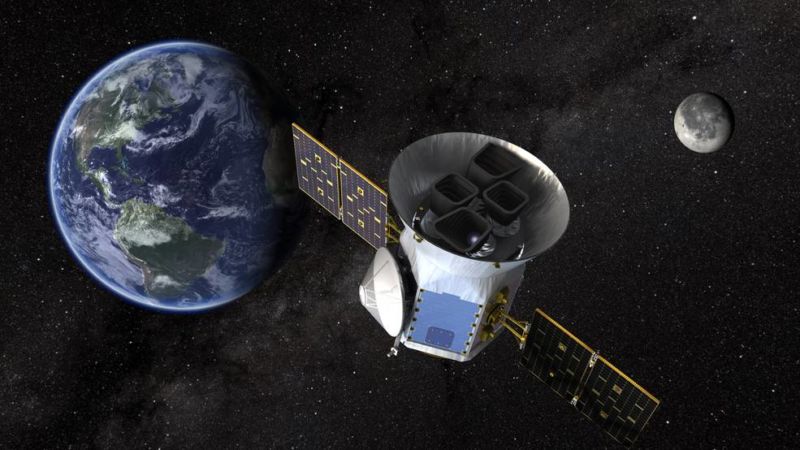
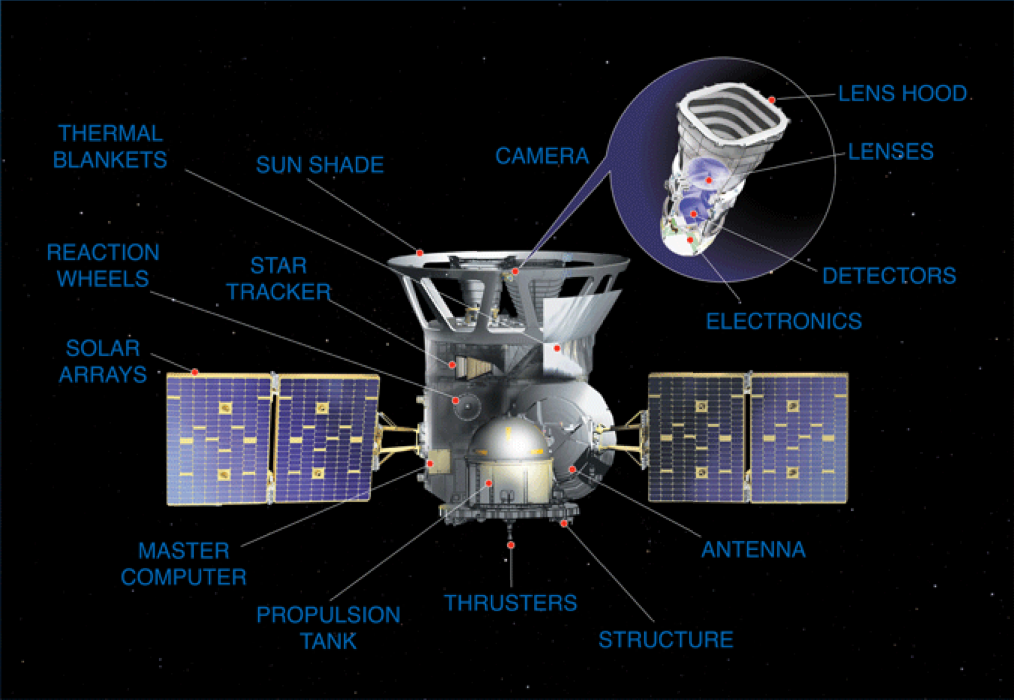
The Transiting Exoplanet Survey Satellite (or TESS) was launched with the intention of helping us figure out what exoplanets are actually like. TESS is designed to identify planets orbiting bright stars relatively close to Earth, conditions that should allow follow-up observations to figure out their compositions and potentially those of their atmospheres.
Right now, there's a conference happening that's dedicated to describing some of the first discoveries made using TESS. Those discoveries include a three-planet system that seems perfectly positioned to test all of our exoplanet characterization techniques.
What are we looking at?
Both Kepler and TESS identify planets using what's called the transit method. This works for systems in which the planets orbit in a plane that takes them between their host star and Earth. As this occurs, the planet blocks a small fraction of the starlight that we see from Earth (or nearby orbits). If these dips in light occur with regularity, they're diagnostic of something orbiting the star.
This tells us something about the planet. The frequency of the dips in the star's light tells us how long an orbit takes, which tells us how far the planet is from its host star. That, combined with the brightness of the host star, tells us how much incoming light the planet receives, which will influence its temperature. (The range of distances at which temperatures are consistent with liquid water is called the habitable zone.) And we can use that, along with how much light is being blocked, to figure out how big the planet is.
But this leaves a lot of important questions unanswered.
Take a planet that appears to be larger than Earth. It could be rocky, like Earth, placing it in the super-Earth category. But it could also have a dense core surrounded by a thick, gaseous atmosphere, making it a mini-Neptune. Or it could be water-dominated, making for a water- or ice-giant, depending on where it orbits.
That last issue isn't as clear as it seems, either. The temperature of a planet depends in part on its distance from its host star (as well as that star's brightness). Some of that light will be reflected by the planet's surface and any clouds present in its atmosphere. And a fraction of the energy that's absorbed by the planet will be trapped in the atmosphere by greenhouse gasses (including, yes, carbon dioxide).
So the planet's composition and its atmosphere's contents play huge roles in influencing its temperature. At a given distance from a star, it's often possible for these factors to make the difference between a frozen body and one that's hot enough to boil off its oceans.
So, to really understand other planets and their potential to support life, we have to understand what they're made of and what their atmosphere looks like. And, while TESS itself doesn't answer those questions, it's designed to find planets where other instruments could.
Finding things to look at
Fortunately, there are ways of figuring these things out. For example, knowing the size of a planet and its mass tells us its density, which in turn lets us make inferences about its composition. From there, it's possible to figure out a planet's mass. One option is to figure out how much a planet tugs on its host star as it moves about in its orbit.
This tugging creates small Doppler shifts in the light coming from the star. This shift allows us to figure out the force the planet is exerting on the star, and thus its mass.
Alternately, if planets' orbits are packed tightly enough, they exert gravitational influences on each other: they speed up or slow down each other's orbits. These transit-timing variations can be registered over time and plugged into models that will provide plausible estimates for the planets' mass.
The transit method also has the potential to give us a sense of what's in the planet's atmosphere. As it passes in front of its host star, a small percentage of the starlight will be absorbed by the gasses in its atmosphere, creating a signature that can reveal the identity of those gasses. While this tiny signal is swamped by the noise in a single transit, observing multiple transits can eventually overcome this limitation.
All of this, however, requires a fair bit of light to start with, which means a bright, relatively nearby star. And we'd need to image multiple orbits, which means the planet in question needs to be orbiting relatively close to its host star.
These are precisely the things TESS is designed to pick up.
The new system
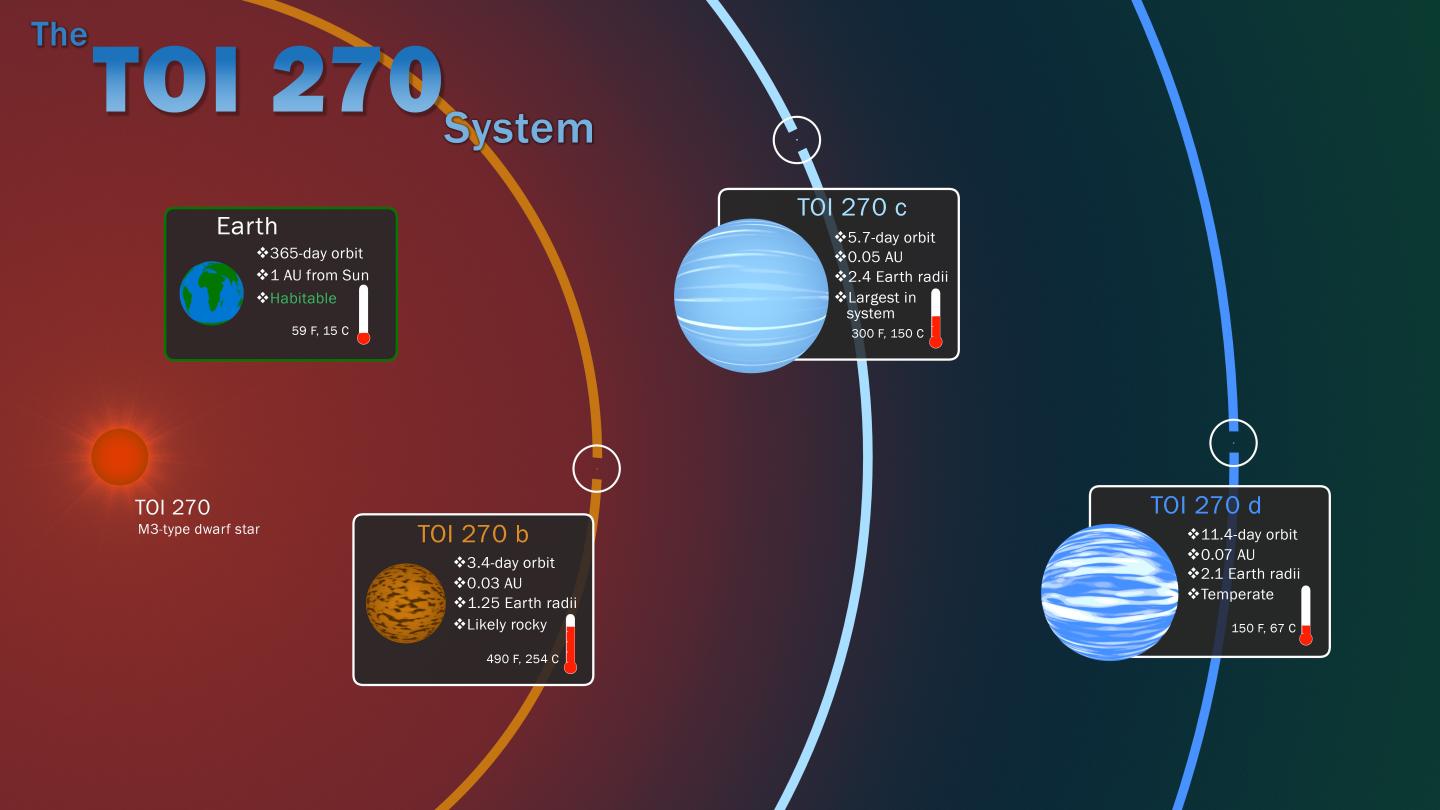
The new three-planet system is called TOI-270, and it's about 75 light years from Earth. The star at the center of the system is a red dwarf, a bit less than half the size of the Sun. Despite its small size, it's brighter than most of the nearby stars we know hosts planets. And—critically—it's stable. That means that variations in the star's light are minimal, and they're less likely to get in the way of trying to pick up subtle changes caused by its orbiting planets.
The three planets have orbital periods of 3.4 days, 5.7 days, and 11.4 days. The ratio among these periods can be expressed as ratios of integers, a feature that's called "orbital resonance."
These resonances tend to stabilize the orbits, keeping the planets' interactions from ejecting one of them from the system or send one diving into the star. Based on the size of the planets, the trio consists of a super Earth as the innermost planet, while the two outer planets are somewhat larger, falling into the class termed sub-Neptunes.
Right now, we only have enough observations of the TOI-270 system to confirm the existence of the three planets. Orbital simulations, however, suggest that a wide range of orbital eccentricities would be stable in the system, so it will take extended observations to figure out the precise details of the orbits.
But, since the longest orbit is under 12 days, that's not so onerous. Once the orbits are figured out, the planets are close enough together to cause transit-timing variations, providing us one avenue toward getting the masses of the planets. They're also large enough and close to the star to drag it around a bit while they orbit, creating Doppler shifts that would allow an independent measurement of the mass.
Significant atmospheres
The outer two planets, which are expected to have significant atmospheres, are prime candidates for studies of their composition. The authors estimate that the James Webb Space Telescope will eventually have a view of the system for over half the year, and it should be able to pick out the atmospheric signals for both planets.
What are we likely to find? All three planets are extremely hot, with only the outermost planet potentially being able to support some liquid water. However, it's also at the edge of boiling off any water into the atmosphere; the authors suggest temperate conditions are more likely on any moons it has. The interactions among the three planets also mean that each is likely to be tidally locked to the host star, which can result in a frigid far side of the planet and a baking star-facing side.
But even if habitability isn't an issue here, the system is definitely worth a careful look. When we have the sort of telescope hardware that will let us detect atmospheres, we'll want to test it out on something where it's likely to work and where we can troubleshoot the inevitable problems that will occur with the analysis. There will also be a learning process with the giant telescopes and James Webb that will be necessary for this work. That makes TOI-270 an important discovery, since it provides the perfect test conditions for exoplanet characterization.
For years, astronomers have been on a lookout for Earth-like planets outside our solar system. NASA’s Transiting Exoplanet Survey Satellite (TESS) has been dedicatedly employed to search exoplanets to explore the possibility of finding life in deep space and also, learning the secrets of the evolution of the Milky Way.
NASA’s exoplanet specialist telescope has now hunted down a certain rocky exoplanet locked in a triple-star system approximately 22.5 light-years away from our planet. Being referred to as LTT 1445Ab, the exoplanet is orbiting the primary star of the three red dwarfs that make the system. Hence, if you’re standing on its surface, you can spot three suns in the sky, as per Jennifer Winters, astronomer at Harvard-Smithsonian Center for Astrophysics.
The planet-hunting telescope, particularly focusing on exoplanets that pass between Earth and their home star came across the exoplanet, detecting how it was blocking a small percentage of light of its star. The dimming of the planet, as a result, grasped the attention of scientists who observed tiny movements of the star. Scientists could, thus, place constraints on the size and mass of the planet as it pulled the star only slightly owing to its gravity.
About 1.35 times the size of the physical Earth, LTT 1445Ab packs up to 8.4 times Earth’s mass, a lot denser than our home planet. Chances of habitability on this rocky exoplanet are slim even though it falls into the category of Mars, Venus and Earth-like terrain. However, it sure witnesses some really stunning skies. Besides, the new exoplanet could have an atmosphere which keeps scientists charged up for taking a closer look.
Scientists believe that LTT 1445Ab could be an excellent candidate for testing detection tools that are used to look for biogases such as methane and carbon dioxide. The reason being its frequent transitions which will offer ample number of opportunities for scientists for observation. As per cosmic scales, the exoplanet is not very far away from us and is just optimally lit by its stars for a conducive survey. The study has been submitted to the Astronomical Journal and is available on arXiv.
Unfortunately, our website is currently unavailable in most European countries. We are engaged on the issue and committed to looking at options that support our full range of digital offerings to the EU market. We continue to identify technical compliance solutions that will provide all readers with our award-winning journalism.
Look up! We are having a double meteor shower tonight. The Delta Aquarids and Alpha Capricornids will shine through the sky tonight. Saturn will also be visible. The shower peaks tonight with up to 20 meteors per hour possible.
However, this shower could be hard to see for some because of the rain showers and storms that are possible overnight.
The best way to see the meteors is to look southeast away from any lights which includes the moon. The good news is the moon is only 5.9% visible because it is a waning crescent which will increase your chances of seeing the meteors flying across the sky tonight.