Sabtu, 23 April 2022

All-private SpaceX astronaut mission to return home from the ISS after week-long delay - CTV News

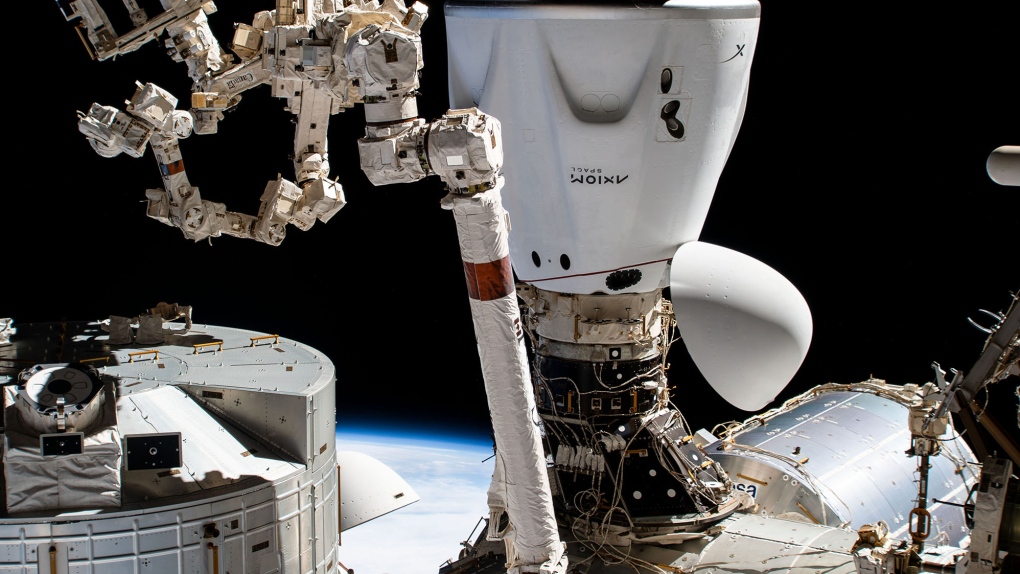
The first all-private mission to the International Space Station is slated to complete the final leg of its journey in the next few days, capping off what turned into a longer-than-expected journey after bad weather kept the passengers on the space station for several extra days.

The mission, called AX-1, was brokered by the Houston, Texas-based startup Axiom Space, which books rocket rides, provides all the necessary training, and coordinates flights to the ISS for anyone who can afford it.

The four crew members — Michael López-Alegría, a former NASA astronaut-turned-Axiom employee who is commanding the mission; Israeli businessman Eytan Stibbe; Canadian investor Mark Pathy; and Ohio-based real estate magnate Larry Connor — are slated to leave the space station aboard their SpaceX Crew Dragon capsule on Sunday at 8:55 pm ET. That's another 24-hour delay from what NASA and Axiom were targeting on Saturday.

They now plan to spend a day free flying through orbit before plummeting back into the atmosphere and parachuting to a splashdown landing off the coast of Florida at about 1 pm ET Monday, according to a tweet from Kathy Lueders, the head of NASA's human spaceflight program.

AX-1, which launched on April 8, was originally billed as a 10-day mission, but delays have extended the mission by about a week.

During their first 12 days on the space station, the group stuck to a regimented schedule, which included about 14 hours per day of activities, including scientific research that was designed by various research hospitals, universities, tech companies and more. They also spent time doing outreach events by video conferencing with children and students.

The weather delays then afforded to them "a bit more time to absorb the remarkable views of the blue planet and review the vast amount of work that was successfully completed during the mission," according to Axiom.

It's not clear how much this mission cost. Axiom previously disclosed a price of $55 million per seat for a 10-day trip to the ISS, but the company declined to comment on the financial terms for this specific mission beyond saying in a press conference last year that the price is in the "tens of millions."

The mission has been made possible by very close coordination among Axiom, SpaceX and NASA, since the ISS is government-funded and operated. And the space agency has revealed some details about how much it charges for use of its 20-year-old orbiting laboratory.

For each mission, bringing on the necessary support from NASA astronauts will cost commercial customers US$5.2 million, and all the mission support and planning that NASA lends is another $4.8 million. While in space, food alone costs an estimated $2,000 per day, per person. Getting provisions to and from the space station for a commercial crew is another $88,000 to $164,000 per person, per day.

But the extra days the AX-1 crew spent in space due to weather won't add to their own personal overall price tag, according to a statement from NASA.

"Knowing that International Space Station mission objectives like the recently conducted Russian spacewalk or weather challenges could result in a delayed undock, NASA negotiated the contract with a strategy that does not require reimbursement for additional undock delays," the statement reads.

It's not the first time paying customers or otherwise non-astronauts have visited the ISS, as Russia has sold seats on its Soyuz spacecraft to various wealthy thrill seekers in years past.

But AX-1 is the first mission with a crew entirely comprised of private citizens with no active members of a government astronaut corps accompanying them in the capsule during the trip to and from the ISS. It's also the first time private citizens have traveled to the ISS on a U.S.-made spacecraft.

The mission has set off yet another round of debate about whether people who pay their way to space should be referred to as "astronauts," though it should be noted a trip to the ISS requires a far larger investment of both time and money than taking a brief suborbital ride on a rocket built by companies like Blue Origin or Virgin Galactic.

López-Alegría, a veteran of four trips to space between 1995 and 2007 during his time with NASA, had this to say about it: "This mission is very different from what you may have heard of in some of the recent — especially suborbital — missions. We are not space tourists. I think there's an important role for space tourism, but it is not what Axiom is about."

Though the paying customers will not receive astronaut wings from the U.S. government, they were presented with the "Universal Astronaut Insignia" — a gold pin recently designed by the Association of Space Explorers, an international group comprised of astronauts from 38 countries. López-Alegría presented Stibbe, Pathy and Connor with their pins during a welcome ceremony after the group arrived at the space station.

Adblock test (Why?)


https://news.google.com/__i/rss/rd/articles/CBMigAFodHRwczovL3d3dy5jdHZuZXdzLmNhL3NjaS10ZWNoL2FsbC1wcml2YXRlLXNwYWNleC1hc3Ryb25hdXQtbWlzc2lvbi10by1yZXR1cm4taG9tZS1mcm9tLXRoZS1pc3MtYWZ0ZXItd2Vlay1sb25nLWRlbGF5LTEuNTg3MzQyMNIBAA?oc=5

2022-04-23 16:44:00Z
1303164067

Celebrating the Hubble Space Telescope’s 32nd Birthday With a Stunning Galaxy Grouping - SciTechDaily

Hickson Compact Group 40

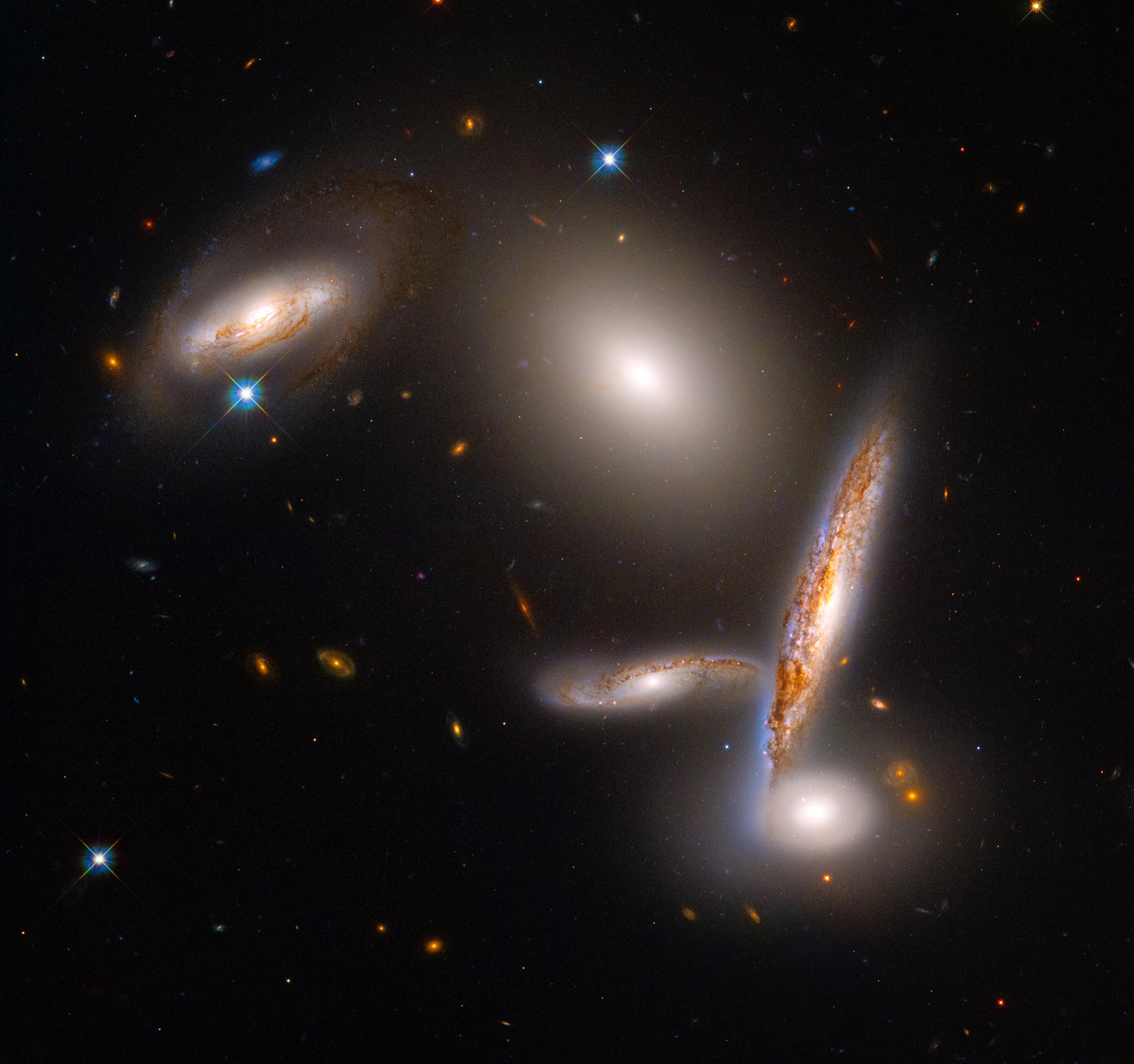
The NASA/ESA Hubble Space Telescope is celebrating its 32nd birthday with a stunning look at an unusual close-knit collection of five galaxies, called the Hickson Compact Group 40. This snapshot reflects a special moment in their lifetimes as they fall together before they merge. Credit: NASA, ESA and STScI

The NASA/ESA Hubble Space Telescope is celebrating its 32nd birthday with a magnificent view of the Hickson Compact Group 40, an extraordinary close-knit grouping of five galaxies. This photograph captures a special moment in their lifetimes as they fall together before merging.

This menagerie includes three spiral-shaped galaxies, an elliptical galaxy, and a lenticular (lens-like) galaxy. Somehow, these different galaxies have crossed paths to create an unusually crowded and diversified galaxy sampler.


The NASA/ESA Hubble Space Telescope is celebrating its 32nd birthday with a stunning look at an unusual close-knit collection of five galaxies.

Caught in a leisurely gravitational dance, the whole group is so closely packed that it could fit within a region of space that is less than twice the diameter of our Milky Way’s stellar disc.

Though such galaxy groupings can be found in the center of massive galaxy clusters, these galaxies are notable for being isolated in their own small area of the Universe, in the direction of the constellation Hydra.

Hickson Compact Group 40 Wide Field View

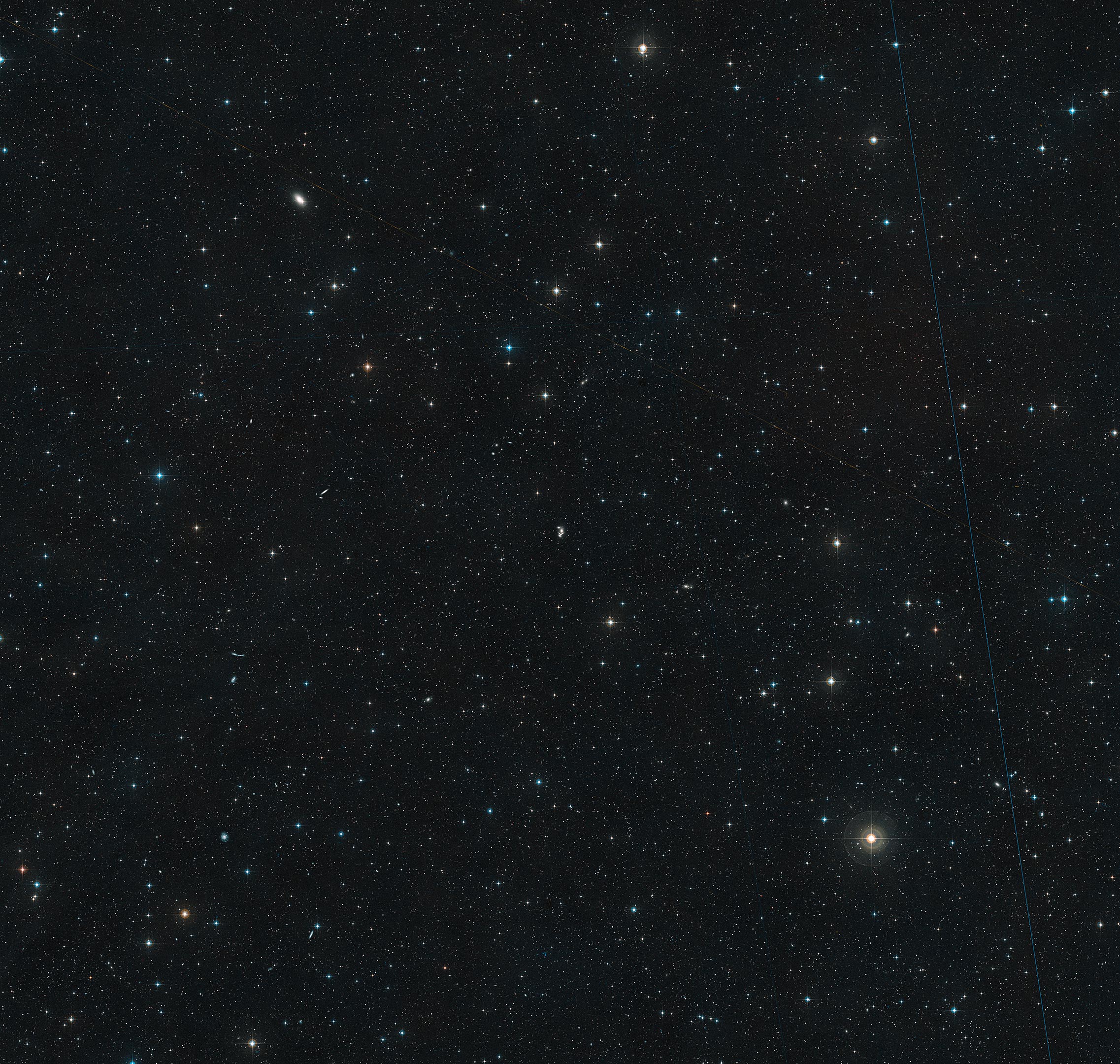
This image shows a wide-field view centered on the Hickson Compact Group 40. Credit: ESA/Hubble, Digitized Sky Survey 2, Acknowledgment: D. De Martin

One possibility is that there’s a lot of dark matter (a poorly understood and invisible form of matter) associated with these galaxies. If they come close together the dark matter can form a big cloud within which the galaxies orbit. As the galaxies plow through the dark matter they feel a frictional force that results from its gravitational effects. This slows their motion and makes the galaxies lose energy, so they fall together. As a result, this photograph captures the galaxies at a particularly special point in their lives. They will eventually collide and combine to form a single gigantic elliptical galaxy in around 1 billion years.


The NASA/ESA Hubble Space Telescope is celebrating its 32nd birthday with a stunning look at an unusual close-knit collection of five galaxies, called the Hickson Compact Group 40. This snapshot reflects a special moment in their lifetimes as they fall together before they merge. Credit: NASA, ESA, and STScI

This compact galaxy group has been studied not only in visible light, but also in radio, infrared, and x-ray wavelengths. Almost all of the galaxies have a compact radio emission source at their core, which could indicate the presence of a supermassive black hole. X-ray observations reveal that the galaxies have been gravitationally interacting, as evidenced by the presence of a large amount of hot gas among them. Infrared observations reveal clues on the rate at which new stars develop.

Though over 100 such compact galaxy groups have been cataloged in sky surveys going back several decades, Hickson Compact Group 40 is one of the most densely packed. Observations suggest that such tight groups may have been more abundant in the early Universe and provided fuel for powering black holes, known as quasars, whose light from superheated inflating material blazed across space. Studying the details of galaxies in nearby groups like this helps astronomers sort out when and where galaxies assembled themselves, and what they are assembled from.

For more on this, see Celebrating Hubble’s 32nd Birthday: A Stunning Look at an Unusual Collection of Five Galaxies.

More information

The Hubble Space Telescope is a project of international cooperation between ESA and NASA.

As Hubble celebrates its 32nd year of operations, below are some captivating facts about the famous observatory’s achievements and impact:

  • Launched on April 24, 1990, the NASA/ESA Hubble Space Telescope has made more than 1.5 million observations of about 50,000 celestial objects.
  • Astronomers using Hubble data have published more than 19,000 scientific papers, with more than 1000 of those papers published in 2021.
  • Approximately 100,000 citations attributed to Hubble are accumulated every three years. On average, each paper based on Hubble data has roughly 54 citations.

The observations were conducted as part of the Hubble observing program 16848 (PI: C. Britt).

Adblock test (Why?)


https://news.google.com/__i/rss/rd/articles/CBMib2h0dHBzOi8vc2NpdGVjaGRhaWx5LmNvbS9jZWxlYnJhdGluZy10aGUtaHViYmxlLXNwYWNlLXRlbGVzY29wZXMtMzJuZC1iaXJ0aGRheS13aXRoLWEtc3R1bm5pbmctZ2FsYXh5LWdyb3VwaW5nL9IBc2h0dHBzOi8vc2NpdGVjaGRhaWx5LmNvbS9jZWxlYnJhdGluZy10aGUtaHViYmxlLXNwYWNlLXRlbGVzY29wZXMtMzJuZC1iaXJ0aGRheS13aXRoLWEtc3R1bm5pbmctZ2FsYXh5LWdyb3VwaW5nL2FtcC8?oc=5

2022-04-23 21:18:56Z
1391690346

Skookum Jim, whose discovery led to the Klondike gold rush, gets a namesake asteroid - CBC.ca

A legendary Yukoner received a posthumous honour that's out of this world.

Skookum Jim, also known as Jim Mason, discovered gold in the Bonanza Creek in 1897, leading to the Klondike gold rush. When he died in 1916, he put the fortune he made into a trust to help improve the lives of Indigenous people in the Yukon.

Last week, on the recommendation of the Yukon Astronomical Society, an asteroid between Mars and Jupiter was named after him.

"I think it's great," said Zena McLean, Skookum Jim Mason's great grand niece who didn't know her ancestor's name had been submitted.

"Anything that keeps Skookum Jim Mason's name up in public history of the Yukon is important to his remaining nieces and nephews and family."

The Skookum Jim Friendship Centre in Whitehorse. (Philippe Morin/CBC)

Skookum Jim Mason was Tagish of the Dak l'a Weidi Clan. The trust fund he established in his will is still in existence today, according to the friendship centre that bears his name in Whitehorse. The interest generated from the fund is used to provide recognition to Indigenous people who have helped their community.

Maria Benoit, Haa Shaa du Hen, or chief, of the Carcross/Tagish First Nation and former executive director of the Skookum Jim Friendship Centre, was very happy to hear the news. Her great grandfather was Skookum Jim Mason's nephew.

"Coming from a First Nation, it's history in the making," she said.

Skookum Jim asteroid

The Skookum Jim asteroid is a main belt asteroid. It orbits with other asteroids in between the orbits of Mars and Jupiter. 

"It takes a little over five years to complete a full orbit around the sun," explained Christa Van Laerhoven, president of the Yukon Astronomical Society. "Its orbit is not quite circular. It's not wildly what we call eccentric. It's not highly uncircular, but just a bit. And it's tilted relative to Earth's orbit by about 15 degrees."

As far as Van Laerhoven knows, it's the second asteroid whose name has a link to the Yukon.

"The only other asteroid that I can find with the Yukon connection is named Klondike," she said, adding it's named after two brothers who came up for the Klondike gold rush, made a fortune and donated money to a university in Finland that built a library.

In a quirk of fate, Van Laerhoven said it's the university where the Skookum Jim asteroid was initially discovered.

However, if you're hoping to see the Skookum Jim asteroid, Van Laerhoven said you'll need a telescope. 

"Something fairly large," she said, large enough that it wouldn't be easy to bring out in your backyard.

McLean said she hopes that one day, science will be able to identify what the asteroid is made of.

"Wouldn't it be fantastic if it was heavily laden with gold?" she said with a laugh.

Naming process

The naming all started with an email from the Royal Astronomical Society of Canada to the Yukon Astronomical Society that said they had an opportunity to put some names forward to the International Astronomical Union (IAU), which is in charge of naming things in space.

The way the email was worded, Van Laerhoven said, sounded like the IAU wanted to honour someone who had served society well.

"We really felt that if we were going to honour a Yukoner, we wanted to honour Skookum Jim," she said.

"We really felt that his presence in Yukon history loomed so large that if we were going to get an asteroid named after a Yukoner, then it really should be him."

9:30Look! Up in the sky! It's the Skookum Jim asteroid

There is now an asteroid officially named after Yukoner Skookum Jim. Christa Van Laerhoven of the Yukon Astronomical Society explains how this came about. 9:30

The suggestion was put forward in 2018. 

The Yukon Astronomical Society was notified of the honour last week, on April 11.

"I'm absolutely tickled pink that the IAU took our suggestion," said Van Laerhoven.

Adblock test (Why?)


https://news.google.com/__i/rss/rd/articles/CBMiQ2h0dHBzOi8vd3d3LmNiYy5jYS9uZXdzL2NhbmFkYS9ub3J0aC9za29va3VtLWppbS1hc3Rlcm9pZC0xLjY0MjUzOTHSASBodHRwczovL3d3dy5jYmMuY2EvYW1wLzEuNjQyNTM5MQ?oc=5

2022-04-23 19:22:35Z
CBMiQ2h0dHBzOi8vd3d3LmNiYy5jYS9uZXdzL2NhbmFkYS9ub3J0aC9za29va3VtLWppbS1hc3Rlcm9pZC0xLjY0MjUzOTHSASBodHRwczovL3d3dy5jYmMuY2EvYW1wLzEuNjQyNTM5MQ

World’s largest particle collider is now even more powerful - Digital Trends

The Large Hadron Collider (LHC), the world-famous particle accelerator which was used to discover the Higgs boson particle in 2012, has restarted after a three-year break to perform maintenance and upgrades. The accelerator can now resume its work to uncover more about the constituent particles of the universe.

The Large Hadron Collider tunnel at point 1.
The LHC tunnel at point 1. CERN

The LHC is housed in a 17-mile circumference tunnel beneath the border of France and Switzerland and was built by the European Organization for Nuclear Research (CERN). On Friday, 22 April, it shot two beams of protons at each other with an energy of 450 billion electronvolts (450 GeV).

“These beams circulated at injection energy and contained a relatively small number of protons,” said Rhodri Jones, the head of CERN’s Beams Department, in a statement. “High-intensity, high-energy collisions are a couple of months away. But first beams represent the successful restart of the accelerator after all the hard work of the long shutdown.”

The three year maintenance period, called Long Shutdown or LS2, began in December 2018 and included improvements to the accelerators which should allow even higher energy beams to be produced, of up to 6.8 TeV per beam. The magnets that direct and focus the particle beams have been fitted with an improved electrical insulation system as well, and some of the magnets have been replaced.

Overall, the improvements to the LHC will allow the particle accelerator to work at higher energies, and also to perform more frequent collisions. The researchers working with the accelerator hope this will enable them to learn more about the Higgs boson particle and to further test the Standard Model of physics which describes three of the four fundamental forces: Electromagnetic, weak nuclear, and strong nuclear forces.

“The machines and facilities underwent major upgrades during the second long shutdown of CERN’s accelerator complex,” said Mike Lamont, CERN’s Director for Accelerators and Technology. “The LHC itself has undergone an extensive consolidation program and will now operate at an even higher energy and, thanks to major improvements in the injector complex, it will deliver significantly more data to the upgraded LHC experiments.”

Editors' Recommendations

Adblock test (Why?)


https://news.google.com/__i/rss/rd/articles/CBMiQ2h0dHBzOi8vd3d3LmRpZ2l0YWx0cmVuZHMuY29tL25ld3MvbGhjLXJlc3RhcnRzLWZvbGxvd2luZy11cGdyYWRlcy_SAQA?oc=5

2022-04-23 16:00:43Z
1392781173

Jumat, 22 April 2022

Check out this fantastic Hubble image of five colliding galaxies - WION

Although James Webb Space Telescope is soon to open entirely new vista of space research for us, good ol' Hubble deserves its due. Humanity's very firt eye in the sky has been steadfast in sending pictures of far corners of space for last three decades. And to commemorate its 32nd year of operation, a unique image has been released.

The image shows five galaxies that are eventually going to collide. The galaxies are so closely situated (well in galactic terms) that it in itself is a thing of wonder.

This group of galaxies is called Hickson Compact Group 40. These galaxies are situated unusually close.

These galaxies are on a collision course, about a billion years from now, all five galaxies would collide to form a single elliptical galaxy.

So what are the types of galaxies present in the photo?

We can see three spiral galaxies, marked by orange colour visible due to space dust. The one in the middle is an elliptical galaxy. The one in the bottom right corner is a lenticular (lens-like) galaxy.

This galactic huddle is sitting somewhere in the direction of constellation Hydra.

Also Read | Breakthrough in search for aliens? What does a habitable ice shell on Jupiter's moon Europa mean?

How big is this huddle? Well all five of these galaxies would fit inside two Milky Ways.

Scientists think Dark Matter is playing part in merger of these galaxies. They think that the Dark Matter is forming a cloud around the group and slowing individual galaxies down.

Adblock test (Why?)


https://news.google.com/__i/rss/rd/articles/CBMiYmh0dHBzOi8vd3d3Lndpb25ld3MuY29tL3NjaWVuY2UvY2hlY2stb3V0LXRoaXMtbmFzYS1odWJibGUtaW1hZ2Utb2YtZml2ZS1jb2xsaWRpbmctZ2FsYXhpZXMtNDczMDM40gEA?oc=5

2022-04-22 16:06:53Z
1391690346

How to see shooting stars when the Lyrid meteor shower peaks this week - Lonely Planet Travel News

A special celestial event that causes shooting stars is taking place this week, with peak activity expected on Thursday night and Friday morning. 

The Lyrid is one of the year's oldest known meteor showers, having first delighted stargazers about 2,700 years year ago, according to NASA. 

They first became active this year on April 14 but will reach their peak tonight and into the early hours of Friday morning, when people may observe up to 20 meteor showers shooting across the night sky each hour.

Shooting stars in the sky over Germany
The Lyrids seen over Burg auf Fehmarn, Germany © Daniel Reinhardt/Picture Alliance via Getty Images

What is the Lyrid meteor shower?

The Lyrid meteor shower generally lasts from 16 to 25 April each year, and its peak is expected to occur this week in the early hours of April 22. It is one of the oldest meteor showers known to man and emanates from the lyre – a point in the constellation Lyra.

The meteors are dust particles ejected by Comet Thatcher, an ancient comet first discovered in 1861 that orbits the sun once every 415 years. As the particles enter the Earth's atmosphere, they shoot overhead at 30 miles per second and glow as they burn up.

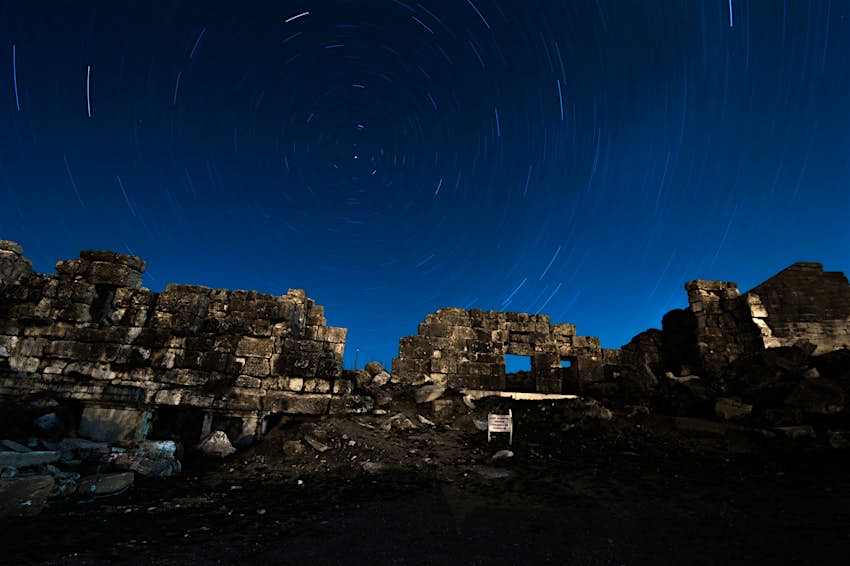
Shooting stars seen in the sky over the ancient city of Aizanoi
The Lyrid meteor shower seen over the ancient city of Aizanoi in Kutahya, Turkey © Fatma Selma Kocabas Aydin/Anadolu Agency/Getty Images

How can I observe the Lyrid meteor shower?

These shooting stars are normally best seen from a spot without light pollutions, such as a Dark Sky Reserve, but as it happens, there’s a bright, waning gibbous moon in the sky tonight so it could interfere with viewing conditions.

Observers in the Northern Hemisphere will see the most Lyrids, with the best time to watch between midnight and 2am, so you may wish to stay up late or get up early to catch this special celestial event. The good news is that the shooting stars can be seen with the naked eye, and as a bonus, you may also be able to spot one or two during the nights after.

It is anticipated that 10-20 moderately bright meteors will be visible per hour at the shower's peak, although on various occasions in the past, the shower has produced hundreds of meteors.

Adblock test (Why?)


https://news.google.com/__i/rss/rd/articles/CBMiYWh0dHBzOi8vd3d3LmxvbmVseXBsYW5ldC5jb20vbmV3cy9seXJpZC1tZXRlb3Itc2hvd2VyLXBlYWtzLXRvbmlnaHQtaG93LXRvLXNlZS10aGUtc2hvb3Rpbmctc3RhcnPSAWVodHRwczovL3d3dy5sb25lbHlwbGFuZXQuY29tL2FtcC9uZXdzL2x5cmlkLW1ldGVvci1zaG93ZXItcGVha3MtdG9uaWdodC1ob3ctdG8tc2VlLXRoZS1zaG9vdGluZy1zdGFycw?oc=5

2022-04-22 10:34:37Z
1350237005

After supernova, hypernova, kilonova, astronomers now observe a micronova - ThePrint

Adblock test (Why?)


https://news.google.com/__i/rss/rd/articles/CBMiK2h0dHBzOi8vd3d3LnlvdXR1YmUuY29tL3dhdGNoP3Y9REpnLVlfQlZLNkXSAQA?oc=5

2022-04-22 05:30:01Z
1385571802