Senin, 19 September 2022

China unveils scientific research results of Mars mission - CGTN

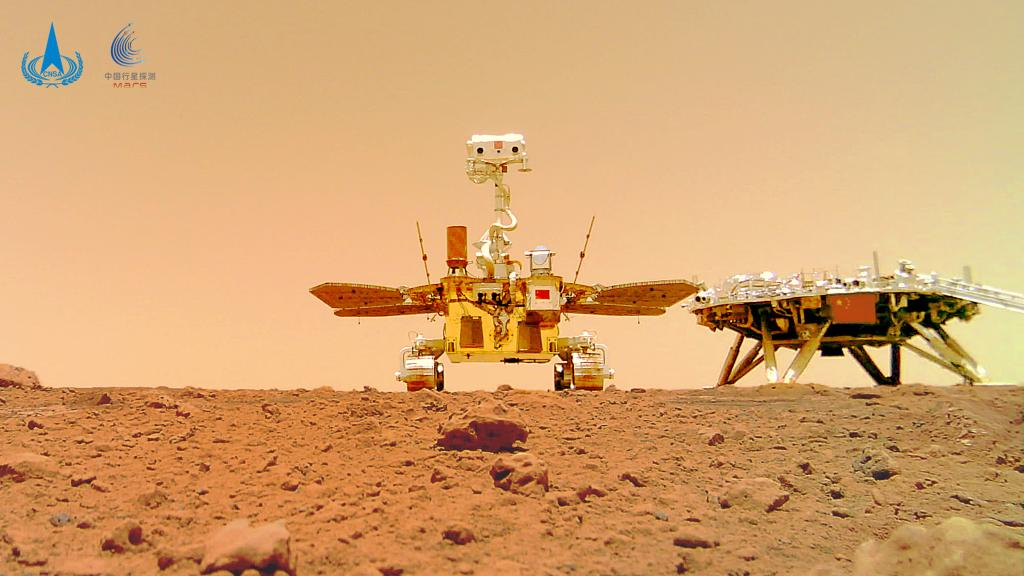
China's first Mars rover Zhurong with its landing platform. /CNSA

China's first Mars rover Zhurong with its landing platform. /CNSA

The China National Space Administration (CNSA) on Sunday released a batch of scientific research results from its first Mars exploration mission.

The Tianwen-1 orbiter had been operating for 780 days and the rover Zhurong had traveled 1,921 meters on the surface of the red planet as of Thursday, according to the CNSA's Lunar Exploration and Space Program Center.

Both the orbiter and rover have completed targeted scientific exploration missions, and acquired 1,480 gigabytes of raw scientific data, the center said.

Using data gathered by Zhurong, Chinese scientists revealed the relationship between the formation of geological features and water activities on Mars by conducting a comprehensive study of these geological features in the landing area.
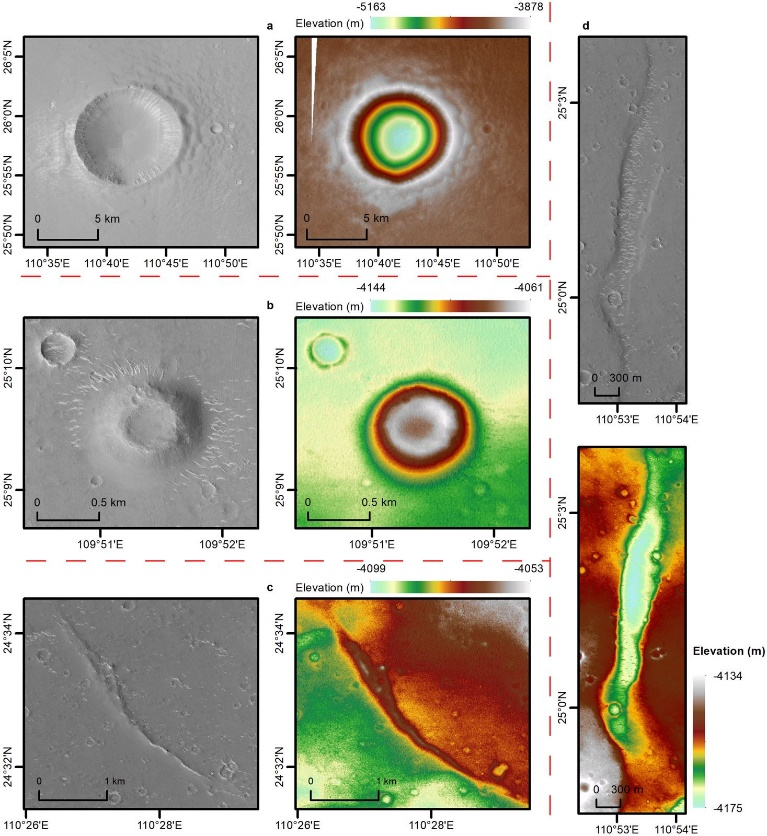
Geomorphology of impact craters, pitted cones, grooves and ridges at the landing area of China's Mars rover Zhurong. /CMG

Geomorphology of impact craters, pitted cones, grooves and ridges at the landing area of China's Mars rover Zhurong. /CMG

Chinese scientists have also found hydrated minerals in platy-like rocks, a layer of "duricrust," proving that there has been substantial liquid water activity at the landing area since the Amazonian epoch, which was about 1 billion years ago. 

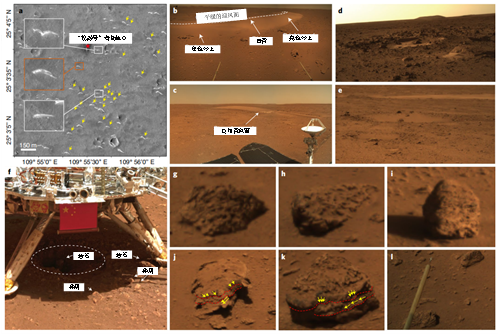
Platy-like rocks and the schematic model of the duricrust formation process at the landing area of China's Mars rover Zhurong. /CMG

Platy-like rocks and the schematic model of the duricrust formation process at the landing area of China's Mars rover Zhurong. /CMG

Scientists have also found that the Martian soil has high bearing strength and low friction parameters, revealing the site where the rover landed must have experienced wind and possibly water erosion.
Geological features of Mars at the landing area of China's Mars rover Zhurong. /CMG

Geological features of Mars at the landing area of China's Mars rover Zhurong. /CMG

These results revealed the impact of wind and water activities on Mars' geological evolution and environmental changes, and provided support for the hypothesis that there was once an ocean in the Utopian Planitia, according to the CNSA.

In addition, Chinese scientists have obtained a number of scientific results on the relationship between the density of rocks on the Martian surface and the degree of surface erosion, the distribution of ions and neutral particles in the near-Mars space environment, and the gravity field of Mars.

Relevant studies were published in Nature Astronomy, Nature Geoscience and Science Advances.

Future missions will continue to conduct remote sensing surveys and accumulate scientific data, said the CNSA.

The Tianwen-1 probe, consisting of an orbiter, a lander and a rover, was launched on July 23, 2020. On May 15, 2021, it touched down at the pre-selected landing area in Utopia Planitia, a vast Martian plain, marking the first time that China has landed a probe on the planet.

Adblock test (Why?)


https://news.google.com/__i/rss/rd/articles/CBMieWh0dHBzOi8vbmV3cy5jZ3RuLmNvbS9uZXdzLzIwMjItMDktMTgvQ2hpbmEtcmVsZWFzZXMtZmlyc3QtYmF0Y2gtb2YtcmVzZWFyY2gtZnJvbS1NYXJzLWV4cGxvcmF0aW9uLTFkcWx6MDVjUnNRL2luZGV4Lmh0bWzSAQA?oc=5

2022-09-19 09:10:18Z
1569872795

NASA’S Perseverance rover collected four samples from an ancient river on Mars - Tech Explorist

NASA’s Perseverance rover has recently collected four samples from an ancient river delta in the Red Planet’s Jezero Crater. This detection is made in an area where, in the distant past, sediment and salts were deposited into a lake under conditions in which life could potentially have existed.

Jezero Crater, which is Twenty-eight miles (45 kilometers) wide, is an ancient fan-shaped feature formed about 3.5 billion years ago at the convergence of a Martian river and a lake.

Thomas Zurbuchen, NASA‘s associate administrator for science in Washington, said, “We picked the Jezero Crater for Perseverance to explore because we thought it had the best chance of providing scientifically excellent samples – and now we know we sent the rover to the right location.”

“These first two science campaigns have yielded an amazing diversity of samples to bring back to Earth by the Mars Sample Return campaign.”

Perseverance project scientist Ken Farley of Caltech in Pasadena, California, said, “The delta, with its diverse sedimentary rocks, contrasts beautifully with the igneous rocks – formed from the crystallization of magma – discovered on the crater floor. This juxtaposition provides a rich understanding of the geologic history after the crater formed and a diverse sample suite. For example, we found a sandstone with grains and rock fragments created far from Jezero Crater and a mudstone with intriguing organic compounds.”

The rock has been named Wildcat Ridge, which formed billions of years ago as mud and fine sand settled in an evaporating saltwater lake. The Perseverance rover, on July 20th, abraded some of the surfaces of Wildcat Ridge so it could analyze the area with the instrument SHERLOC.

SHERLOC’s analysis indicates the samples feature a class of organic molecules that are spatially correlated with those of sulfate minerals. Sulfate minerals found in sedimentary rock layers can yield important information about the aqueous environments in which they formed.

Farley said, “In the distant past, the sand, mud, and salts that now make up the Wildcat Ridge sample were deposited under conditions where life could have thrived. The fact the organic matter was found in such a sedimentary rock – known for preserving fossils of ancient life here on Earth – is important. However, as capable as our instruments aboard Perseverance are, further conclusions regarding what is contained in the Wildcat Ridge sample will have to wait until it’s returned to Earth for in-depth study as part of the agency’s Mars Sample Return campaign.”

The geologic diversity of the samples already carried in the rover is so good that the rover team is looking into depositing select tubes near the base of the delta in about two months. After depositing the cache, the rover will continue its delta explorations.

Adblock test (Why?)


https://news.google.com/__i/rss/rd/articles/CBMiZmh0dHBzOi8vd3d3LnRlY2hleHBsb3Jpc3QuY29tL25hc2EtcGVyc2V2ZXJhbmNlLXJvdmVyLWNvbGxlY3RlZC1mb3VyLXNhbXBsZXMtYW5jaWVudC1yaXZlci1tYXJzLzUzNzk4L9IBAA?oc=5

2022-09-19 06:56:39Z
1567812010

Minggu, 18 September 2022

Once-in-a-lifetime event! Jupiter to be closest to Earth in 70 years on THIS day! NASA reveals date - HT Tech

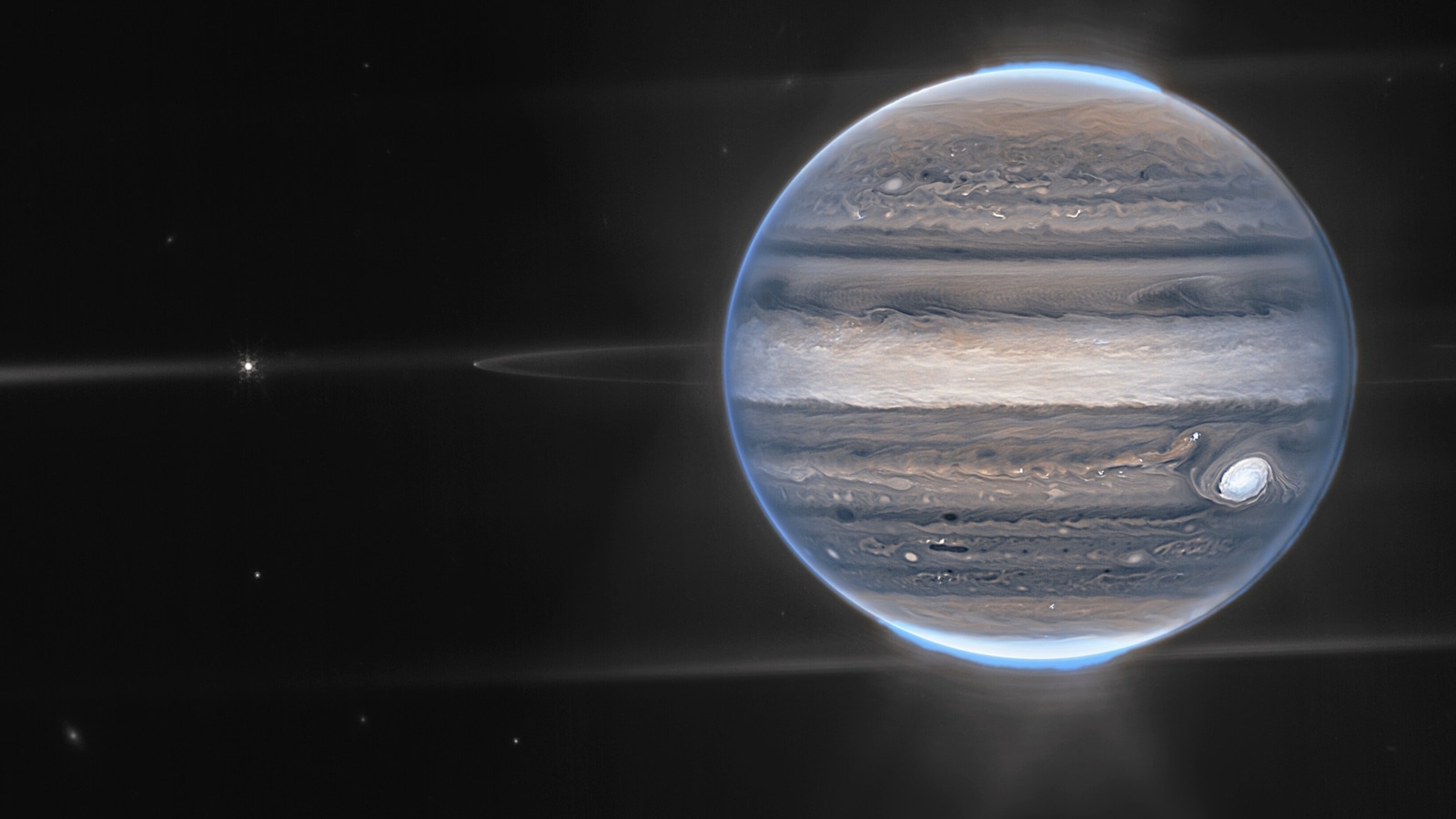
Jupiter and Earth will be closest in 70 years next week! Know when and how to spot Jupiter at its largest.

Skywatchers will have the once-in-a-lifetime opportunity to catch a glimpse of Jupiter at its biggest next week! The largest planet of the solar system, Jupiter is ready to make its closest and opposite approach to Earth. NASA shared that "opposition" happens when an astronomical object rises in the east as the Sun sets in the west from the perspective of Earth. This brings the space object and the Sun on the opposite sides of the Earth. In the similar manner, the opposition of Jupiter occurs after every 13 months, which makes the planet look brighter and larger than usual days.

However, it is the closest approach of the largest planet to Earth which really makes it a special event and that is all set to happen soon. After a gap of 70 years, Jupiter and Earth will be at their closest! As a result, Earth and Jupiter pass each other at varying distances throughout the year because their orbits around the Sun are not perfectly round. Rarely does Jupiter's closest approach to Earth coincide with its opposition, so this year's view will be unique. Jupiter will be roughly 365 million miles from Earth when it makes its closest approach. At its furthest point, the giant planet is roughly 600 million miles from Earth.

When and how to catch a glimpse of Jupiter

Stargazers don't have to worry much! As they can expect excellent views of Jupiter the entire night of Monday, September 26 when the giant planet reaches opposition point to Earth and will have the brightest view. Adam Kobelski, a research astrophysicist at NASA's Marshall Space Flight Center suggested that with the help of good binoculars at least the central band and three or four of the Galilean satellites (moons) will be visible.

However, to have a better view and catch Jupiter's Great Red Spot and bands, you may need a 4 inch-or-larger telescope. Also, some filters in the green to blue range may enhance the visibility of these features of Jupiter. Kobelski suggests that an ideal viewing location will be at a high elevation in a dark and dry area. Best part? You can have the views a few days before and after September 26, in case you miss the chance on this particular day.

Did you know?

Although Jupiter has 53 identified moons, researchers estimate that a total of 79 moons have been discovered. The Galilean satellites, named after Galileo Galilei, who made the first observation of Jupiter's four largest moons in 1610, are Io, Europa, Ganymede, and Callisto.

Adblock test (Why?)


https://news.google.com/__i/rss/rd/articles/CBMinAFodHRwczovL3RlY2guaGluZHVzdGFudGltZXMuY29tL3RlY2gvbmV3cy9vbmNlaW5hbGlmZXRpbWUtZXZlbnQtanVwaXRlci10by1iZS1jbG9zZXN0LXRvLWVhcnRoLWluLTcwLXllYXJzLW9uLXRoaXMtZGF5LW5hc2EtcmV2ZWFscy1kYXRlLTcxNjYzNDkxMzg0NTQ1Lmh0bWzSAQA?oc=5

2022-09-18 08:58:11Z
1562631236

Jumat, 16 September 2022

NASA's Perseverance rover finds organic matter on Mars in rock samples - USA TODAY

NASA's Perseverance rover is investigating signs of ancient life on Mars, and has now collected some of the most promising samples from the Red Planet yet.

According to NASA, several rock samples containing organic matter were found in Jezero Crater, a 28-mile wide crater home to what scientists believe was once a river delta that formed about 3.5 billion years ago.

"Jezero was selected for this mission because... it allows us to explore an ancient habitable environment (and) it allows us to seek evidence of possible, Martin life in rocks deposited at that time, about 3 and-a-half billion years ago," Perseverance project scientist Ken Farley said in a recorded panel about the rover's findings.

"I want to emphasize, this mission is not looking for extant life, things that are alive today. Instead, we are looking into the very distant past, when Mars' climate was very different than it is today," Farley added.

Want to hear what it sounds like on Mars? NASA's Perseverance rover gives you the chance.  

Martian water: Orbiter discovers 'significant amounts of water' in Grand Canyon-like area of Mars  

NASA’s Perseverance rover puts its robotic arm around a rocky outcrop called “Skinner Ridge” in Mars’ Jezero Crater.
Thursday, Sept. 15, 2022

Perseverance launched in July 2020, and made its February 2021 landing in Jezero Crater. Since July 7 of this year, NASA says, the rover has collected four samples from the delta – bringing the total number of collected, "scientifically compelling rock samples" to 12.

Martian rocks with organic matter

Perseverance is currently studying the delta's sedimentary rocks. The rover previously explored Jezero Crater's floor, finding igneous rocks. The contrast of the two "provides us with a rich understanding of the geologic history after the crater formed and a diverse sample suite," Farley said in a news release.

For example, the project scientist pointed to one collected mudstone that contains "intriguing organic compounds."

With the help of an instrument called Scanning Habitable Environments with Raman & Luminescence for Organics & Chemicals, or SHERLOC, organic molecules were found in "Wildcat Ridge," a 3 foot-wide rock believed to have formed with mud and fine sand in an evaporating saltwater lake billions of years ago.

"It's clear that we're uncovering a bigger story than what's happening in Jezero Crater. We found signals that we think are possibly from organic matter on every target that we've observed with SHERLOC to date," Sunanda Sharma, SHERLOC scientist, said in the panel. 

Sharma added that this wasn't "unexpected," as it aligns with previous research. "However, it does say that organics seem to persist in the very harsh Martian surface environment, which is very exciting for us."

Watch: Mars's Phobos solar eclipse captured on video by NASA's Perseverance Mars Rover 

What's everyone talking about? Sign up for our trending newsletter to get the latest news of the day  

According to NASA, Curiosity Mars rover previously found evidence of organic matter in rock-powder samples back in 2013. Perseverance has also detected organics in Jezero Crater before, but the latest finding was made in an area with conditions that would've allowed life to exist in the distant past, scientists say.

“The fact the organic matter was found in such a sedimentary rock – known for preserving fossils of ancient life here on Earth – is important," Farley said.

"However, as capable as our instruments aboard Perseverance are, further conclusions regarding what is contained in the Wildcat Ridge sample will have to wait until it’s returned to Earth for in-depth study as part of (NASA and European Space Agency's) Mars Sample Return campaign."

Adblock test (Why?)


https://news.google.com/__i/rss/rd/articles/CBMibmh0dHBzOi8vd3d3LnVzYXRvZGF5LmNvbS9zdG9yeS9uZXdzL25hdGlvbi8yMDIyLzA5LzE2L25hc2EtcGVyc2V2ZXJhbmNlLXJvdmVyLW9yZ2FuaWMtbWF0dGVyLW1hcnMvMTAzOTU2NDEwMDIv0gEA?oc=5

2022-09-16 13:38:54Z
1567812010

The North Star is not the constant we think is - Skywatching - Castanet.net

Most of us know how to find the Pole, or North Star.

We find the Dipper and follow the line indicated by the pair of stars opposite the handle. It is the star that does not appear to move, while the rotation of the Earth carries all the other stars in circles around it.

This star is overhead at the North Pole, which is why it is called the Pole Star, or Polaris, which is its "star name". It is also called the North Star, because for anyone in the Northern Hemisphere, not standing at the pole, looking in its direction means we are looking North. In addition, measuring its angle of elevation from the northern horizon tells us our latitude.

A few centuries ago, when we had no accurate way of determining our longitude (our position east-west), we would navigate our way across the oceans by using Polaris. We sailed north or south until we were at the latitude of our destination, and then sailed east or west, depending on where we were going, keeping Polaris at the same angle above the horizon. The Pole, or North Star, has been so fundamental, for so long that it is easy to assume it is a constant thing. It is not.

At some point, we must all have played with spinning tops. If we set them spinning fast enough, they would stay upright, balancing on their tips. We found that it is very hard to set a top spinning exactly upright, and that when we failed to do so, the top would describe slow, circular wobbles, but not fall over. This wobbling process is known as precession and is due to the interplay between the spinning motion and gravity trying to pull that non-upright top over. The Earth is in a similar situation.

Our planet spins on its axis once a day. However, a uniform, fixed spin is made impossible by the Earth not being perfectly spherical. It bulges at the equator, and has the Sun and Moon gravitationally tugging at that bulge. The result is that, like the top, our spinning planet wobbles; it precesses. This means Polaris has not always been the Pole Star and won't remain so into the future.

If we stand at the North Pole and look upwards to the zenith—the point exactly overhead—we will be looking along the line of the Earth's axis of rotation, and see that the axis points very close to Polaris. This means that as the Earth rotates, that star stays where it is, and all the other stars appear to circle around it. As the Earth's rotation precesses, the axis of rotation will describe a circle among the stars.

It takes 26,000 years to complete each lap. Back in the days of the ancient Egyptians, the axis pointed at Thuban, in the constellation of Draco, "The Dragon". Since then it moved until it pointed close to Polaris. Now it is slowly moving away and in the direction of the star Alderamin, in the constellation of Cepheus (a constellation named after the husband of Queen Cassiopeia), so in 7500 AD that will be our North Star.

The constellation of Cepheus looks rather like a house, and none of the stars in it, including Alderamin are very bright.

Around 10,000 AD the pole position will lie in the constellation of Cygnus, the Swan. In 13,700 AD the North Star will be the bright, bluish star Vega, which at the moment lies almost overhead in the evening. Around 23,000 AD Thuban will be the Pole Star again, and by 27,000 AD Polaris will be back on the job.

One interesting consequence of precession is that the signs of the Zodiac are slowly slipping backwards.

The first sign of the Zodiac is the constellation sitting at the point where the Sun crosses the celestial equator in the spring. That used to be Aries. The first sign is now Pisces. However, in just under 26,000 years, when the Earth starts its next wobble, it will be Aries again.

•••

• On Sept. 23, the Sun will cross the equator, heading south, marking the autumn equinox. It will be in front of the constellation of Virgo.

•Saturn and Jupiter are in the sky after sunset. Mars rises three hours later.

• The Moon will be new on the Sept. 25.

This article is written by or on behalf of an outsourced columnist and does not necessarily reflect the views of Castanet.

Adblock test (Why?)


https://news.google.com/__i/rss/rd/articles/CBMiX2h0dHBzOi8vd3d3LmNhc3RhbmV0Lm5ldC9uZXdzL1NreXdhdGNoaW5nLzM4NTQxNS9UaGUtTm9ydGgtU3Rhci1pcy1ub3QtdGhlLWNvbnN0YW50LXdlLXRoaW5rLWlz0gEA?oc=5

2022-09-16 11:00:00Z
CBMiX2h0dHBzOi8vd3d3LmNhc3RhbmV0Lm5ldC9uZXdzL1NreXdhdGNoaW5nLzM4NTQxNS9UaGUtTm9ydGgtU3Rhci1pcy1ub3QtdGhlLWNvbnN0YW50LXdlLXRoaW5rLWlz0gEA