Jumat, 26 Mei 2023

NASA Sets Coverage for Axiom Mission 2 Departure from Space Station - NASA

[unable to retrieve full-text content]

  1. NASA Sets Coverage for Axiom Mission 2 Departure from Space Station  NASA
  2. Ax-2 Mission Update: May 25 — Axiom Space  Axiom Space
  3. Ax-2 Mission | Space Center Houston STEAM Event  Axiom Space
  4. Private Ax-2 astronauts get warm welcome from space station crew (video)  Space.com
  5. Ax-2 Mission Update: May 24 — Axiom Space  Axiom Space
  6. View Full Coverage on Google News

https://news.google.com/rss/articles/CBMiZmh0dHBzOi8vd3d3Lm5hc2EuZ292L3ByZXNzLXJlbGVhc2UvbmFzYS1zZXRzLWNvdmVyYWdlLWZvci1heGlvbS1taXNzaW9uLTItZGVwYXJ0dXJlLWZyb20tc3BhY2Utc3RhdGlvbtIBAA?oc=5

2023-05-26 20:58:52Z
2055080659

Rocket Lab Successfully Launches Second Batch of TROPICS Satellites for NASA - Business Wire

[unable to retrieve full-text content]

  1. Rocket Lab Successfully Launches Second Batch of TROPICS Satellites for NASA  Business Wire
  2. NASA Mini Satellites Will Help Track Hurricanes  Scientific American
  3. Rocket Lab launches final TROPICS mission - NASASpaceFlight.com  NASASpaceflight.com
  4. Live coverage: Rocket Lab launches NASA's final two TROPICS satellites – Spaceflight Now  Spaceflight Now
  5. LIVE: Rocket Lab launches second batch of a NASA spacecraft constellation  Reuters
  6. View Full Coverage on Google News

https://news.google.com/rss/articles/CBMihQFodHRwczovL3d3dy5idXNpbmVzc3dpcmUuY29tL25ld3MvaG9tZS8yMDIzMDUyNTAwNTkzNS9lbi9Sb2NrZXQtTGFiLVN1Y2Nlc3NmdWxseS1MYXVuY2hlcy1TZWNvbmQtQmF0Y2gtb2YtVFJPUElDUy1TYXRlbGxpdGVzLWZvci1OQVNB0gEA?oc=5

2023-05-26 05:08:00Z
2062257439

Kamis, 25 Mei 2023

Newly discovered chemical is a highly targeted killer of parasitic worms - Science

The most abundant animals on farms—and everywhere on land, in fact—are microscopic worms called nematodes. Some kinds benefit the soil, but others parasitize crops, inflicting more than $100 billion in losses worldwide each year. Although pesticides can get rid of harmful nematodes, they inflict collateral damage on other life.

Now, researchers have discovered a new chemical that selectively kills harmful nematodes with a much lower risk of toxicity to humans and other creatures. “This is really unique,” says parasitologist Tim Geary of McGill University and Queen’s University Belfast, who was not involved. “It could offer a way to improve control of crop pests.”

Farmers try to prevent nematode damage in various ways. Rotating crops, sterilizing soil with plastic sheets, and planting nematode-resistant crop varieties can all help control the problem, but the most effective solution is treating fields with pesticides. Yet most of the widely used chemicals known to kill nematodes have been banned because of their toxicity to humans and wildlife. In 2004, chemical manufacturers began to phase out methyl bromide, another chemical widely used to fumigate soils, because it harms Earth’s ozone layer. Since then, chemical companies have developed several new, safer pesticides for nematodes.

The latest candidate comes from the lab of Peter Roy, a chemical geneticist at the University of Toronto (U of T). In recent years, he and colleagues have evaluated about 100,000 small molecules to see whether they kill Caenorhabditis elegans, a harmless nematode whose biology is well known to scientists. If the lab identifies a chemical lethal to C. elegans, Andrew Burns, a biochemical geneticist at U of T, and colleagues check whether it also harms other kinds of organisms, such as fungi, insects, and mice. “We’re not interested in chemicals that are going to kill everything,” he says.

In 2016, a compound that passed those tests caught Burns’s interest. Its chemical structure resembled a drug called levamisole, which is used to treat livestock infected with parasitic nematodes, but the compound had different effects on the worms. Levamisole paralyzes them, whereas the newly discovered small molecule—dubbed selectivin—kills them outright.

Further experiments revealed selectivin’s lethal methods. Once the nematode’s body absorbs it, the worm modifies it with enzymes, called cytochrome P450s, which in many organisms detoxify foreign molecules. But for some reason, the nematode version of cytochrome P450 instead turns selectivin into a toxic chemical. “That was the first aha moment for me,” Burns says. Cytochrome P450 needs oxygen to function, so Burns hypothesized that selectivins might be good for killing nematodes that live in soil, where oxygen is abundant.

This “bioactivation” of the chemicals didn’t happen in other kinds of organisms tested, perhaps because their versions of cytochrome P450 deal with it safely, which suggests it would be nontoxic to humans, wildlife, and soil microorganisms. A structurally similar molecule even leaves some beneficial nematodes unharmed, such as Phasmarhabditis hermaphrodita, which kills slugs and snails that would otherwise eat crops. Some farmers also release certain kinds of beneficial nematodes to control insect pests, which the worms infect and kill.

A new pesticide that leaves these beneficial nematodes unscathed while killing the plant-parasitizing nematodes would be a boon, says Charles Opperman, a nematologist at North Carolina State University. “It would really provide more options for growers to maintain soil health.”

Next, the team collaborated with researchers at the U.S. Department of Agriculture to try selectivin against a notorious and nefarious nematode, Meloidogyne incognita, which infects many kinds of crops. In tests with greenhouse tomato plants, selectivin controlled the nematodes as well or slightly better than existing pesticides, the researchers report in Nature.

Another advantage of selectivin is that it may be cheaper to manufacture than existing pesticides used against nematodes. Only two cheap solvents are required, and the needed chemical reactions could be completed without expensive catalysts or high temperatures. “The fact that it’s relatively inexpensive to manufacture could be a big deal,” Opperman says.

There’s still a long way to go before the new chemical is available to farmers—most pesticides require 10 years of experimentation and $250 million or more to ensure efficacy and safety before reaching market. The challenge hasn’t deterred Roy, however, who is eager to find commercial partners to help move the drug through development.

Adblock test (Why?)


https://news.google.com/rss/articles/CBMiaGh0dHBzOi8vd3d3LnNjaWVuY2Uub3JnL2NvbnRlbnQvYXJ0aWNsZS9uZXdseS1kaXNjb3ZlcmVkLWNoZW1pY2FsLWhpZ2hseS10YXJnZXRlZC1raWxsZXItcGFyYXNpdGljLXdvcm1z0gEA?oc=5

2023-05-25 22:04:01Z
2061758522

Rabu, 24 Mei 2023

Vancouver Island University welcomes award-winning foot and ankle researcher | News | Vancouver Island University | Canada - Vancouver Island University News

Dr. Michael Asmussen received a Michael Smith Health Research BC Scholar award to bring his research to VIU.

“You need to improve your stability” is one of the most common pieces of advice offered by clinicians to people recovering from an injury resulting from a fall.

Despite this, researchers are still trying to determine the best way to help people maintain their stability as they age. This is the focus of an award-winning researcher joining Vancouver Island University (VIU). Dr. Michael Asmussen is investigating the structure, function and neural control of the foot and ankle during movement in healthy, injured and diseased states and translating this into innovative health-care solutions.

Asmussen is the recipient of a Michael Smith Health Research BC Scholar award. The award supports early-career health researchers who are building leading-edge research programs and is highly competitive.

It’s the latest career achievement for Asmussen, who has held a Canada Research Chair position in Neuromechanics and Human Physiology at Mount Royal University since 2020. In 2021, he was awarded the International Society of Biomechanics World Athletics Award for his research related to locomotion biomechanics.

Asmussen’s research program focuses on how the foot and ankle are essential for the human ability to walk and run. He aims to provide a mechanistic understanding of how the foot-ankle complex contributes to stability during common mobility tasks such as walking or balancing. He will then translate this research into innovative health-care and technology solutions. He uses a combination of biomechanical tools, physiological measures, computer modelling and simulation techniques to answer pressing research questions.

At VIU, Asmussen will work mostly with human participants. He will work with clinics in the mid-Island region to develop tools that are better able to assess and improve a person’s mobility using low-cost, easy-to-use technologies.

“VIU is thrilled to have such an exceptional scholar join our institution,” said Dr. Nicole Vaugeois, Associate Vice-President of Scholarship, Research and Creative Activity. “Dr. Asmussen’s highly innovative research program will help inform important health-care solutions in our region and beyond.”

-30-

MEDIA CONTACT: 

Eric Zimmer, Communications Officer, Vancouver Island University

P: 250.618.7296 | E: Eric.Zimmer@viu.ca | T: @VIUNews

Adblock test (Why?)


https://news.google.com/rss/articles/CBMiYGh0dHBzOi8vbmV3cy52aXUuY2EvdmFuY291dmVyLWlzbGFuZC11bml2ZXJzaXR5LXdlbGNvbWVzLWF3YXJkLXdpbm5pbmctZm9vdC1hbmQtYW5rbGUtcmVzZWFyY2hlctIBAA?oc=5

2023-05-24 22:22:36Z
CBMiYGh0dHBzOi8vbmV3cy52aXUuY2EvdmFuY291dmVyLWlzbGFuZC11bml2ZXJzaXR5LXdlbGNvbWVzLWF3YXJkLXdpbm5pbmctZm9vdC1hbmQtYW5rbGUtcmVzZWFyY2hlctIBAA

GARDEN CLIPPINGS: Flowering dogwoods found more in Southwestern Ontario - Tillsonburg News

Article content

A mere decade or three ago there were only a few flowering dogwoods to be found in Lambton County. 

Advertisement 2

Article content

A few decades may seem like a long time, but if we consider Adam and Eve, Noah or whichever human first roamed the earth, a decade is but a blink in time. 

It’s a scary thought, but thanks to climate change, flowering dogwoods are gracing the local landscape, something that until recently, could only be done on the West Coast or quite a few miles south of the 49th parallel.   

Blaming climate change on the ability to grow flowering dogwoods may not be totally accurate, but you catch the drift.  There probably are a few mature flowering dogwoods in Sarnia-Lambton, but they would be few in number, and growing under perfect conditions.   

No doubt horticulturists and plant breeders have also played a role in the upswing of flowering dogwoods. These scientists are in a constant quest to create plants with characteristics such as colour, height, hardiness, dwarfness, disease resistance and flowering time.   

Article content

Advertisement 3

Article content

Gray dogwood (Cornus racemosa) is a native large growing shrub commonly found in the bush in Southwestern Ontario. Its white flower clusters appear on a haphazardly shaped bush in late spring. Grey dogwood is favoured by many birds who feast on the berries in early fall. Easy to grow in any conditions, grey dogwood is a must for those wishing to promote native landscapes.   

Red twig dogwoods are the name given to several dogwood shrubs that are just as adaptable and easy to grow as grey dogwood, but with striking red stems. Flowers are white, often not showy, followed by small berries in mid-summer. All will grow in sun or partial shade, but the brightest red stems will be found on plants grown in full sun.   

The lineup of ornamental flowering dogwoods is vast and continuously increasing. All have delightful long-lasting blooms appearing in mid to late spring. Most cultivars bloom in white, opening up wide with four showy petals. Flower petals are not actually petals but are coloured bracts with much smaller and less significant flowers in their centres.   

Advertisement 4

Article content

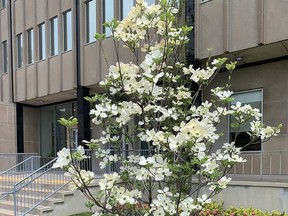
Kousa dogwood (Cornus kousa) is an ornamental plant with four-season interest. It welcomes spring with white blooms. Summer is noteworthy because of its layered horizontal branch pattern on a tidy small tree. Red, raspberry-type fruit is favoured by many birds. Fall foliage colour is bronzy red.   

Closely related to kousa is Satomi dogwood, which is similar in all respects but with pinkish red blooms. Both are small growing trees rarely growing more than 15 feet at maturity.   

Other highly ornamental flowering dogwoods include Rosy Teacups with long-lasting rosy pink flowers in spring, and Greensleeves which opens greenish white in spring, turning creamy white as flowers develop. For a narrow growing Dogwood that takes up little room, look for Snowtower, growing up to 15 feet tall with width of four to six feet.   


Comments

Postmedia is committed to maintaining a lively but civil forum for discussion and encourage all readers to share their views on our articles. Comments may take up to an hour for moderation before appearing on the site. We ask you to keep your comments relevant and respectful. We have enabled email notifications—you will now receive an email if you receive a reply to your comment, there is an update to a comment thread you follow or if a user you follow comments. Visit our Community Guidelines for more information and details on how to adjust your email settings.

Join the Conversation

Advertisement 1

Adblock test (Why?)


https://news.google.com/rss/articles/CBMigAFodHRwczovL3d3dy5ub3Jmb2xrYW5kdGlsbHNvbmJ1cmduZXdzLmNvbS9uZXdzL2xvY2FsLW5ld3MvZ2FyZGVuLWNsaXBwaW5ncy1mbG93ZXJpbmctZG9nd29vZHMtZm91bmQtbW9yZS1pbi1zb3V0aHdlc3Rlcm4tb250YXJpb9IBrgFodHRwczovL3d3dy5ub3Jmb2xrYW5kdGlsbHNvbmJ1cmduZXdzLmNvbS9uZXdzL2xvY2FsLW5ld3MvZ2FyZGVuLWNsaXBwaW5ncy1mbG93ZXJpbmctZG9nd29vZHMtZm91bmQtbW9yZS1pbi1zb3V0aHdlc3Rlcm4tb250YXJpby93Y20vZDhhN2U0NmYtYzA3Yi00YTViLTk4NjgtYTFkNzg2OTVmMjg1L2FtcC8?oc=5

2023-05-24 20:07:13Z
CBMigAFodHRwczovL3d3dy5ub3Jmb2xrYW5kdGlsbHNvbmJ1cmduZXdzLmNvbS9uZXdzL2xvY2FsLW5ld3MvZ2FyZGVuLWNsaXBwaW5ncy1mbG93ZXJpbmctZG9nd29vZHMtZm91bmQtbW9yZS1pbi1zb3V0aHdlc3Rlcm4tb250YXJpb9IBrgFodHRwczovL3d3dy5ub3Jmb2xrYW5kdGlsbHNvbmJ1cmduZXdzLmNvbS9uZXdzL2xvY2FsLW5ld3MvZ2FyZGVuLWNsaXBwaW5ncy1mbG93ZXJpbmctZG9nd29vZHMtZm91bmQtbW9yZS1pbi1zb3V0aHdlc3Rlcm4tb250YXJpby93Y20vZDhhN2U0NmYtYzA3Yi00YTViLTk4NjgtYTFkNzg2OTVmMjg1L2FtcC8

Axiom Space's Mission Control Center Plays Integral Role During Ax-2 Mission — Axiom Space - Axiom Space

The Axiom Space Mission Control Center (MCC-A) is an integral part of the Ax-2 mission. Since the company's first private astronaut mission, Axiom Mission 1 (Ax-1), MCC-A has achieved a significant milestone in establishing a direct, live connection to NASA’s Johnson Space Center’s Mission Control Center (MCC-H) services.  

Axiom Space’s MCC-A is officially the 12th Ground Segment Partner for the International Space Station (ISS) Program. This connection is allowing Axiom Space to execute the Ax-2 mission and future missions out of the  Axiom Space Headquarters in Houston. The new capability enables  MCC-A to connect and communicate via voice and video through NASA’s MCC-H connection to support ISS on-orbit operations. Axiom Space will continue to add services and capabilities as progress is made toward the launch and operation of Axiom Station’s first module. 

Throughout the Ax-2 mission, MCC-A will be staffed with knowledgeable Axiom Space specialists who will communicate with the crew via voice and video capabilities. The room is led by an Axiom Operations Lead, also called an AXOL, and around the room are positions for officers responsible for research, communications, medical, integration, and stowage and timeline operations. 

This is a significant step in Axiom Space’s journey toward building the world’s first commercial space station and expanding access to low-Earth orbit. Through this facility, Axiom Space is enabling its customers and the global community to have a front row seat to the work being done on station. 

In January 2022, MCC-A conducted its first-ever, on-orbit operation on the ISS, supporting the SQuARES payload’s scientific research. SQuARES, the Sampling Quadrangle Assemblages Research Experiment, treats the ISS as an archaeological site and documents how items located around the station change over time. In June 2022, MCC-A supported the Ax-1 mission by engaging crew outreach and ensuring that research and scientific work with the payloads were accomplished. 

 The next MCC-A milestone will include expanded services and capabilities for Axiom Mission 3 (Ax-3).  

Adblock test (Why?)


https://news.google.com/rss/articles/CBMiKGh0dHBzOi8vd3d3LmF4aW9tc3BhY2UuY29tL25ld3MvYXgyLW1jY2HSAQA?oc=5

2023-05-23 20:27:00Z
CBMiKGh0dHBzOi8vd3d3LmF4aW9tc3BhY2UuY29tL25ld3MvYXgyLW1jY2HSAQA

Senin, 22 Mei 2023

NASA Astronomy Picture of the Day 22 May 2023: Supernova snapped by astrophotographer - HT Tech

The universe contains an astonishing number of stars, estimated to be around 200 billion trillion. There are at least 100 billion stars within our own Milky Way Galaxy, while the entire universe harbours over 100 billion galaxies. When a star explodes, the subsequent explosion which takes place, known as a Supernova, is the largest explosion to occur in space. According to NASA, a supernova happens when there is a change in the core, or center, of a star. A change can occur in two different ways, with both resulting in a supernova. Just days ago, a supernova was discovered located near a spiral galaxy.

Today's NASA Astronomy Picture of the Day is a snapshot of the supernova SN 2023ixf located near the M101 spiral galaxy. This supernova was discovered by Japanese astronomer Koichi Itagaki and was located on the automated images captured by the Zwicky Transient Facility, a wide-field sky astronomical survey in California.

About this supernova

According to NASA, SN 2023ixf is a Type-II supernova, one that occurs when a star runs out of nuclear fuel and it collapses. Although a supernova occurs for only a short span of time, it can tell scientists a lot about the universe. By studying supernovas, scientists have also shed light on the fact that we're living in an ever-expanding universe.

The picture was captured by astrophotographer Craig Stocks.

NASA's description of the picture

After this nearby star exploded, humanity's telescopes quickly turned to monitor it. The supernova, dubbed SN 2023ixf, was discovered by Japanese astronomer Koichi Itagaki three days ago and subsequently located on automated images from the Zwicky Transient Facility two days earlier. SN 2023ixf occurred in the photogenic Pinwheel Galaxy M101, which, being only about 21 million light years away, makes it the closest supernova seen in the past five years, the second closest in the past 10 years, and the second supernova found in M101 in the past 15 years.

Rapid follow up observations already indicate that SN 2023ixf is a Type II supernova, an explosion that occurs after a massive star runs out of nuclear fuel and collapses. The featured image shows home spiral galaxy two days ago with the supernova highlighted, while the roll-over image shows the same galaxy a month before. SN 2023ixf will likely brighten and remain visible to telescopes for months. Studying such a close and young Type II supernova may yield new clues about massive stars and how they explode.

Adblock test (Why?)


https://news.google.com/rss/articles/CBMikgFodHRwczovL3RlY2guaGluZHVzdGFudGltZXMuY29tL3RlY2gvbmV3cy9uYXNhLWFzdHJvbm9teS1waWN0dXJlLW9mLXRoZS1kYXktMjItbWF5LTIwMjMtc3VwZXJub3ZhLXNuYXBwZWQtYnktYXN0cm9waG90b2dyYXBoZXItNzE2ODQ3Mzg2OTk5MDMuaHRtbNIBlgFodHRwczovL3RlY2guaGluZHVzdGFudGltZXMuY29tL2FtcC90ZWNoL25ld3MvbmFzYS1hc3Ryb25vbXktcGljdHVyZS1vZi10aGUtZGF5LTIyLW1heS0yMDIzLXN1cGVybm92YS1zbmFwcGVkLWJ5LWFzdHJvcGhvdG9ncmFwaGVyLTcxNjg0NzM4Njk5OTAzLmh0bWw?oc=5

2023-05-22 07:04:57Z
CBMikgFodHRwczovL3RlY2guaGluZHVzdGFudGltZXMuY29tL3RlY2gvbmV3cy9uYXNhLWFzdHJvbm9teS1waWN0dXJlLW9mLXRoZS1kYXktMjItbWF5LTIwMjMtc3VwZXJub3ZhLXNuYXBwZWQtYnktYXN0cm9waG90b2dyYXBoZXItNzE2ODQ3Mzg2OTk5MDMuaHRtbNIBlgFodHRwczovL3RlY2guaGluZHVzdGFudGltZXMuY29tL2FtcC90ZWNoL25ld3MvbmFzYS1hc3Ryb25vbXktcGljdHVyZS1vZi10aGUtZGF5LTIyLW1heS0yMDIzLXN1cGVybm92YS1zbmFwcGVkLWJ5LWFzdHJvcGhvdG9ncmFwaGVyLTcxNjg0NzM4Njk5OTAzLmh0bWw