Rabu, 27 Maret 2024

NASA to launch sounding rockets into moon's shadow during solar eclipse - Phys.org

NASA to launch sounding rockets into moon's shadow during solar eclipse
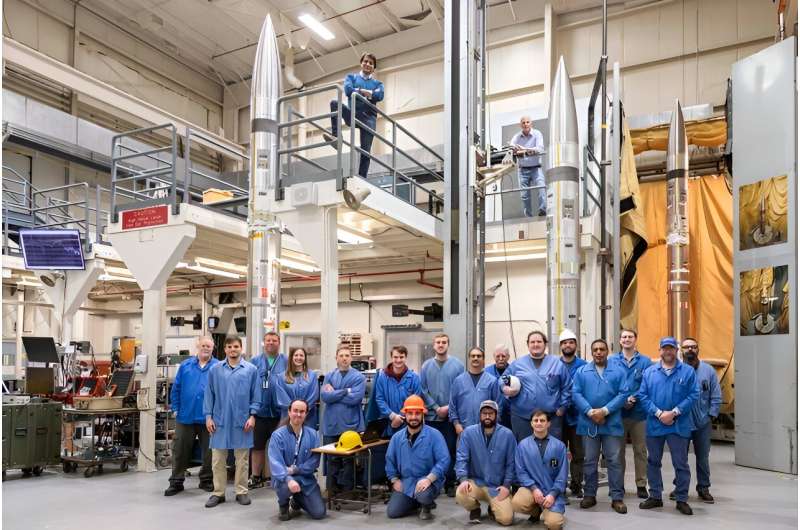
This photo shows the three APEP sounding rockets and the support team after successful assembly. The team lead, Aroh Barjatya, is at the top center, standing next to the guardrails on the second floor. Credit: NASA/Berit Bland

NASA will launch three sounding rockets during the total solar eclipse on April 8, 2024, to study how Earth's upper atmosphere is affected when sunlight momentarily dims over a portion of the planet.

The Atmospheric Perturbations around Eclipse Path (APEP) sounding rockets will launch from NASA's Wallops Flight Facility in Virginia to study the disturbances in the created when the moon eclipses the sun. The sounding rockets had been previously launched and successfully recovered from White Sands Test Facility in New Mexico, during the October 2023 .

They have been refurbished with new instrumentation and will be relaunched in April 2024. The mission is led by Aroh Barjatya, a professor of engineering physics at Embry-Riddle Aeronautical University in Florida, where he directs the Space and Atmospheric Instrumentation Lab.

The sounding rockets will launch at three different times: 45 minutes before, during, and 45 minutes after the peak local eclipse. These intervals are important to collect data on how the sun's sudden disappearance affects the ionosphere, creating disturbances that have the potential to interfere with our communications.

The ionosphere is a region of Earth's atmosphere that is between 55 to 310 miles (90 to 500 kilometers) above the ground. "It's an electrified region that reflects and refracts and also impacts as the signals pass through," said Barjatya. "Understanding the ionosphere and developing models to help us predict disturbances is crucial to making sure our increasingly communication-dependent world operates smoothly."

A sounding rocket is able to carry science instruments between 30 and 300 miles above Earth's surface. These altitudes are typically too high for science balloons and too low for satellites to access safely, making sounding rockets the only platforms that can carry out direct measurements in these regions. Credit: NASA's Goddard Space Flight Center

The ionosphere forms the boundary between Earth's lower atmosphere—where we live and breathe—and the vacuum of space. It is made up of a sea of particles that become ionized, or electrically charged, from the sun's energy or .

When night falls, the ionosphere thins out as previously ionized particles relax and recombine back into neutral particles. However, Earth's terrestrial weather and space weather can impact these particles, making it a dynamic region and difficult to know what the ionosphere will be like at a given time.

It's often difficult to study short-term changes in the ionosphere during an eclipse with satellites because they may not be at the right place or time to cross the eclipse path. Since the exact date and times of the are known, NASA can launch targeted sounding rockets to study the effects of the eclipse at the right time and at all altitudes of the ionosphere.

As the eclipse shadow races through the atmosphere, it creates a rapid, localized sunset that triggers large-scale atmospheric waves and small-scale disturbances or perturbations. These perturbations affect different radio communication frequencies. Gathering the data on these perturbations will help scientists validate and improve current models that help predict potential disturbances to our communications, especially high-frequency communication.

This conceptual animation is an example of what observers might expect to see during a total solar eclipse, like the one happening over the United States on April 8, 2024. Credit: NASA's Scientific Visualization Studio

The APEP rockets are expected to reach a maximum altitude of 260 miles (420 kilometers). Each rocket will measure charged and neutral particle density and surrounding electric and magnetic fields. "Each rocket will eject four secondary instruments the size of a two-liter soda bottle that also measure the same data points, so it's similar to results from fifteen rockets while only launching three," explained Barjatya. Embry-Riddle built three secondary instruments on each rocket, and the fourth one was built at Dartmouth College in New Hampshire.

In addition to the rockets, several teams across the U.S. will also be taking measurements of the ionosphere by various means. A team of students from Embry-Riddle will deploy a series of high-altitude balloons. Co-investigators from the Massachusetts Institute of Technology's Haystack Observatory in Massachusetts and the Air Force Research Laboratory in New Mexico will operate a variety of ground-based radars taking measurements.

Using this data, a team of scientists from Embry-Riddle and Johns Hopkins University Applied Physics Laboratory are refining existing models. Together, these various investigations will help provide the puzzle pieces needed to see the bigger picture of ionospheric dynamics.

The animation depicts the waves created by ionized particles during the 2017 total solar eclipse. Credit: MIT Haystack Observatory/Shun-rong Zhang. Zhang, S.-R., Erickson, P. J., Goncharenko, L. P., Coster, A. J., Rideout, W. & Vierinen, J. (2017). Ionospheric Bow Waves and Perturbations Induced by the 21 August 2017 Solar Eclipse. Geophysical Research Letters, 44(24), 12,067-12,073. https://doi.org/10.1002/2017GL076054

When the APEP- launched during the 2023 annular solar eclipse, scientists saw a sharp reduction in the density of charged particles as the annular eclipse shadow passed over the atmosphere.

"We saw the perturbations capable of affecting radio communications in the second and third rockets, but not during the first rocket that was before peak local eclipse," said Barjatya. "We are super excited to relaunch them during the total eclipse to see if the perturbations start at the same altitude and if their magnitude and scale remain the same."

The next total solar eclipse over the contiguous U.S. is not until 2044, so these experiments are a rare opportunity for scientists to collect crucial data.

Provided by NASA

Citation: NASA to launch sounding rockets into moon's shadow during solar eclipse (2024, March 27) retrieved 27 March 2024 from https://phys.org/news/2024-03-nasa-rockets-moon-shadow-solar.html

This document is subject to copyright. Apart from any fair dealing for the purpose of private study or research, no part may be reproduced without the written permission. The content is provided for information purposes only.

Adblock test (Why?)


https://news.google.com/rss/articles/CBMiQWh0dHBzOi8vcGh5cy5vcmcvbmV3cy8yMDI0LTAzLW5hc2Etcm9ja2V0cy1tb29uLXNoYWRvdy1zb2xhci5odG1s0gFAaHR0cHM6Ly9waHlzLm9yZy9uZXdzLzIwMjQtMDMtbmFzYS1yb2NrZXRzLW1vb24tc2hhZG93LXNvbGFyLmFtcA?oc=5

2024-03-27 15:08:43Z
CBMiQWh0dHBzOi8vcGh5cy5vcmcvbmV3cy8yMDI0LTAzLW5hc2Etcm9ja2V0cy1tb29uLXNoYWRvdy1zb2xhci5odG1s0gFAaHR0cHM6Ly9waHlzLm9yZy9uZXdzLzIwMjQtMDMtbmFzYS1yb2NrZXRzLW1vb24tc2hhZG93LXNvbGFyLmFtcA

A total eclipse of the sun is coming in April, Sask. to see partial - saskNOW

“The moon is blocking that sun’s rays but for us, because we’re in partial, there is no safe point at all to look at it,” he said, noting that while the rule applies all year round, people worry more about a celestial event more.

An eclipse happens about once every 18 months when the sun, the moon and the earth are in line with one another.

“As the moon is orbiting around the earth, on occasion…that moon positions itself in a spot that essentially is going to block some of the sun’s light,” he said.

While it does happen fairly regularly, the astronomy enthusiast explained it happens in a narrow corridor.

“What makes this sort of thing unique, it’s not something that we will see very often in our lifetime unless we want to travel somewhere.”

In fact, the last time a total eclipse happened, its corridor was right over Estevan and the next won’t appear until 2044.

“That one – Saskatchewan happens to be in the path,” Yaworski said.

The stargazer said while a partial eclipse isn’t on par with a total eclipse, it still is a sight to behold.

“When you’re looking at it with that protective gear, you’re going to see the sun slowly get eaten away like someone taking a bite out of a cookie,” he said.

For those planning on watching the event in the Battlefords and Meadow Lake, Yaworski said since the province is on the far end of the corridor, only about 31 per cent of the sun will be blocked.

That is why it’s so dangerous.

“Normally, on a day like today if you look up at the sun or if you look straight at the sun, it is so bright that your eyes automatically basically say ‘Stop looking at that’ right? And you get that reaction to look away,” he said.

The problem comes because the sun isn’t as bright or intense due to the moon obscuring part of the sun.

“Our natural flight reaction to look away goes away.”

As a result, looking at it for a long period of time will cause irreparable damage. Yaworski explained that ultraviolet radiation is directed to the macula – a part of the retina – and essentially causes a sunburn.

“There’s no pain receptors in the eye. So, no matter what happens to our eyes, there’s no feedback to say we’re doing some damage here,” he said, referring to the retina.

As always, however, the viewing party is weather dependent and if Saskatchewan is lucky, clear skies mean people are in for a treat.

Yaworski however, doesn’t mince words: the goal is to see totality. For one to four minutes, day turns to night, the birds cease to sing and planetary bodies appear and he’s hoping to be a part of it for the first time this spring.

“The difference between a 99 per cent partial eclipse and a total eclipse of the sun? A total eclipse of the sun is like being in the mosh pit at a Taylor Swift concert – live Taylor Swift concert and the 99 per cent partial eclipse is like being in the parking lot, listening to the concert on your car radio,” he said referring to a meme.

Unable to find eclipse glasses? Make your own safety wear. Here’s how: https://science.nasa.gov/eclipses/safety/ and https://www.youtube.com/watch?v=PI1ttQxXt5s

—

julia.lovettsquires@pattisonmedia.com

On X: jls194864

Adblock test (Why?)


https://news.google.com/rss/articles/CBMiYWh0dHBzOi8vc2Fza25vdy5jb20vMjAyNC8wMy8yNi9hLXRvdGFsLWVjbGlwc2Utb2YtdGhlLXN1bi1pcy1jb21pbmctaW4tYXByaWwtc2Fzay10by1zZWUtcGFydGlhbC_SAQA?oc=5

2024-03-26 23:21:18Z
CBMiYWh0dHBzOi8vc2Fza25vdy5jb20vMjAyNC8wMy8yNi9hLXRvdGFsLWVjbGlwc2Utb2YtdGhlLXN1bi1pcy1jb21pbmctaW4tYXByaWwtc2Fzay10by1zZWUtcGFydGlhbC_SAQA

Special solar eclipse glasses needed, London doctor says - CTV News London

Many of us are eagerly anticipating the solar eclipse on April 8 — a once in a lifetime event, with southern Ontario one of the hot spots for viewing.

But one of Canada’s leading ophthalmologists is warning that our eyesight could be at risk if we don’t take necessary precautions.

“It really isn’t dangerous during that very brief period when the whole sun is covered,” explained Dr. Phil Hooper of the Ivey Eye Institute at St. Joseph’s Health Care in London, Ont.

“In London it’s going to be less than a minute," he continued. "And the remaining time the sun gets around the edge of the moon, and that’s the damage point.”

Hooper said even a quick unprotected look at the eclipse can burn a hole in the eye’s macular tissue. That’s why special purpose solar eclipse glasses are a must.

“When you’re looking at the sun the light is too much for the eyes to bear, and these cells are actually cooked, if you will, by the sun, and it doesn’t take very long for that to happen. It’s a permanent change, and it’s right in the centre of your vision. So, tremendous devastation if that happens,” he explained.

Legitimate solar eclipse glasses should be marked with ISO certification. (Bryan Bicknell/CTV News London) Hooper is offering the following advice for viewing the solar eclipse:

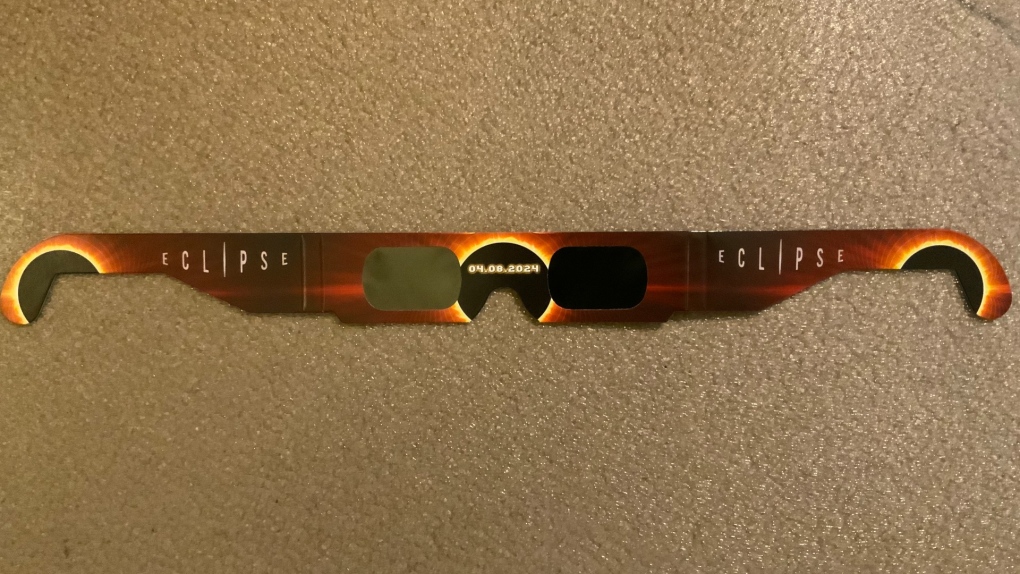
  • Protect your eyes at all times using safe solar-viewing glasses or a safe, handheld solar viewer that complies with the ISO 12312-2 international standard
  • Make sure the glasses are not torn, scratched or otherwise damaged before use.
  • Do not look at the sun through a camera lens, telescope, binoculars or any other optical device while wearing eclipse glasses or using a handheld solar viewer, as the concentrated solar rays will burn through the filter and can cause serious eye injury
  • Always supervise children using solar viewers

One of the best areas in southern Ontario to view the solar eclipse will be Elgin County. A partial eclipse begins at approximately 2 p.m. Viewed from Port Stanley, the full eclipse begins at 3:16 p.m. and lasts for approximately two minutes. The partial eclipse ends at approximately 4:30 p.m.

With an influx of visitors expected, Elgin County CAO Blaine Parkin said emergency services are gearing up, much like they would for any long weekend in the summer.

Solar eclipse glasses are being distributed by Elgin County ahead of the April 8, 2024 total solar eclipse. Elgin County lies within the path of totality. (Bryan Bicknell/CTV News London) “We’ve been planning over the past number of months with not only our tourism people, but our provincial police and our fire and emergency services just to be on the safe side and to make sure that everyone is enjoying the day but doing it responsibly,” he said.

Part of the preparation also includes distributing special-purpose solar eclipse glasses, according to Elgin County Warden Ed Ketchabaw.

“They’re available right now in the administrative offices at the Heritage Centre. They will be available at local library branches across the county, and our local municipal partners will have a supply,” he said.

However you acquire your classes, Hooper stressed to make sure they are ISO certified, and that they have a wide side panel for optimum protection.

Adblock test (Why?)


https://news.google.com/rss/articles/CBMiYWh0dHBzOi8vbG9uZG9uLmN0dm5ld3MuY2EvZG9uLXQtYnVybi15b3VyLWV5ZXMtc3BlY2lhbC1nbGFzc2VzLW5lZWRlZC1mb3Itc29sYXItZWNsaXBzZS0xLjY4MjMzNjnSAQA?oc=5

2024-03-26 21:37:00Z
CBMiYWh0dHBzOi8vbG9uZG9uLmN0dm5ld3MuY2EvZG9uLXQtYnVybi15b3VyLWV5ZXMtc3BlY2lhbC1nbGFzc2VzLW5lZWRlZC1mb3Itc29sYXItZWNsaXBzZS0xLjY4MjMzNjnSAQA

Selasa, 26 Maret 2024

Your answers: If aliens exist, what message would you have for them? - CBC.ca

Published 2024-03-26 04:45

We asked, you answered


Every week, we take a deep dive into a topic that’s making headlines in a series called KN Explains. Then, we ask you to Have Your Say by sharing your own experiences and opinions. Here’s a selection of thoughtful answers submitted by kids from across Canada. Swipe through to read them all!


Last week we asked our audience: If aliens exist, what message would you have for them?

We received many thoughtful and fun answers. 

Check out some of them here:

(The answers have been edited for length and clarity.)

In case you missed it, watch KN Explains: Alien life

Check out this week’s KN Explains

This week, we have a new explainer and question for you to answer:

Learn all about fasting then have your say for a chance to be featured on cbckidsnews.ca next week.

Have more questions? Want to tell us how we're doing? Use the “send us feedback” link below. ⬇️⬇️⬇️

Was this story worth reading?

Adblock test (Why?)


https://news.google.com/rss/articles/CBMiYmh0dHBzOi8vd3d3LmNiYy5jYS9raWRzbmV3cy9wb3N0L3lvdXItYW5zd2Vycy1pZi1hbGllbnMtZXhpc3Qtd2hhdC1tZXNzYWdlLXdvdWxkLXlvdS1oYXZlLWZvci10aGVt0gEA?oc=5

2024-03-26 08:34:48Z
CBMiYmh0dHBzOi8vd3d3LmNiYy5jYS9raWRzbmV3cy9wb3N0L3lvdXItYW5zd2Vycy1pZi1hbGllbnMtZXhpc3Qtd2hhdC1tZXNzYWdlLXdvdWxkLXlvdS1oYXZlLWZvci10aGVt0gEA

Russian Soyuz spacecraft with 3 astronauts docks at the International Space Station - Wings

MOSCOW (AP) — A Russian spacecraft with three astronauts successfully docked Monday at the International Space Station.

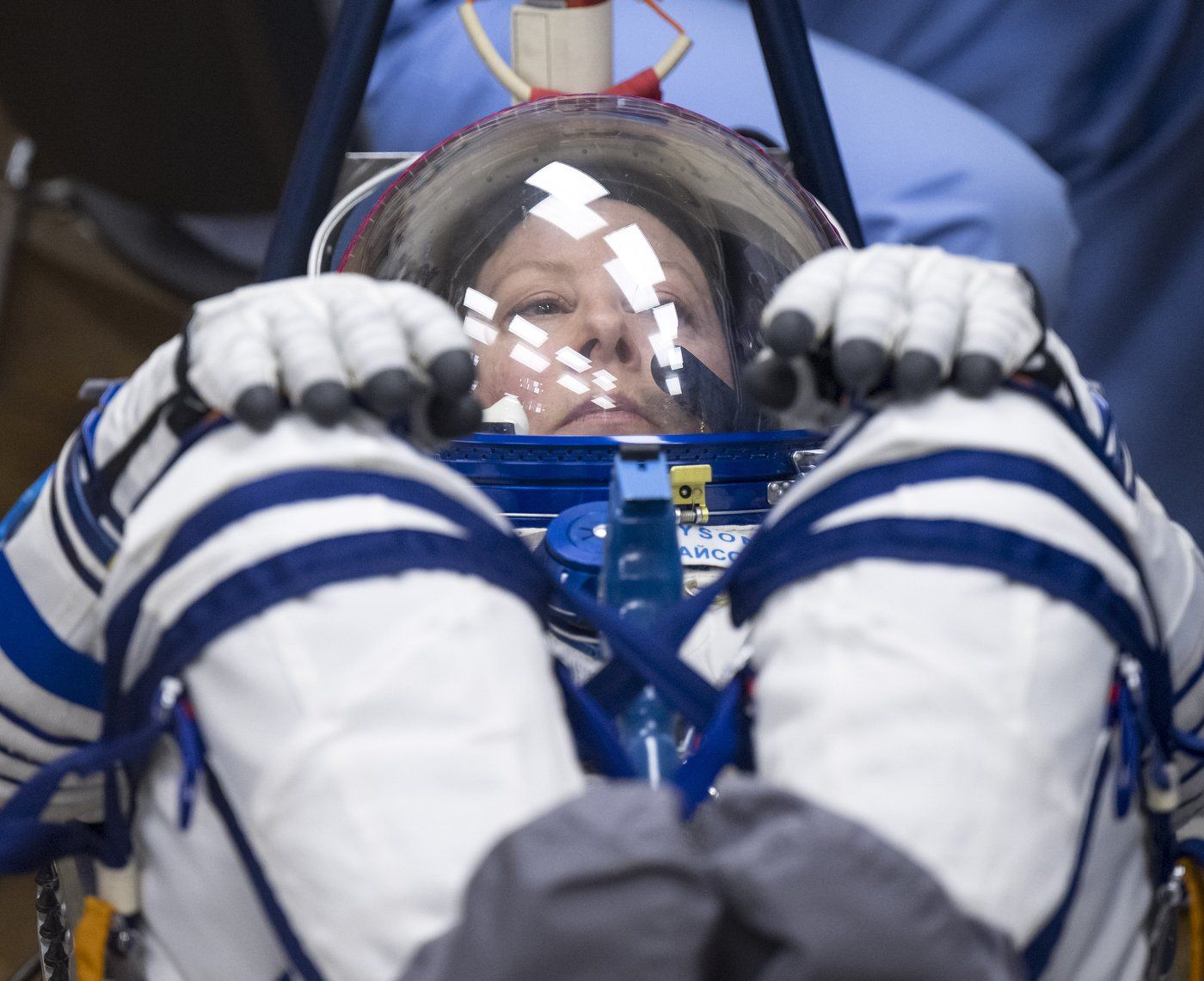
The Soyuz MS-25 spacecraft carrying NASA astronaut Tracy Dyson, Russian Oleg Novitsky and Marina Vasilevskaya of Belarus reached the space outpost after Saturday’s blastoff from the Russian-leased Baikonur launch facility in Kazakhstan that followed an aborted launch attempt two days earlier.

Thursday’s attempted launch was halted by an automatic safety system about 20 seconds before the scheduled liftoff. Roscosmos and NASA said the crew wasn’t in danger during the aborted launch.

The head of the Russian space agency, Yuri Borisov, said the launch abort was triggered by a voltage drop in a power source.

Advertisement

The three astronauts join the station’s crew consisting of NASA astronauts Loral O’Hara, Matthew Dominick, Mike Barratt, and Jeanette Epps, as well as Russians Oleg Kononenko, Nikolai Chub, and Alexander Grebenkin.

Dyson is on her third trip to the orbital complex, where she is set to spend six months before returning to Earth in September with Kononenko and Chub, who will complete a year-long mission on the space lab.

Novitsky, who is making his fourth flight to the orbiting outpost, and Vasilevskaya, on her first space mission as her country’s first astronaut, will spend 12 days on the station and will return to Earth along with O’Hara.

The space station, which has served as a symbol of post-Cold War international cooperation, is now one of the last remaining areas of collaboration between Russia and the West amid tensions over Moscow’s military action in Ukraine. NASA and its partners hope to continue operating the orbiting outpost until 2030.

News from © Canadian Press Enterprises Inc., 2023

Adblock test (Why?)


https://news.google.com/rss/articles/CBMiN2h0dHBzOi8vd3d3LndpbmdzbWFnYXppbmUuY29tL3J1c3NpYW4tc295dXotc3BhY2VjcmFmdC_SAQA?oc=5

2024-03-25 20:22:45Z
CBMiN2h0dHBzOi8vd3d3LndpbmdzbWFnYXppbmUuY29tL3J1c3NpYW4tc295dXotc3BhY2VjcmFmdC_SAQA

Expert tips on protecting your eyes during the solar eclipse - CTV News Barrie

Excitement is growing for the upcoming solar eclipse on April 8, but experts warn there is also a safety risk for anyone planning to watch the rare celestial event.

"The sun carries a lot of solar radiation, which can be very damaging to multiple areas of the eye," says Rominder Singh, local optometrist and owner of Georgian Optometry.

Singh says solar radiation can burn your retina, the back lining of your eye.

"Some of the symptoms don't actually show up until hours after the fact. You won't know immediately that you're doing damage to your eye. Unfortunately, some of the effects can be permanent," says Singh.

Singh says the only safe way to look directly at the sun is through specially designed solar filters; adding regular sunglasses isn't safe for viewing.

"I would recommend going to the Ontario Association of Optometrists website; you can trust those vendors there. One thing you can do is, if you have a solar filter, look through it. You should not be able to see lights that you typically see," says Singh.

Eclipse glasses use special filters made of black polymer or aluminized polyester to reduce the intensity of the sunlight.

"You get a solar eclipse once every year and a half or so somewhere on the planet. If you miss this one, there's another one happening in October, but you have to go to the bottom of South America to see that one, so it's rare for an eclipse to come to your house," says CTV News Science and Technology Specialist Dan Riskin.

Riskin says the total eclipse is expected to last about three and a half minutes, depending on where you're watching from.

"Anywhere in Ontario is a great place to see this eclipse because it's going to be magnificent, and it's almost going to be totally covered by the moon for viewers all across this province," says Riskin.

Riskin adds that there will not be another total solar eclipse in Canada for another 20 years and that one is expected to occur in Alberta.

Adblock test (Why?)


https://news.google.com/rss/articles/CBMiXGh0dHBzOi8vYmFycmllLmN0dm5ld3MuY2EvaGVyZS1zLWhvdy10by1wcm90ZWN0LXlvdXItZXllcy1kdXJpbmctdGhlLXNvbGFyLWVjbGlwc2UtMS42ODIxNzEy0gEA?oc=5

2024-03-25 22:05:17Z
CBMiXGh0dHBzOi8vYmFycmllLmN0dm5ld3MuY2EvaGVyZS1zLWhvdy10by1wcm90ZWN0LXlvdXItZXllcy1kdXJpbmctdGhlLXNvbGFyLWVjbGlwc2UtMS42ODIxNzEy0gEA

Senin, 25 Maret 2024

Northern Lights and satellite interference: What to know about geomagnetic storms heading to Earth - Euronews

Space weather forecasters are expecting solar flaring to reach Earth on Monday causing a geomagnetic storm and the appearance of the Northern Lights.

A large geomagnetic storm could interfere with radio communications on Earth on Monday, space weather forecasters have warned after spotting an outburst of plasma from a solar flare from the Sun's surface.

It will also mean for those hunting Northern Lights sightings, the solar flaring will make for great aurora viewing.

There's no reason for the public to be concerned, according to the alert issued on Saturday by the US' National Oceanic and Atmospheric Administration's (NOAA) Space Weather Prediction Center in Boulder, Colorado.

The storm could interrupt high-frequency radio transmissions, such as by aircraft trying to communicate with distant traffic control towers. 

Most commercial aircraft can use satellite transmission as backup, said Jonathan Lash, a forecaster at the centre.

Solar activity at its most active

Satellite operators might have trouble tracking their spacecraft, and power grids could also see some "induced current" in their lines, though nothing they can't handle, he said.

"For the general public, if you have clear skies at night and you are at higher latitudes, this would be a great opportunity to see the skies light up," Lash said.

Every 11 years, the sun's magnetic field flips, meaning its north and south poles switch positions. 

Solar activity changes during that cycle, and it's now near its most active, called the solar maximum.

During such times, geomagnetic storms of the type that arrived on Sunday can hit Earth a few times a year, Lash said. During solar minimum, a few years may pass between storms.

In December, the biggest solar flare in years disrupted radio communications.

Adblock test (Why?)


https://news.google.com/rss/articles/CBMigwFodHRwczovL3d3dy5ldXJvbmV3cy5jb20vbmV4dC8yMDI0LzAzLzI1L25vcnRoZXJuLWxpZ2h0cy1hbmQtc2F0ZWxsaXRlLWludGVyZmVyZW5jZS13aGF0LXRvLWtub3ctYWJvdXQtZ2VvbWFnbmV0aWMtc3Rvcm1zLWhlYWRpbmctdNIBAA?oc=5

2024-03-25 08:51:34Z
CBMigwFodHRwczovL3d3dy5ldXJvbmV3cy5jb20vbmV4dC8yMDI0LzAzLzI1L25vcnRoZXJuLWxpZ2h0cy1hbmQtc2F0ZWxsaXRlLWludGVyZmVyZW5jZS13aGF0LXRvLWtub3ctYWJvdXQtZ2VvbWFnbmV0aWMtc3Rvcm1zLWhlYWRpbmctdNIBAA