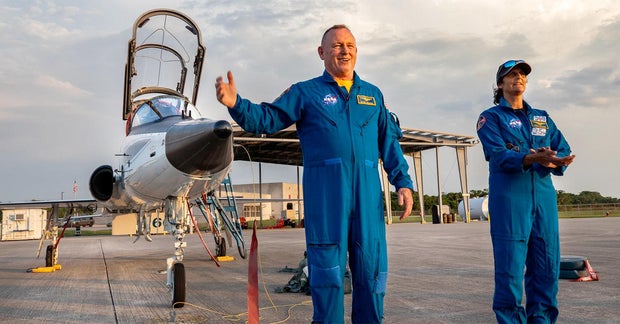
After yesterday’s launch of the first crewed Starliner mission was scrubbed, NASA, Boeing and ULA made the decision to wait a few days before making another attempt. Starliner was scheduled to finally lift off on Saturday afternoon after a series of delays, but this attempt was aborted due to a last-minute issue with a ground computer system that plays a key role in launching the rocket. While NASA and partners discussed possibly flying today following their assessment of the issue, they’ve decided to hold off until the next opportunities, either on June 5 or 6.
Saturday’s launch wasn’t scrubbed due to a problem with the Starliner craft itself, but because an automatic hold was issued by the ground launch sequencer for a then-unknown reason. In a press conference later on Saturday, Tory Bruno, president and CEO of ULA explained that it came down to a problem in verifying the launch sequencer’s redundancy. There are three large computers in this system, all of which are the same so it’s “triple redundant,” Bruno said. During the system health check in the minutes before launch, one of the computers came up slow, triggering an automatic hold.
NASA said the decision to forgo today’s launch attempt was made in order to “give the team additional time to assess a ground support equipment issue.” The launch window opens again on June 5, but no target liftoff time has been announced just yet. If Starliner doesn’t fly by June 6, it’ll be set back by at least another 10 days, ArsTechnica reports, as the ULA team will need to swap out the Atlas V rocket’s batteries.
If you missed the recent show from the aurora borealis (or northern lights, as they're known in the northern hemisphere), fear not – we could be on the cusp of a repeat during the week starting June 3.
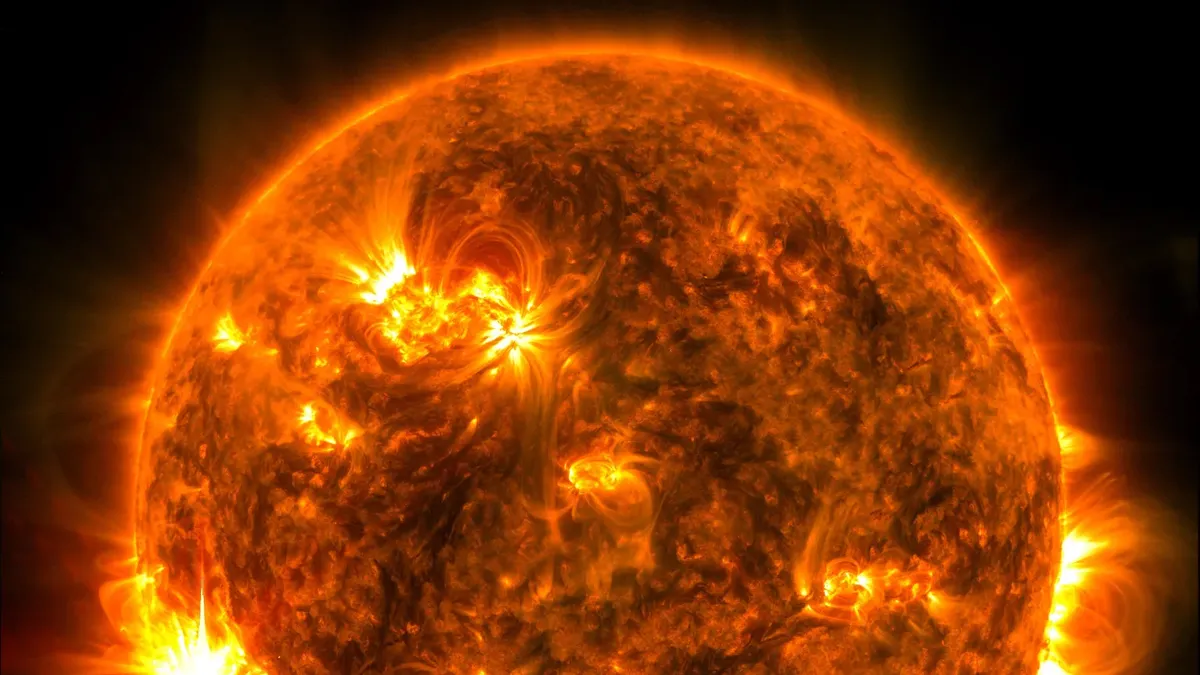
Although there are absolutely no guarantees, the part of the sun that caused a G5 geomagnetic storm (the strongest since 2003) last month has returned to face Earth. And the good news is that it’s still active.
According to NASA, the sunspot AR3697 (formerly known as AR3664) let rip an X-class solar flare, rated at X1.4, on May 29. Aurora is caused by the solar wind accelerating down the field lines of our planet’s magnetosphere – which is Earth’s armor against charged particles spewed into space by the sun.
(Image credit: NASA)
The solar wind and the aurora are caused by what astronomers call coronal mass ejections (CMEs), clouds of charged particles that can be shot into space from the sun in the wake of a solar flare.
However, when an active region faces Earth, a window of opportunity for aurora opens. The sun rotates every 27 days, so June 6 is exactly one sun cycle since May 10’s display. As luck would have it, that’s the date of the new moon, which means dark skies at night.
This means that, weather permitting, there could be opportunities to see and shoot the northern lights a few days either side of that date. Here's how to stay up to date on the potential opportunities and prepare to photograph them with a camera or phone...
5 steps for planning Northern Lights photos
1. Check the conditions
Who do you rely on to tell you that there’s about to be a massive geomagnetic storm? It’s social media – but you have to be so very careful. There's a lot of misinformation and cult-like social media accounts surrounding the aurora.
If you hear the words “kill shot” or any chat about the weakness of Earth’s magnetic field, run a mile. Rely only on solar physicists and expert aurora hunters who do this as a career and a passion.
Here are the best websites and X (formerly Twitter) feeds to follow for up-to-the-minute information about incoming space weather:
The best websites and apps
(Image credit: Aurora Watch)
The best social media accounts to follow
(Image credit: X / Vincent Ledvina)
Dr. Ryan French (@RyanJFrench): British Solar Astrophysicist at the National Solar Observatory and author of The Sun: Beginner’s Guide to Our Local Star.
Sara Housseal (@SNHWx), Operational Space Wx Forecaster & Meteorologist at Johns Hopkins University and a Master’s Student at Millersville University.
Vincent Ledvina (@Vincent_Ledvina): “The Aurora Guy,” a northern lights photographer in Alaska and a Space Physics PhD student at the UAF Geophysical Institute.
A well as a reliable warning about incoming space weather, you'll also need a clear sky. If there are clouds, it makes no difference how strong the geomagnetic storm is – you’ll see nothing. So consult the best travel and weather apps, such as Windy, for the latest guidance.
2. Find the right location
Although hours of darkness are few at northern latitudes in the northern hemisphere, it’s wise to have somewhere in mind to drive to for midnight just in case a strong display of aurora is forecast.
A great place to consult before any other is the Find A Dark Place on the DarkSky website, which details all the certified International Dark Sky Places. These are protected land and night skies in 22 countries on six continents, from Arches National Park in Utah and Cherry Springs State Park in Pennsylvania to Aoraki Mackenzie in New Zealand and Elan Valley in mid-Wales.
(Image credit: Dark Sky)
However, you don’t need to go somewhere with protected sky – anywhere about 40 miles from a city should have a reasonably dark sky. A light pollution map and GoStargazing are both useful for locating pockets of darkness.
Remember that it doesn’t get dark until about midnight at mid-northern latitudes in June. That will make a difference by narrowing the window of opportunity nightly. For example, the aurora was spotted before midnight on May 10 in the UK. If a powerful geomagnetic storm strikes again this week in early June, it’s going to be after midnight that the aurora becomes visible.
3. Plan your shot
When the aurora appears in the skies above, it's tempting just to take a shot. Any shot, just to prove you saw it. That's completely understandable, but it's not how to take a memorable image of the aurora. Go look at any news articles about the aurora, and you'll find that most of them include landscapes or people. Or both.
If you have the luxury of time to think about where you might want to photograph the aurora, try to get something interesting in the foreground – such as the silhouette of a gnarly tree, a building or a lake (for reflections), or crowds of people watching the aurora.
(Image credit: Future | Tim Coleman)
It’s wise to think about the direction of the aurora. Typically, they appear in an oval around the Arctic or Antarctic circles. If a geomagnetic storm is particularly strong, that oval stretches to more southerly latitudes in the northern hemisphere and two more northerly latitudes in the southern hemisphere.
That means the northern lights are typically seen in the northern sky, and the southern lights are in the southern sky. It's something to remember when planning a shot – and this is where planning apps like PhotoPills, The Photographer's Ephemeris and Planit Pro come in handy. However, the fact is that May 10’s geomagnetic storm was so strong that the aurora was visible to the south in the northern parts of the U.K.
(Image credit: Future | Tim Coleman)
Dark skies aren’t everything. Aurora are captured using long exposures of a few seconds or more – depending on their brightness – so it is possible to image them in cities. May’s displays proved that. It’s also true that post-production can be used to remove the unwanted effects of too much sky glare.
It may be that you actively want to photography the aurora in an unexpected place, such as a city. However, it's best to keep away from bright light sources, such as street lights, security lights and the always-on office lights of city centers. And that can be hard to do.
4. Gather your equipment
Yes, you can shoot the northern lights using a smartphone. They’re ideal for making sure that what you can see is, in fact, an aurora and not a cloud. The fabulous reds and greens you see in images from May 10 look far more vibrant to a camera than to the human eye, which sees mostly grey.
A handheld smartphone will do in a pinch, and it's useful for checking that Aurora is present. But for a good, memorable shot, you still ideally need a tripod. That applies to both a smartphone and a manual mirrorless or DSLR camera.
While handheld long exposure modes have improved a lot, a tripod is still a handy accessory for many phones (Image credit: Shutterstock / meatbull)
For the latter, use a wide-angle lens with as wide an aperture as possible (for example, a 14mm lens and an aperture of around f/2.8). A spare battery or two and a small head torch will also be useful.
5. Prep the best settings
The best settings for the aurora will depend not only sky conditions but also on what time of night they appear and how bright they are. However, you're looking at a long exposure of at least a few seconds and maybe as long as 20 seconds. Hence, the tripod.
Set the lens to infinity focus, shoot in raw and use a white balance of about 3500K to 4000K. Benchmark settings to begin your experiments would be ISO 800, a shutter speed of somewhere between 5 and 20 seconds (for a bright-dim aurora), at an aperture of f/2.8. Shoot in raw and post-process to bring out the color, though be wary of making the greens and reds too vibrant.
For smartphones, ‘night mode’ is the best choice. If you can control the exposure, experiment with a few to 10 seconds. It’s worth considering using one of thebest camera apps like Halide or a dedicated astrophotography mode, like the one on Google Pixel phones.
You might also like
Jamie is a freelance tech, travel and space journalist based in the UK. He’s been writing regularly for Techradar since it was launched in 2008 and also writes regularly for Forbes, The Telegraph, the South China Morning Post, Sky & Telescope and the Sky At Night magazine as well as other Future titles T3, Digital Camera World, All About Space and Space.com. He also edits two of his own websites, TravGear.com and WhenIsTheNextEclipse.com that reflect his obsession with travel gear and solar eclipse travel. He is the author of A Stargazing Program For Beginners (Springer, 2015),
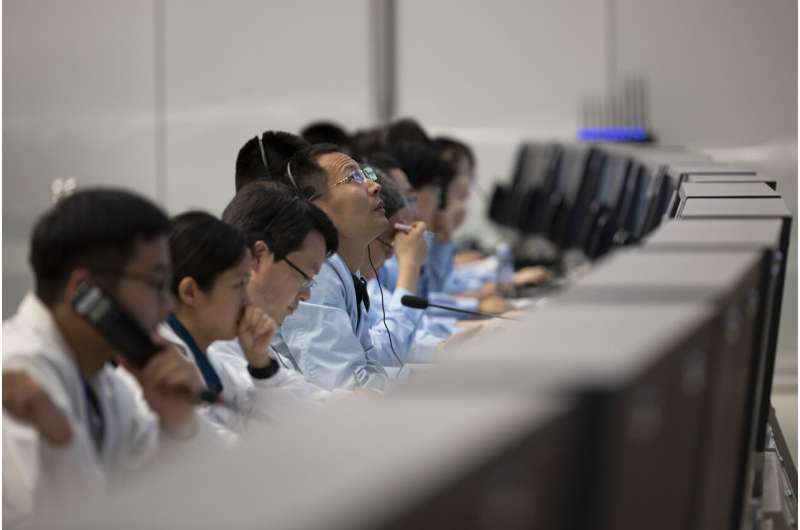
In this photo released by Xinhua News Agency, technical personnel work at the Beijing Aerospace Control Center (BACC) in Beijing, Sunday, June 2, 2024. A Chinese spacecraft landed on the far side of the moon Sunday to collect soil and rock samples that could provide insights into differences between the less-explored region and the better-known near side. Credit: Jin Liwang/Xinhua via AP
A Chinese spacecraft landed on the far side of the moon Sunday to collect soil and rock samples that could provide insights into differences between the less-explored region and the better-known near side.
The landing module touched down at 6:23 a.m. Beijing time in a huge crater known as the South Pole-Aitken Basin, the China National Space Administration said.
The mission is the sixth in the Chang'e moon exploration program, which is named after a Chinese moon goddess. It is the second designed to bring back samples, following the Chang'e 5, which did so from the near side in 2020.
The moon program is part of a growing rivalry with the U.S.—still the leader in space exploration—and others, including Japan and India. China has put its own space station in orbit and regularly sends crews there.
The emerging global power aims to put a person on the moon before 2030, which would make it the second nation after the United States to do so. America is planning to land astronauts on the moon again—for the first time in more than 50 years—though NASA pushed the target date back to 2026 earlier this year.
U.S. efforts to use private-sector rockets to launch spacecraft have been repeatedly delayed. Last-minute computer trouble nixed the planned launch of Boeing's first astronaut flight Saturday.
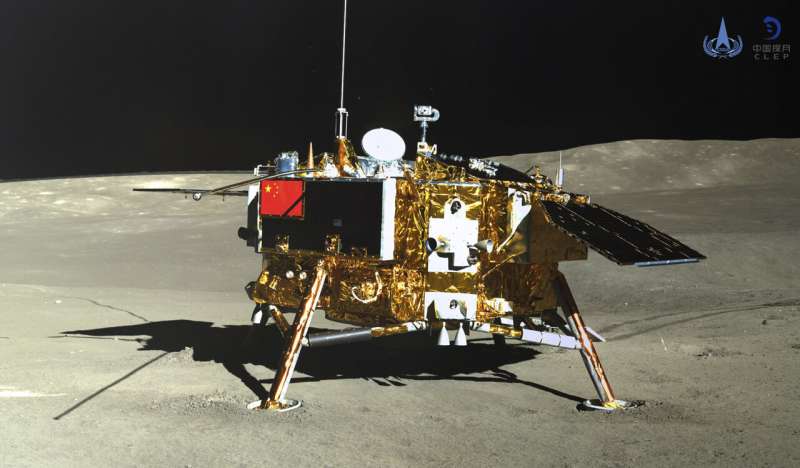
This photo provided on Jan. 12, 2019, by the China National Space Administration via Xinhua News Agency shows the lunar lander of the Chang'e-4 probe in a photo taken by the rover Yutu-2 on Jan. 11. China is preparing to launch a lunar probe Friday, May 3, 2024, that would land on the far side of the moon and return with samples that could provide insights into geological and other differences between the less-explored region and the better-known near side. Credit: China National Space Administration/Xinhua News Agency via AP, File
Earlier Saturday, a Japanese billionaire called off his plan to orbit the moon because of uncertainty over the development of a mega rocket by SpaceX. NASA is planning to use the rocket to send its astronauts to the moon.
In China's current mission, the lander is to use a mechanical arm and a drill to gather up to 2 kilograms (4.4 pounds) of surface and underground material over about two days.
An ascender atop the lander will then take the samples in a metal vacuum container back to another module that is orbiting the moon. The container will be transferred to a re-entry capsule that is due to return to Earth in the deserts of China's Inner Mongolia region about June 25.
Missions to the moon's far side are more difficult because it doesn't face the Earth, requiring a relay satellite to maintain communications. The terrain is also more rugged, with fewer flat areas to land.
The South Pole-Aitken Basin, an impact crater created more than 4 billion years ago, is 13 kilometers (8 miles) deep and has a diameter of 2,500 kilometers (1,500 miles), according to a report by China's Xinhua News Agency.
It is the oldest and largest of such craters on the moon, so may provide the earliest information about it, Xinhua said, adding that the huge impact may have ejected materials from deep below the surface.
Citation:
A Chinese spacecraft lands on the moon's far side to collect rocks in growing space rivalry with US (2024, June 2)
retrieved 2 June 2024
from https://phys.org/news/2024-06-chinese-spacecraft-moon-side-space.html
This document is subject to copyright. Apart from any fair dealing for the purpose of private study or research, no
part may be reproduced without the written permission. The content is provided for information purposes only.
China landed an uncrewed spacecraft on the far side of the moon on Sunday, overcoming a key hurdle in its landmark mission to retrieve the world's first rock and soil samples from the dark lunar hemisphere. The Chang'e-6 craft, equipped with an array of tools and its own launcher, touched down in a gigantic impact crater called the South Pole-Aitken Basin on the moon's space-facing side at 6:23 a.m. Beijing time (2223 GMT), the China National Space Administration said. The mission "involves many engineering innovations, high risks and great difficulty", the agency said in a statement on its website. "The payloads carried by the Chang'e-6 lander will work as planned and carry out scientific exploration missions." The successful mission is China's second on the far side of the moon, a region no other country has reached. The side of the moon perpetually facing away from the Earth is dotted with deep and dark craters, making communications and robotic landing operations more challenging. Given these challenges, lunar and space experts involved in the Chang'e-6 mission described the landing phase as a moment where the chance of failure is the highest. "Landing on the far side of the moon is very difficult because you don’t have line-of-sight communications, you’re relying on a lot of links in the chain to control what is going on, or you have to automate what is going on," said Neil Melville-Kenney, a technical officer at the European Space Agency working with China on one of the Chang'e-6 payloads. "Automation is very difficult especially at high latitudes because you have long shadows which can be very confusing for landers," Melville added. The Chang'e-6 probe launched on May 3 on China's Long March 5 rocket from the Wenchang Satellite Launch Center on the southern island of Hainan, reaching the lunar vicinity roughly a week later before tightening its orbit in preparation for a landing. Chang'e-6 marks the world's third lunar landing this year: Japan's SLIM lander touched down in January, followed the next month by a lander from US startup Intuitive Machines. The other countries that have sent spacecraft to Earth's nearest neighbor are the then-Soviet Union and India. The United States is the only country to have landed humans on the moon, starting in 1969.
The space capsule will carry a two-person team to the International Space Station (ISS).
The launch countdown for Boeing’s new Starliner space capsule on its inaugural crewed test flight has been halted, postponing the mission for at least 24 hours.
The postponement was announced during a live NASA webcast on Saturday.
Earlier, launch forecasts had called for a 90 percent chance of favourable weather conditions.
However, less than four minutes prior to liftoff, a ground system computer triggered an automatic abort command that paused the countdown clock, according to mission officials.
The reason for the halt remains unclear.
.@NASA, @BoeingSpace , and @ulalaunch (United Launch Alliance) scrubbed today’s launch opportunity due to the computer ground launch sequencer not loading into the correct operational configuration after proceeding into terminal count. The ULA team is working to understand the… pic.twitter.com/pKkS6cdxYO
— NASA Space Operations (@NASASpaceOps) June 1, 2024
The CST-200 Starliner’s first voyage carrying two astronauts, Butch Wilmore and Suni Williams, to the International Space Station (ISS) has been highly anticipated and much-delayed as Boeing scrambles to gain a greater share of lucrative NASA business now dominated by Elon Musk’s SpaceX.
Mission commander Wilmore had earlier given a short but rousing speech telling tens of thousands of people tuning into the live feed that “It’s a great day to be proud of your nation”.
A May 6 countdown was also halted just two hours before launch time over a faulty pressure valve on the Atlas upper stage, followed by weeks of further delays caused by other engineering problems, since resolved, on the Starliner itself.
A backup date is available for Sunday, but it is not yet known whether the spaceship will be ready to launch.
The first attempt by Boeing to send an uncrewed Starliner to the space station in 2019 failed due to software and engineering glitches. But a second try in 2022 succeeded, paving the way for efforts at getting the first crewed test mission off the ground.
NASA astronauts Suni Williams and Butch Wilmore, wearing Boeing spacesuits, wave as they prepare to depart the Neil A Armstrong Operations and Checkout Building at Cape Canaveral Space Force Station Kennedy Space Center in Florida [Miguel J Rodriguez Carrillo/AFP]
Boeing’s struggles
Boeing, whose commercial plane operations are in disarray after several sequential crises, badly needs a win in space for its Starliner venture, a programme several years behind schedule with more than $1.5bn in cost overruns.
While Boeing has struggled, SpaceX has become a dependable taxi to orbit for NASA, which is backing a new generation of privately built spacecraft that can ferry astronauts to ISS, and in the future – under its ambitious Artemis program – to the moon and eventually Mars.
Starliner would compete head-to-head with SpaceX’s Crew Dragon capsule, which since 2020 has been NASA’s only vehicle for sending ISS crew to orbit from US soil.
The flight would mark the first crewed voyage to space using an Atlas rocket since the storied family of Atlas launch vehicles first sent astronauts, including John Glenn, on orbital flights for NASA’s Mercury programme in the 1960s.
Once launched, the capsule is expected to arrive at the space station after a flight of about 26 hours and dock with the orbiting research outpost some 250 miles (400 km) above Earth.
Plans call for the two astronauts to remain at the space station for about a week before riding the Starliner back to Earth for a parachute and airbag-assisted landing in the US southwestern desert – a first for crewed NASA missions.
Depending on the outcome of the first crewed test flight, Starliner is booked to fly at least six more crewed missions to the space station for NASA.
NASA astronauts Barry "Butch" Wilmore and Sunita Williams were strapped into the company's Starline capsule and awaiting liftoff when the countdown was halted at three minutes and 50 seconds. The ship was initially scheduled for liftoff from pad 41 at the Cape Canaveral Space Force Station at 12:25 p.m. EDT, roughly the moment Earth's rotation carried the pad into alignment with the space station's orbit.
With only a split second to take off Saturday afternoon, there was no time to work the latest trouble and everything was called off.
The next possible launch window is Sunday.
----
Previous story
A United Launch Alliance Atlas 5 rocket was fueled for a second launch try Saturday to boost Boeing's Starliner crew capsule into orbit on the oft-delayed crew capsule's first piloted test flight, a voyage to the International Space Station.
With NASA astronauts Barry "Butch" Wilmore and Sunita Williams monitoring the ship's automated ascent, the workhorse Atlas 5 was scheduled for liftoff from pad 41 at the Cape Canaveral Space Force Station at 12:25 p.m. EDT, roughly the moment Earth's rotation carried the pad into alignment with the space station's orbit.
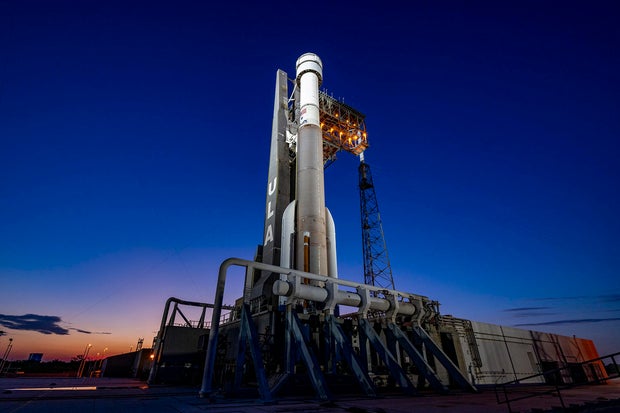
Boeing's Starliner crew capsule, perched atop a United Launch Alliance Atlas 5 rocket, stands poised for blastoff from pad 41 at the Cape Canaveral Space Force Station (file photo).
United Launch Alliance
If all goes well, the Starliner will catch up with the station Sunday and dock at the lab's forward port around 1:50 p.m. Wilmore and Williams plan to return to Earth on June 10.
The long-awaited flight will be the first piloted launch of an Atlas 5 and the first for the Atlas family of rockets since astronaut Gordon Cooper took off just a few miles away on the Mercury program's final flight 61 years ago.
Likewise, it will be the first piloted flight of the Starliner, Boeing's answer to SpaceX's Crew Dragon, an already operational, less expensive spacecraft that has carried 50 astronauts, cosmonauts and civilians into orbit in 13 flights, 12 of them to the space station, since an initial piloted test flight in May 2020.
Commander Barry "Butch" Wilmore and co-pilot Sunita Williams greet well wishers on the Kennedy Space Center runway Tuesday after flying in from the Johnson Space Center in Houston to prepare for launch. Both former Navy test pilots, Wilmore and Williams are among NASA's most experienced astronauts with four flights, 11 spacewalks and 500 days in space between them.
NASA
NASA funded the development of both spacecraft to ensure the agency could launch crews to the outpost even if one company's ferry ship were grounded for any reason.
Already running years behind schedule because of budget shortfalls and a variety of technical problems that cost Boeing more than $1 billion to correct, NASA had hoped to get the Starliner into orbit on May 6. But the launch was scrubbed when United Launch Alliance engineers detected trouble with a pressure-relief valve in the rocket's Centaur upper stage.
The Atlas 5 was hauled off the pad and back to ULA's Vertical Integration Facility where the Centaur valve was quickly replaced. But in the wake of the launch scrub, Boeing engineers saw signs of a small helium leak in the Starliner's propulsion system.
The leak was traced to a flange in plumbing that delivered pressurized helium to drive one specific reaction control system jet in the Starliner's service module. The leak was characterized as "very small," but engineers needed to show it would not drastically worsen in flight and cause problems for other thrusters.
After extensive analysis and testing, mission managers concluded the spacecraft could be safely launched as is, saying that even if the leak rate was 100 times worse than so far observed, it would not pose a risk to the crew or the mission.
Bill Harwood has been covering the U.S. space program full-time since 1984, first as Cape Canaveral bureau chief for United Press International and now as a consultant for CBS News.